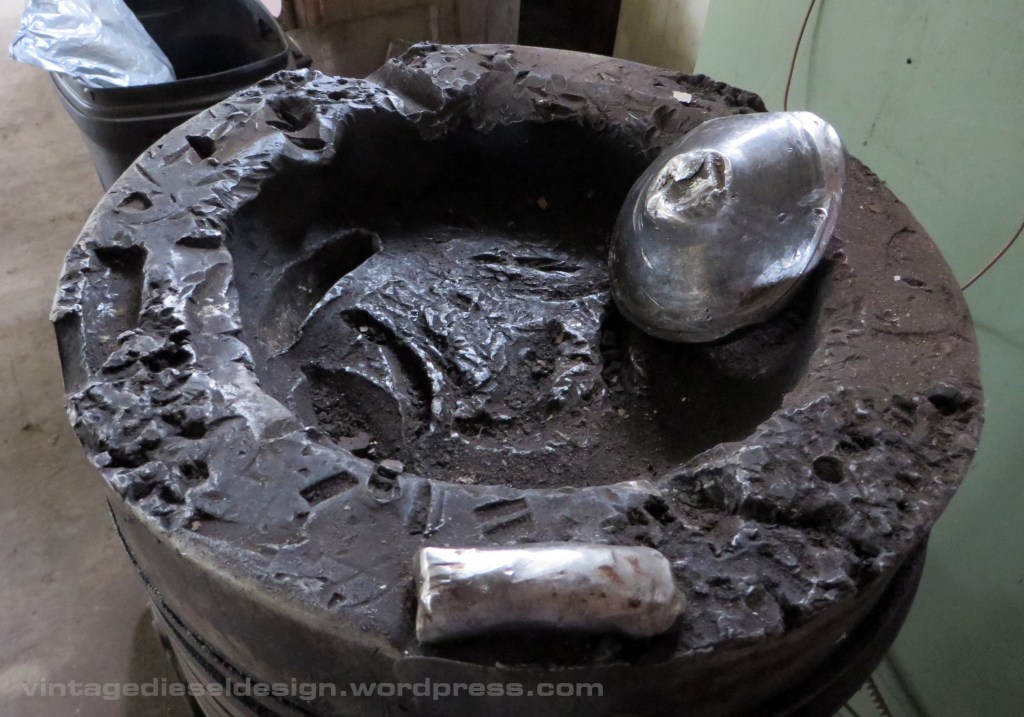
As the saying goes, Ship Happens. Sometimes, worse then others. In todays case, this is a piston and rod on display at the Hoosier Valley Railroad Museum from Erie Lackawanna 310, an Alco S1. The engine in case is an Alco/McIntosh & Seymour 539, a 4 stroke engine with a 12.5″ bore and a 13″ stroke. A valve dropped while the engine was running, and decided to do a little dance in the cylinder.
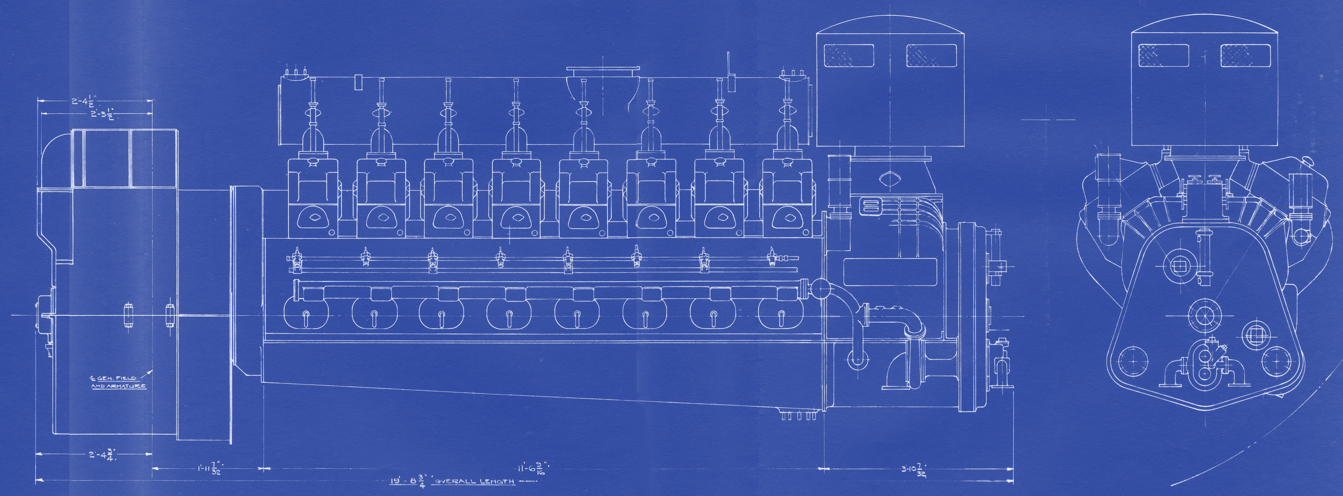
Last year, I picked up several rolls of Navy Microfilm full of engine goodies, two boxes of which were marked as “Alco 16-251A Experimental Submarine Engine”. I pulled them out when I got them, but did not go very far, as it is literally every blueprint sheet to build this engine. Thinking it was just another 251, I put them back in the box.
Last night I dove into them a bit deeper, and naturally the LAST frames on the reels (It looked like a roll of film exploded in the living room) had an elevation drawing. Cool! I devised a way to scan these, although frame by frame on my flatbed. It is a project, but it works. I need to draw up and 3D print some holders to do it more efficiently.
Click the following for larger versions.
After studying the drawing for a second, I noticed the exhaust was not connected to the intake side at all. Wait, 251’s are 4 stroke, and have a turbo…where is the turbo? There is none! That’s a roots blower on the front!
Front mounted on the engine is a blower. The discharge from the blower feeds into a raw water cooled aftercooler before going into the intake side of the engine block.
So, naturally, this raises plenty of questions. I can not find a lick of information about this engine in my usual places, so if anyone has anymore clues as to its history, shoot me a message. I don’t know if this was meant as an emergency generator engine, or propulsion. If anyone wants to build one… I have 600+ plans!
It was sad to hear that this past week, the tug Pegasus made her last trip to the great shipyard in the sky. Figure I would throw together a little post about a cool old vintage tug that would meet an unfortunate end this week.
The Pegasus was built in 1907 by Skinner Shipbuilding in Baltimore, for Standard Oil Company, as the S.O. Co. 16. The tug would later be renamed the Socony 16, and eventually wound up as the Esso Tug #1 after several rounds of company reorganizations. McAllister Towing of New York would purchase the steam powered tug, and rebuild her. Converted to Diesel propulsion, an EMD 567 was installed in place of the large engine and boiler. Now renamed the John E. McAllister, she would join the companies massive fleet doing shipdocking and other harbor work. McAllister would also purchase sister tug Esso Tug #2, and rebuild her the same way, now renamed as the Roderick McAllister. Another Socony sister tug – the Socony #14, would find a new home with Philadelphia’s Independent Pier Company, and was renamed the Jupiter. She also is a museum tug in Philadelphia.
Unknown photographer, Courtesy of Dave Boone
Ernie Arroyo Photo, Courtesy of Dave Boone
By the 1980’s, towing companies were selling off the last of the older, converted steam tugs. Numerous smaller companies would benefit from this, and would give many of these older tugs a new life. In 1987, the John E. McAllister was purchased by Hepburn Marine Towing of New York, where she was renamed as the Pegasus.
Photo by Jay Bendersky
Photo by Jay Bendersky
Hepburn Marine would do various work throughout the city, including spending several years towing carfloats for the New York Cross Harbor Railroad. Hepburn would ultimatly charter the tug James E. Witte from Donjon, the former Central Railroad of New Jersey tug Liberty for doing this work – a tug much better suited. Pegasus would be retired in 1997.
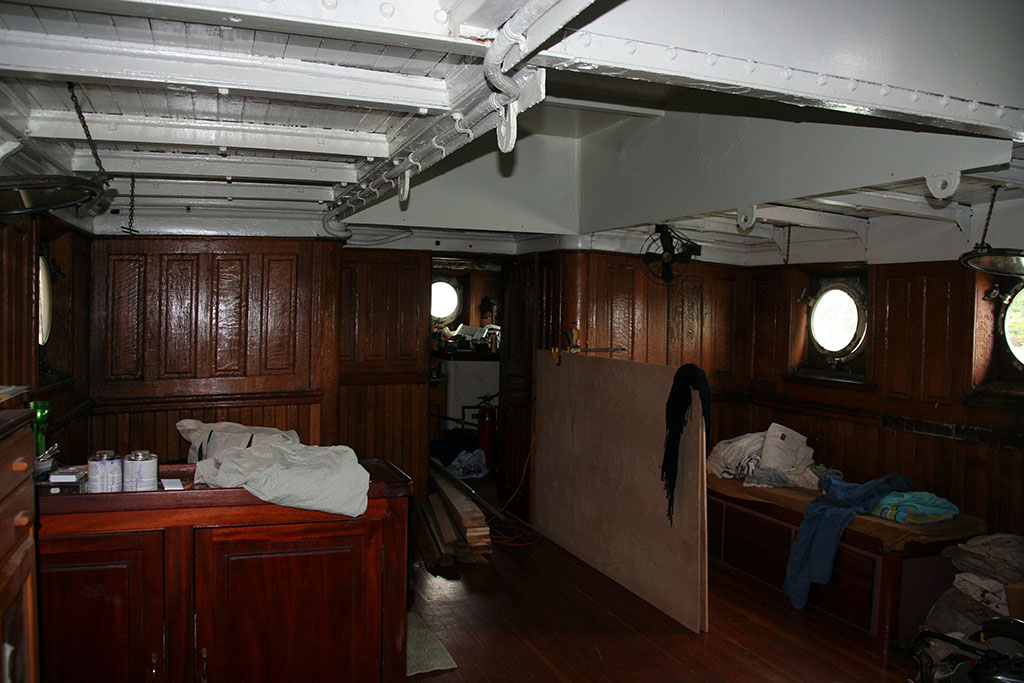
The Tug Pegasus Preservation Project was formed, and spent many years actively restoring the tug from the hull up. Volunteers spent several years actively restoring various parts of the tug, and the Pegasus would tow the Lehigh Valley Barge #79 (The Waterfront Museum – see link below) numerous times around the city. I was only ever inside the Pegasus once, a few photos are below.
Pegasus at the 2009 New York Tugboat Races
Wheelhouse
Inside the deckhouse.
Galley
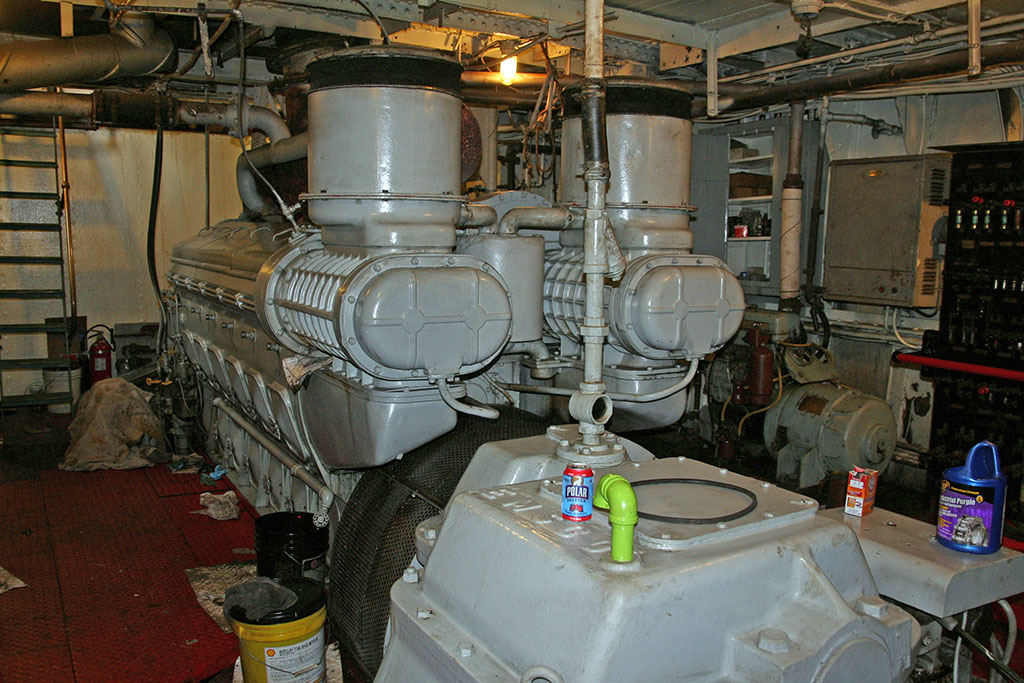
McAllister would repower the tug with a WWII surplus LST package – a 900HP EMD 12-567ATLP, with a Falk (Falk designed, however several contractors during the war built them, including Esco and Lufkin) reverse-reduction gear. This was one of the most common tug repower packages used after WWII, and I am slowly working on a large post about them.
The engine in the Pegasus was originally installed in Landing Ship Tank (LST) #121, shipped by EMD 6/16/1943. LST 121 was launched August 16, 1943 by Jefferson Boat & Machine. 121 would spend her career on the Pacific front and was present at the Marshall Islands, Iwo Jima, The Marianas, Western Caroline Islands and the Tinian Capture, earning 5 battle stars. She would be sold for scrap in 1946.
The Pegasus project fell dormant, and was looking for new caretakers and leadership for several years. Unfortunately, nothing would come to fruition. The museum ship world is one of the hardest aspects of preservation out there, and it gets harder every year as these boats get older. We have lost numerous preserved tugs just in the last few years. Times are tough, but be sure to help support your favorite museum ship. Every one of these groups needs all the help they can get.






 Vintage Diesel Design