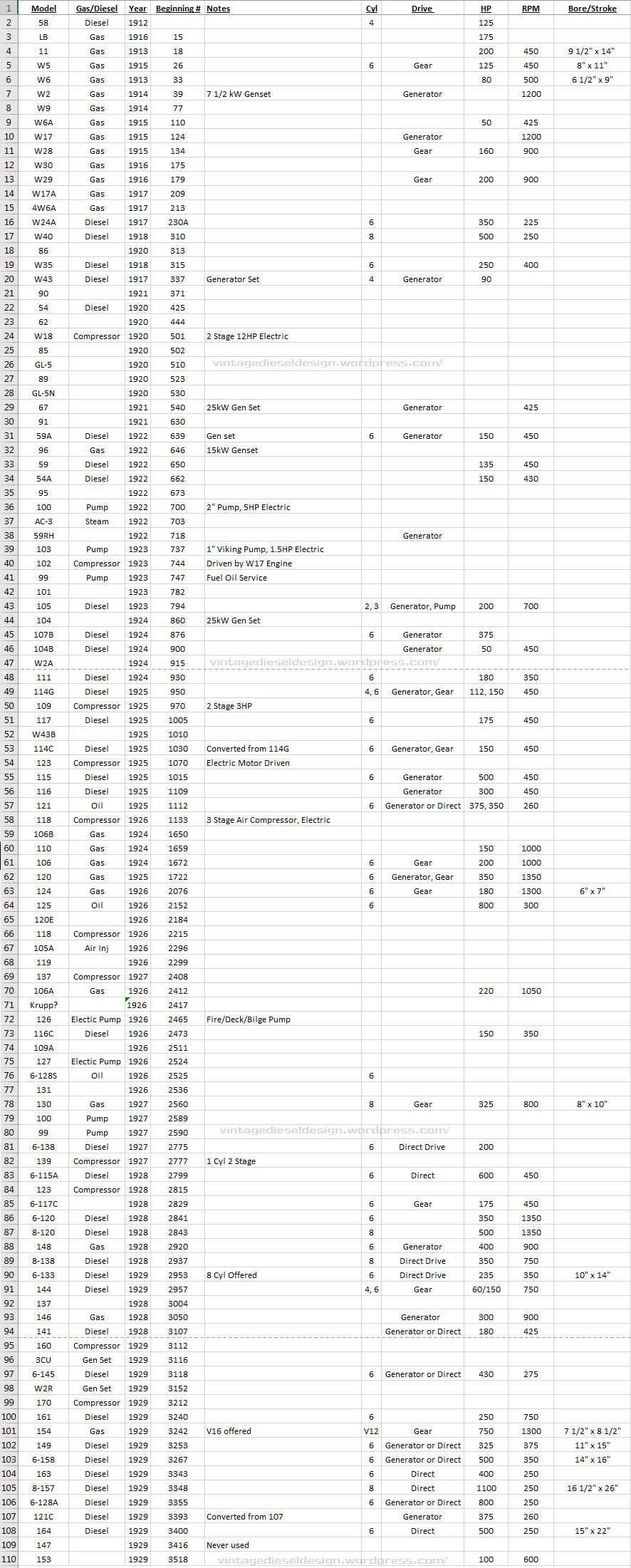
Over the last few months, I have been combing through the records for Winton, and later Cleveland Diesel, and put together the following master list of every engine produced by them. This is the result of several nights of going through 2000+ pages of entries, and then spending the following several months filling in the gaps with specifications using various manuals, brochures, company newsletters and everything else, and even still, there are many, many holes with the early engines.
The records start with engine #15 – thus I can not fill in those very first engines. Note that Winton assigned model numbers to several of their auxiliary units such as compressors and pumps, and are labeled as such below.
3-2023: Since making this post in 2020, I have been able to fill in a huge amount of holes in this, as well as acquiring an official Cleveland listing. This will be posted in the next few weeks.
Click for larger
The last Winton engine before being purchased by GM was engine number #3559 on 6/12/1930, a model 148 engine for Electro-Motive. Winton was purchased by General Motors on 6/20/1930.
Click for larger
On 12/30/1937, Winton Engine Corp., was renamed to the Cleveland Diesel Engine Division of General Motors. The Final Winton Engine was #5359, A 12-201A for Railroad Service. Note 1: 4432/3 are the prototype 201 engines, listed as “used 201” in records.
Click for larger
When it comes to horsepower ratings, especially on the later engines (278A, 268A, 567C), there were simply too many horsepower numbers to list, as it varied by application.
Note that by now – we see engines that are made by sister companies including Detroit and EMC/EMD. Early on, the Detroit Diesel engines sold through CDED (typically part of a “package” for a boat) carried both a Detroit Diesel as well as a Cleveland Diesel builders plate. In the case of the Detroit engines, this was dropped by the 1940’s.
However – with the EMC/EMD 567 line, engines sold though CDED for marine and stationary use carried only a Cleveland builders plate well into the late 1950’s. Only the very last few 567 engines sold through CDED carried both an EMD and a CDED builders plate. More information on this can be found on our post documenting Winton/CDED linked below.
Also to note: This list covers only engines built or sold through Winton and Cleveland Diesel. This does NOT cover any additional engines or developments by Detroit Diesel (such as the 51 or 53 series and later) or EMD (184A, 645 etc.)
Thanks to J. Boggess and P. Cook for helping with this. As always, there are numerous holes in the listing, so please send us a message with any additions or corrections.
Nope, I am not talking about Pabst Blue Ribbon, or Miller High Life. This past week I found myself heading to Wisconsin for a meeting and opted to make a stop over by where Great Lakes Towing operates in the Port of Milwaukee. A pair of Great Lakes Firsts are spending this winter laid up in there.
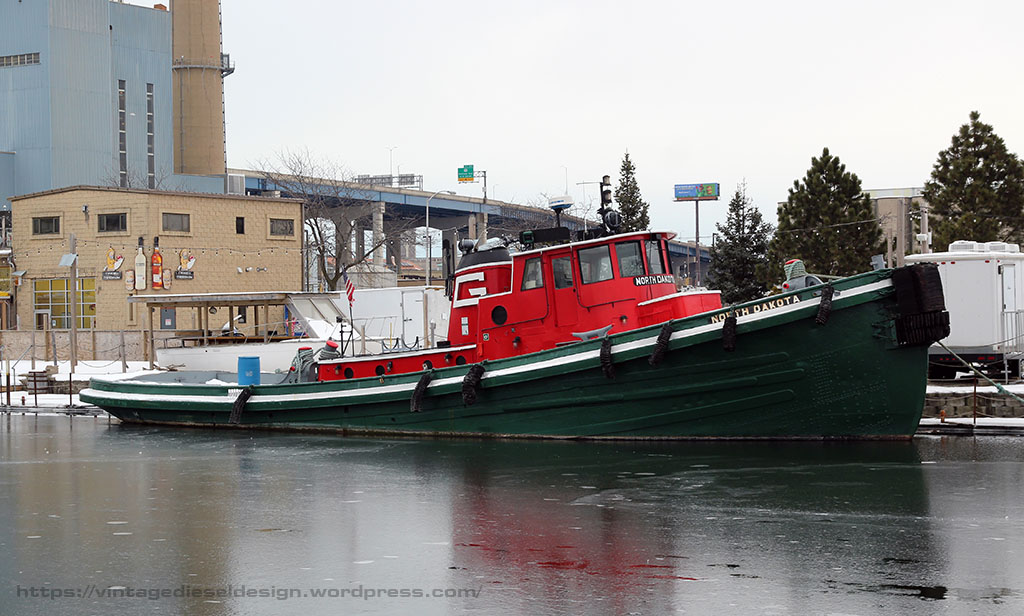
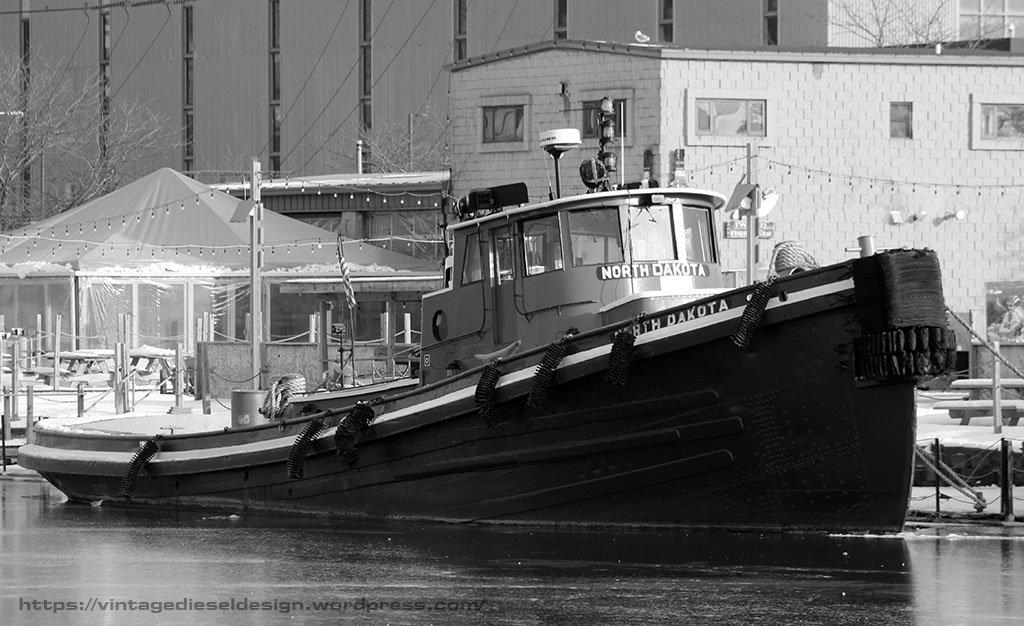
Back in the Menominee River, sits the tug North Dakota. North Dakota, built in 1910 by the Towing Company, was the first “G Tug” converted to Diesel propulsion. North Dakota was converted to diesel in 1949 by Paasche Marine Service in Erie, Pennsylvania, to plans laid out by Tams Inc., and Great Lakes Towing Company. Under the hood so to speak, is a Cleveland Diesel 1200HP 12-278A, that was shipped 2/23/1949, part of order number 5641. These engines drove Falk 12MB reverse reduction gears that swing a 102″ wheel. Order 5641 encompassed the propulsion for four tugs, including North Dakota, Arkansas, Vermont and Illinois. Today, all four of these tugs are still in service.
Click for Larger
North Dakota had some major engine work done recently, and hopefully will be in the fleet for a few more years. The crews in Milwaukee keep their boats looking sharp. North Dakota would be a great museum piece one day, a true testament to the “G Tug”, now going on over 100 years old, and having spent more time with Diesel engines now, then their original steam plants.
Click for Larger
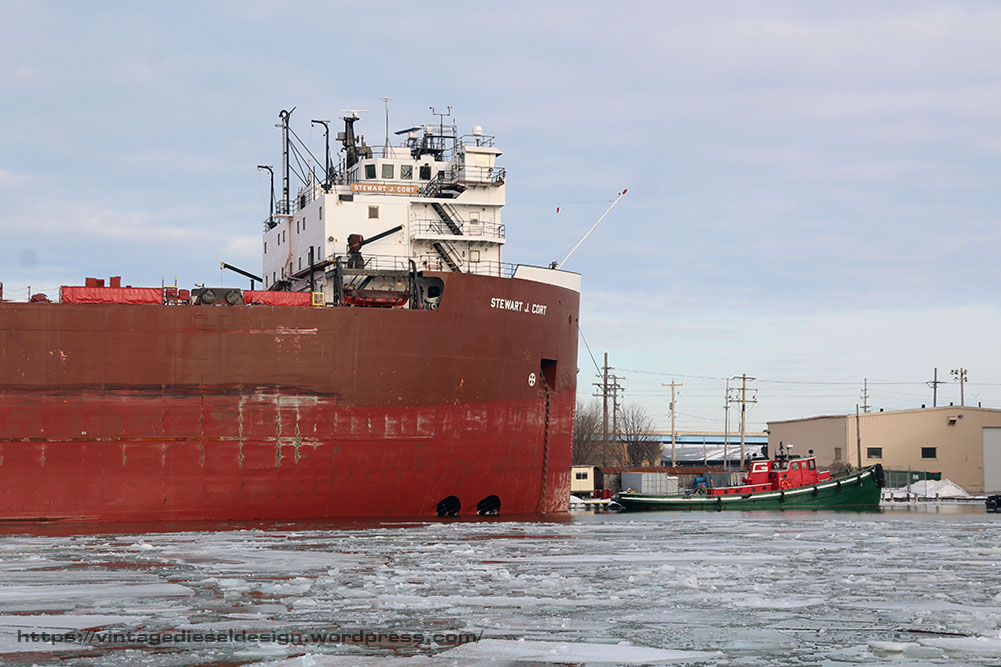
Back at the Kinnickinnic River in the Port, is the Stewart J. Cort. The Cort was the first 1000’ ship built for the Great Lakes, abit in an odd fashion. The bow and stern sections were built by Ingalls Shipbuilding in Mississippi, welded together and sailed to the lakes. On arrival, they were split apart, and a mid-section was added by Erie Marine, also in Erie, PA. The Cort went into service in 1972, on a run she still handles today between Superior, WI and Burns Harbor, IN. The Stewart J. Cort is powered by a quartet of EMD 20-645E7 engines, rated at 3600HP each. Each pair of engines drives an Escher Wyss controllable pitch prop. EMD supplied several of what were essentially locomotive parts for the Cort, including many traction motors that power the Bow and Stern thrusters and various pieces of unloading equipment.
Click for Larger
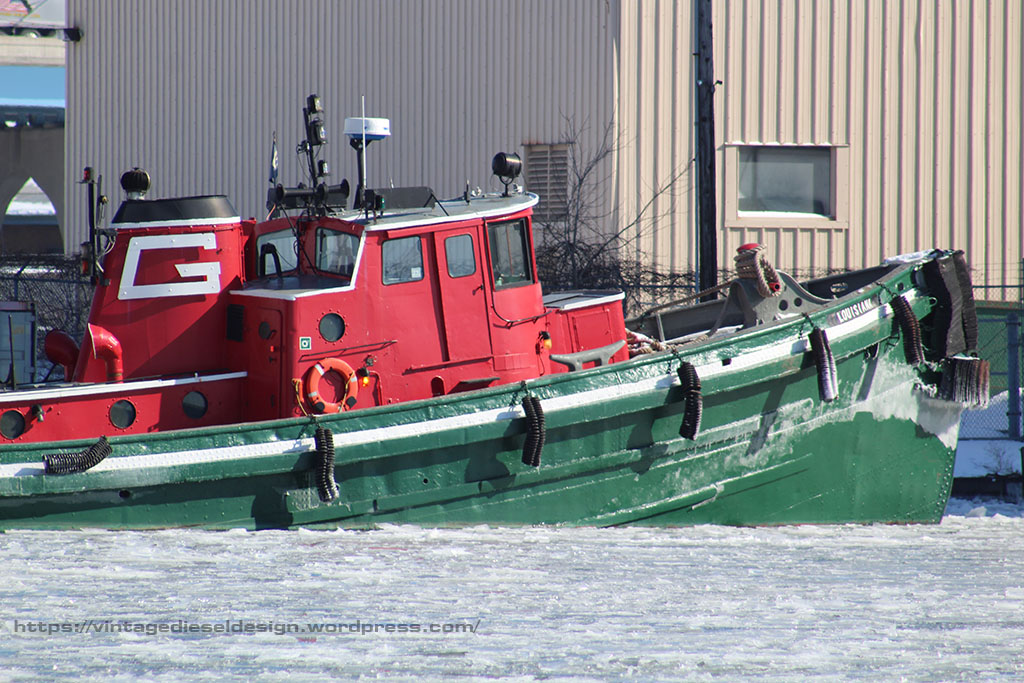
In front of the Stewart J. Cort, is the tug Louisiana. While not a first, she was converted to diesel as part of the 2nd order of engines in late 1949 for Great Lakes Towing. Unlike the first batch, all these engines were WWII surplus that went through Cleveland Diesel’s rebuild program and emerged as brand new engines with new serial numbers. Louisiana’s engine originally powered the Landing Ship – Tank # 935. For all intents and purposes, she is identical to the North Dakota.
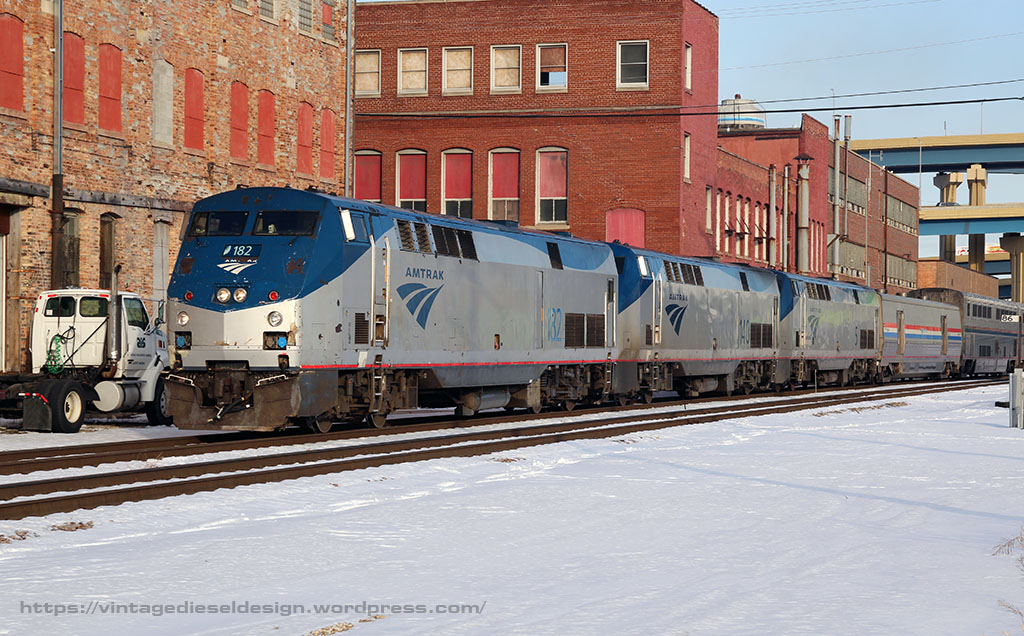
I am going to throw this one in also for the hell of it. On my way back to the highway, Amtrak’s Empire Builder was leaving. While I can’t say railfanning interests me like it used to, I opted to get a quick shot. In the lead is Amtrak 182, a 19 year old General Electric P42DC, followed by two more. Amtrak has begun the process to replace these tired engines with new Siemens Chargers…which, to put bluntly, are ugly as sin. But hey, they said that about the EMD F7 once upon a time also..
What does one of the worlds most versatile elements have to do with a blog about 1950’s diesel engines? Well, we will get to that. Aluminum as we know it, is composed chiefly out of Bauxite Ore, which is ground into a powder and mixed with Sodium Hydroxide to produce Aluminum Oxide, which is then converted by electrolysis at an Aluminum smelter into Billets or Anodes, where it can be further formed. I am not a chemist, so if you want to know more about making Aluminum, look elsewhere.
Being somewhat interested in Rocks & Minerals, I went up to my local shop and picked up a piece of Bauxite.
In 1907, the Aluminum Company of America was formed, later known as Alcoa. Alcoa was the country’s leading Aluminum manufacturer, which was growing at a rapid pace with a slew of plants across the country by the time WWI rolled around. Alcoa was, however, not just an American company. They were worldwide by the teens, operating mines, refinery’s and smelters around the globe. In 1916, Alcoa opened a new Bauxite Ore mine in Moengo, Suriname, part of what was Dutch Guiana– about 70 miles Southeast of the capital city of Paramaribo.
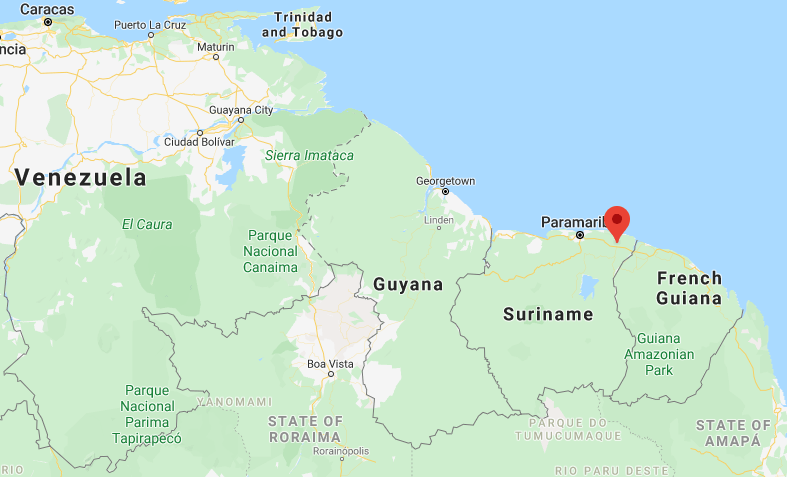
Our story begins in South America… Google Maps.
To get to Moengo: We start at the Atlantic Ocean and begin a very short trip down the Suriname River. We hang a left just inside the harbor and enter the Commewijne River. The Commewijne heads South, and the Cottica River splits off a few miles in, and continues East, before making a hard turn and dropping straight south into Moengo.
Now, most of us are familiar with the Cuyahoga River in Cleveland, Ohio. The Cuyahoga, which has literally burned 13 times, including a major fire in 1952, stretches (for the navigable section) 5 winding miles up the river to what is now the ArcelorMittal Steel Mills. Great Lakes Ships traversing the river, would typically need a pair of tugs (until Bow/Stern thrusters came prevalent), one on the bow, and one on the stern to navigate the rivers bends and bridges.
A pair of Great Lakes Towing tugs assist the steamer Willowglen in the Cuyahoga River at the aptly named Collision Bend in 1985. Most ships today dont even take tugs, and better yet, they even back out! Unknown photographer, VDD Collection
Well, the Cottica River, makes the Cuyahoga look like a drag strip. And it goes for 40 some miles.
The Cottica River down to Moengo. Note the several short cuts that I assume were man made. Be sure to click for the full size. Google Maps.
In Moengo, Alcoa subsidiary Surinaamsche Bauxite Maatschappij operated the Bauxite mine, which would ship the ore by rail a short distance to the processing plant on the Cottica, where it would be transloaded into ships. From there, ships bound for sea would need to transit the Cottica, and naturally, a single screw steam ship of the day, would need an assist tug. That’s where Tams Inc. comes into play.
Alcoa, being an American company, went to Tams Inc. Naval Architects in 1952, and had them design a pair of sister tugs for doing assist work on the Cottica to replace some antique steam tugs. Joe Hack at Tams would design a pair of 103’ tugs, which would be based off the very well received Moran shipdocking tugs of the late 1940’s.
The first tug delivered was the Wana. In a few years Joe Hack would design the tug W.R. Coe for the Virginian Railway, which was almost identical, right down to the streamlined stack flared into the wheelhouse. Cleveland Diesel/Diesel Times.
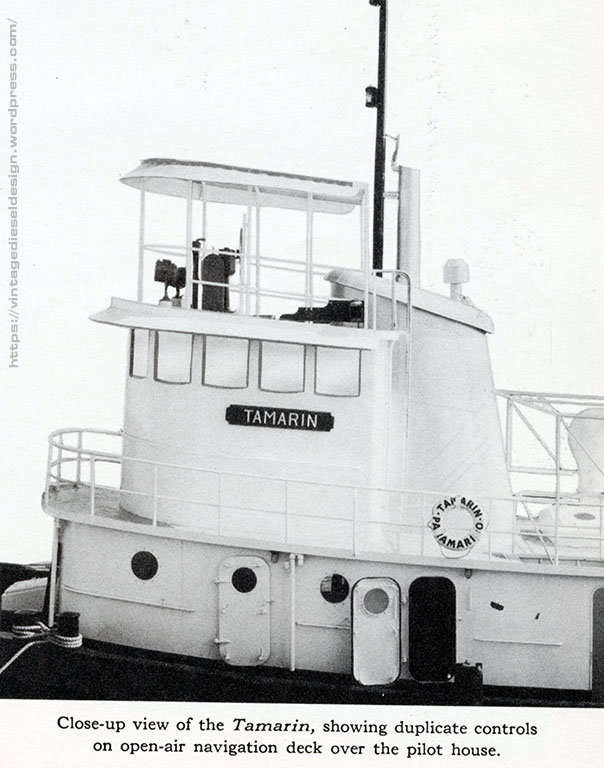
The tugs were operated as day boats, much like traditional NY Harbor Railroad tugs, and thus did not have a need for any major accommodations outside of a small galley and some pipe berths in the bow. For better control towing in the quick turns of the river, the stern H bitt was moved way forward. The unique feature, and what was foretelling for the future of tugs in general, was that the sisters had a second set of controls on top of the wheelhouse, under a simple sunshade.
Tamarin’s upper wheelhouse. Note the “airbrushed” out windows in the lower wheelhouse. Fun fact – That style of drop down window was built by Alco – Yes, American Locomotive built tugboat windows! Cleveland Diesel/Diesel Times
Propulsion would come from a 1640HP Cleveland 16-278A driving a Falk MB reduction gear and Falk Airflex clutches. A pair of 30kW generatros driven by Detroit 3-71s would power the auxiliaries. The tugs were built by Gulfport Shipbuilding of Port Arthur,Texas. The tugs, owned by Alcoa Steamship Co., and operated by Surinaamsche Bauxite Maatschappij would be named the “Wana” and “Tamarin”, and were delivered in late 1952/early 1953. Both tugs were based out of Moengo. Cleveland Diesel covered the tugs in the March 1953 issue of Diesel Times.
Looking aft in the engine room. Cleveland Diesel/Diesel Times.
Each day, one of the tugs would run upriver and meet the ship before the river became a roller coaster ride. According the the NYT article linked below, it was around a 10-hour trip, and it was not uncommon to brush up against the trees or run aground.
Over the last few years I have been lucky enough to acquire some slides of the tugs in action, likely all taken by Alcoa Steamship passengers. Unfortunately I have no idea the photographer and cannot credit them for these rare views.
The Wana in 1956. I assume this is the location where the tugs would pickup the tows. Click for Larger. Unknown Photographer/VDD Collection
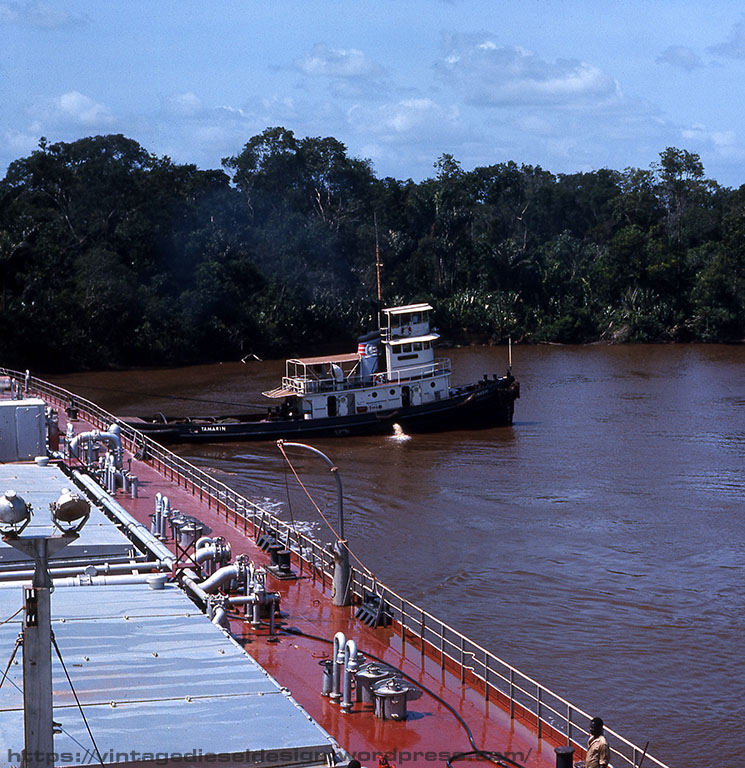
Kodak 126 slide of the Tamarin in March 1967. Note that the stack colors are the same as that of the ship in the above photo. Click for larger. Unknown Photographer/VDD Collection
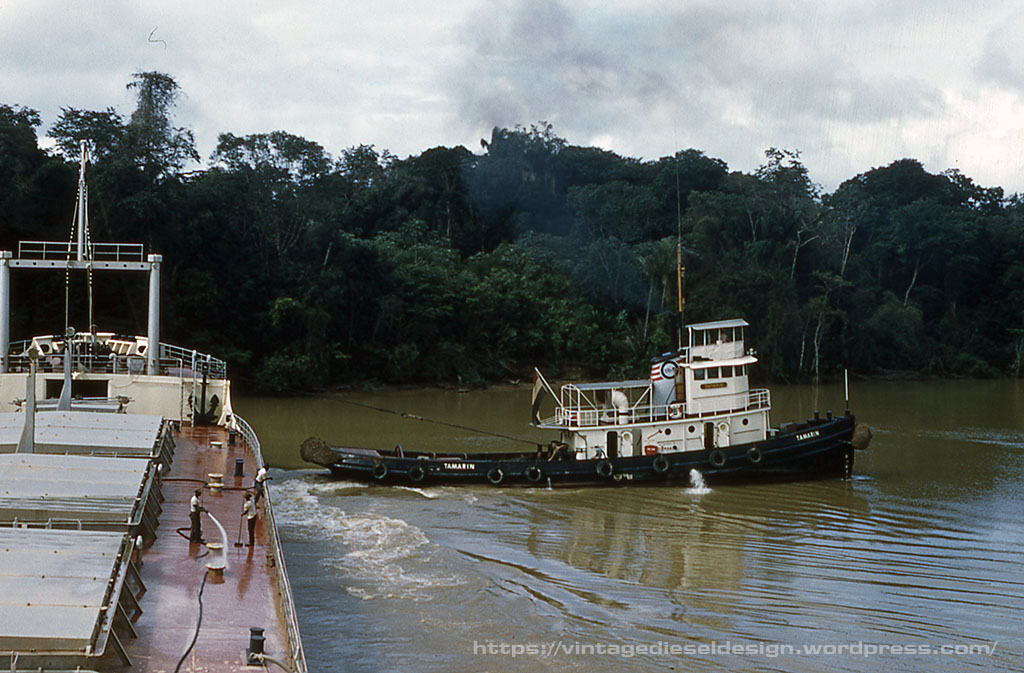
In what looks to be almost the exact same spot as the above photo, the Tamarin makes a hard turn to pull the bow of the ship around the corner in February of 1958. Click for larger. Unknown Photographer/VDD Collection
Same photo as above, but cropped tighter. Note that the rear H Bitt has an awning. The upper wheelhouse has Canvas sides as well, the roof was aluminum. Unknown Photographer/VDD Collection
Tamarin dragging the bow of the ship around a bend, the same day as the above shot. The Cottica was home to several local tribes. Click for larger. Unknown Photographer/VDD Collection
Alcoa (now locally Suralco) would open up a new smelter and refinery in nearby Paranam in 1965, as well as building a massive hydro-electric dam, which would ultimately power most of the area. Unfortunately, finding information about 67-year-old tugboats in South America, can be a bit of a challenge! According to Tim Coltons Shipbuilding History page, the “Wana” was renamed the “Coermotibo” by 1968. After finding one of the local facebook pages for the town of Moengo, and translating some posts, I was able to find out the “Wana” was unfortunately tripped while towing a ship in the river and sunk, killing her 5-man crew. The tug was apparently raised and rebuilt, along with being renamed. The upper wheelhouse was rebuilt into an actual enclosed wheelhouse at this time.
The history of Moengo and nearby Paranam mirror our own Rust Belt in America. The industry pulled out, and the towns went into a slow downward spiral. Alcoa/Suralco closed the Paranam refinery in 1999, and the smelter in in 2015. Alcoa was by far the largest employer, as well as owning a good portion of the area including company housing projects. The Bauxite mine in Moengo would operate until 2015 as well, however I can’t find out if they were still shipping by ship, barge or whatnot. At one point Alcoa even sold tickets aboard their ships to visit Moengo.
At the end of the day, I can’t find a peep on what happened to the “Tamarin” or the “Coermotibo/Wana”. I regret not talking to Joe Hack about them. Quite a few former American tugs are working nearby in Guyana, however its unknown what became of these sister tugs. I suppose they COULD still be running around somewhere down there…
If anyone happens to know what became of them, shoot me a message!
1960’s postcard? of Moengo, with one of the sisters. Note that the little overhang on the stern is gone now. From the Moengo Facebook group.
Since writing this, it has turned into one of the most viewed pages on VDD! Be sure to scroll down to the comments below to read some read memories of former crew and families that ran these tugs.










 Vintage Diesel Design