This week, we feature a prominent local shipyard – Jakobson Shipbuilding, in Oyster Bay, New York. Jakobson (originally Jakobson & Peterson, located in Brooklyn), moved out to Long Island in 1938, and would become very well known for their quality, and typically overbuilt vessels, especially tugboats.
Jakobson would overtime work very closely with TAMS Inc. Naval Architects, Merritt Demarest, Marine Design Inc. (Joe and Al Hack), Cleveland Diesel, EMD, Moran Towing and many others.
“Southern Kraft #9” was designed by Merritt Demarast, and used for moving pulpwood barges in South Carolina. She was covered in the April 1955 issue of Diesel Times, the Cleveland Diesel newsletter.
Jakobson (very often misspelled Jacobson) would keep busy right until the late 1980’s led by George Hossfeld. Jakobson Shipyard’s last new construction was the tug was the “Consort”, built for Express Marine in 1984.
“Julia C. Moran” (and sister “Eugene F. Moran”), designed by Joe Hack, then working at TAMS Inc., was one of the few new tugs that did not last long at Moran. She was sold to Venezuela by the mid 1950’s and renamed the “Puerto Ordaz”. Moran would replace the tug with the former Lehigh Valley tug “Wilkes Barre”, a nearly identical boat, which they also named “Julia C. Moran”. This has created much confusion for historians over the years. Note that Jakobson is misspelled on the ad.
Ultimately, the yard would be sold to Moran Towing, who used it as their personal shipyard, as well as doing other outside work using their marine railways, and a single small drydock. The yard closed in 1993, and the property sold to the town in 1997, where it is now a park. Very little remains of the original yard.
In 1940, Moran Towing would order a 121’ tug, designed by Tams Inc., Naval Architects. The tug would be a decent sized ocean tug for its day (very small by today’s standards), named the “Edmond J. Moran”, after the nephew of Moran Towing’s then president Eugene F. Moran.
The “Edmond J. Moran” was built by Pennsylvania Shipyards, in Beaumont, Texas, with hull number 231 and was delivered in late 1940 to Moran. The tug was powered by engines supplied by Cleveland Diesel, who worked very closely with Tams Inc. The Diesel Electric tug had the first pair of production Cleveland 12-278 engines (NOT 278A engines), rated at 950HP/750RPM. Each engine drove a generator, which in turn powered a pair of electric motors that fed into a double input Farrell -Birmingham reduction gear, with a single output.
Cleveland Diesel publicity photo of the new “Edmond J. Moran”
Edmond J. Moran took over Moran Towing as president in 1941, but it was short lived. With the onset of WWII, Edmond re-enlisted, and Eugene would return as interim president. During the war, Edmond would become a lieutenant commander in the Navy reserve. Later on, Edmond would wind up assembling a fleet of tugs that would help lead the charge in the invasion of Normandy. While Edmond J. Moran was doing this, the tug named for him was also doing war work. While the “Edmond J. Moran” was not outright requisitioned for the war, the tug was on a government charter.
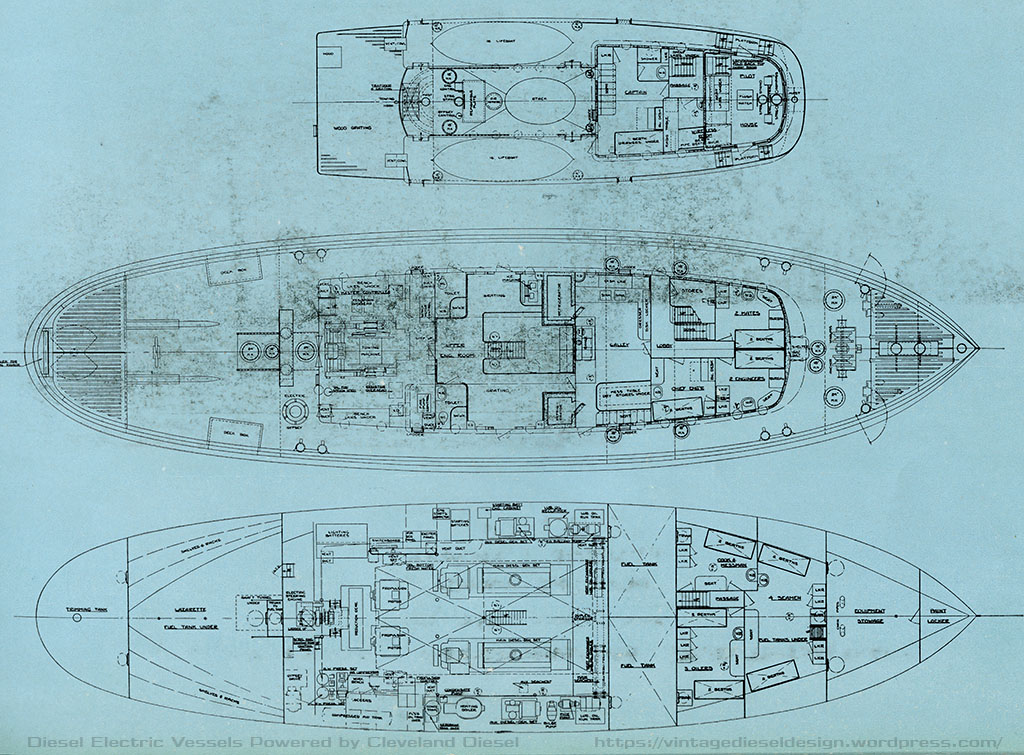
Interior layout of the “Edmond J. Moran”. The tug had room for a crew of 18 spread throughout 7 rooms, a pair of heads, a large central galley complete with walk in ice reefer and ice maker, and a large towing machine located inside, in the rear portion of the deckhouse. Diagram from Cleveland Diesel booklet “Diesel Electric Vessels Powered by Cleveland Diesel”.
During the war, the “Edmond J. Moran” had one hell of a record. She would log over 100,000 miles of service, literally all over the globe. The tug would tow dredges through the Panama Canal, rescue British sailors from a raft at sea, tow various torpedo victims including one specific incident: The tug was towing a British ship to the yard that was torpedoed. There were 91 people onboard. The ship under tow, wound up being attacked again by a German U boat. The tug, under Captain Hugo Kroll, would spend the next several hours playing chicken with the sub, while picking up the survivors. All 91 people were picked up by the tug and would ultimately make it to shore. The tug only had basic armor, a pair of 40mm guns, and the ability to drop a handful of depth charges after 1942.
The war exploits of the tug were well covered in an article published in Popular Science Monthly, September 1944 issue, which was reprinted by Cleveland Diesel in the December 1946 issue of Diesel Times, the company newsletter.
1940’s Cleveland Diesel two page ad featuring the “Edmond J. Moran”.
After the war, Edmond J. Moran would return to the states (after being promoted to Rear Admiral for his services at Normandy) and resume running Moran Towing in 1946, and became Chairman in 1964. He would retire in 1984, and ultimately passed away at age 96, in 1993.
The “Edmond J. Moran”, after returning from her war service, would join the Moran fleet and work as one of their main ocean tugs alongside a handful of former Army LT tugs for some years. The Edmond would live out her final days for Moran in Portland Maine, docking ships, now with a lowered stack and wheelhouse.
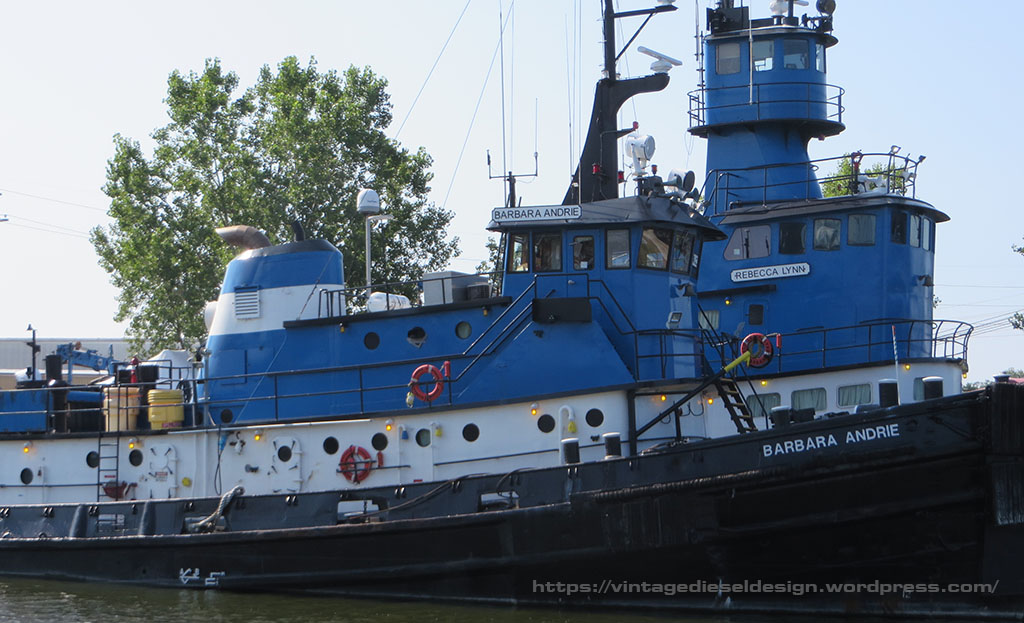
“Barbara Andrie” in Muskegon, Michigan.
In 1976, Beltema Dock & Dredge bought the tug from Moran and bought her up to the Great Lakes. Before entering service, they had renowned Naval Architect Joe Hack and his firm Marine Design Inc., redesign and update the tug. Included was an all new wheelhouse and captains cabin, as well as a repower with a streamlined stack. Out came the Clevelands and electric drive, and a new EMD 16-567C and clutch package went in. The tug was then renamed the “Barbara Andrie”. Beltema would become Canonie Transportation in 1981, and ultimately Andrie, Inc. in 1988. The tugs main work has been moving an asphalt barge throughout the Great Lakes.
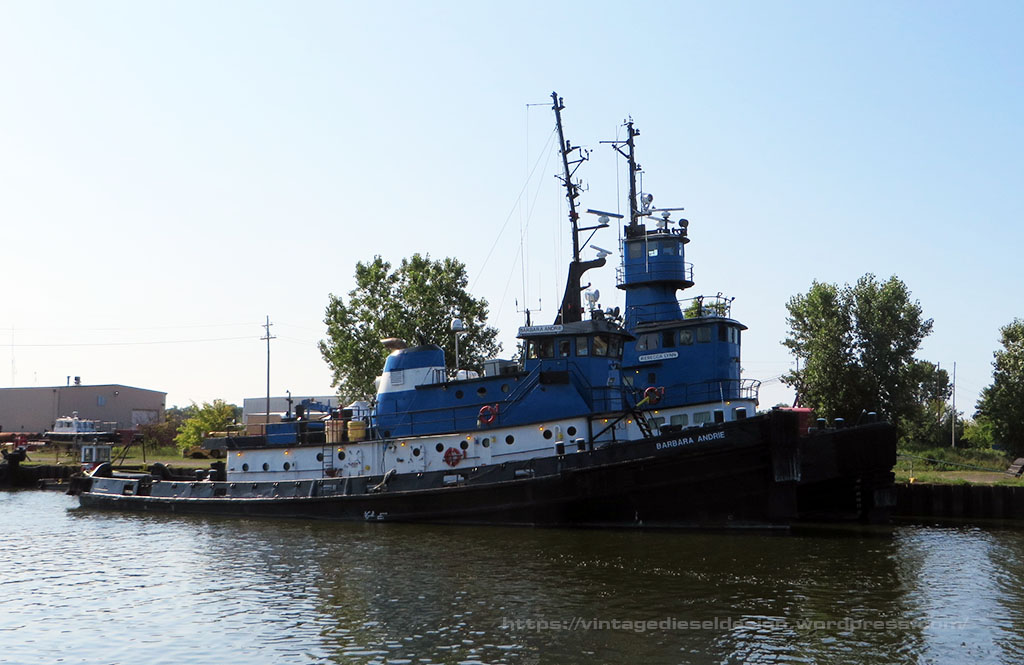
“Barbara Andrie” laid up in Muskegon, Michigan. She was repowered again in 2002 with an EMD 16-645.
In 2015 the “Barbara Andrie” was removed from doing barge work, and semi-retired. The tug currently lives in Andrie’s yard in Muskegon, and does winter ice breaking work and the occasional assist job or ship tow.
Unfortunately back lit, but a photo I am happy to have. The tug behind, the “Rebecca Lynn”, was also designed by Joe Hack and Marine Design Inc.
Today marks the 75th anniversary of D-Day, operation Overlord, and the storming of the Normandy Beaches. Way more then I could ever write has been written about today’s events, and I defect to others on that one. But, today I will share two D-Day Veterans anyone can visit.
Tug LT-5, the “Major Elisha K. Henson”, now a museum ship in Oswego, New York
First up is the LT-5, “Major Elisha K. Henson”, and later known as the “John F. Nash”. The LT-5 is an Army “Large Tug”, built by Jakobson Shipbuilding in 1943. The LT-5 was used on D-Day towing various barges, in part of the operation of building an artificial harbor off of Normandy. After the war the tug was used by the Army Corps of Engineers in the Buffalo area, until begin retired in 1989. Today the LT-5 is part of the H. Lee White Maritime Museum in Oswego, New York.
The LT-5 is powered by an 8 Cylinder, 1200HP, direct reversing Enterprise DMQ-38 engine.
The second ship is the LST-393, or Landing Ship – Tank. 393 was part of the late night landings on June 6th, and would ultimately make 30 round trips to the beach, earning 3 Battle Stars.
LST-393 in Muskegon
After the war, the LST-393 became a Ferry named the “Highway 16”, operating between Muskegon and Milwaukee. The 393 is one of only two (the other being LST-325) original LST’s remaining afloat in this country. LST-393 is now a museum boat in Muskegon, Michigan.
LST-393 is powered by a pair of EMD 12-567ATL engines, which are in essence one of the reasons the 567 line became as well known as they have. These engines were contracted under Cleveland Diesel, and built by EMD in LaGrange, IL. Much more to come about the 567ATL.
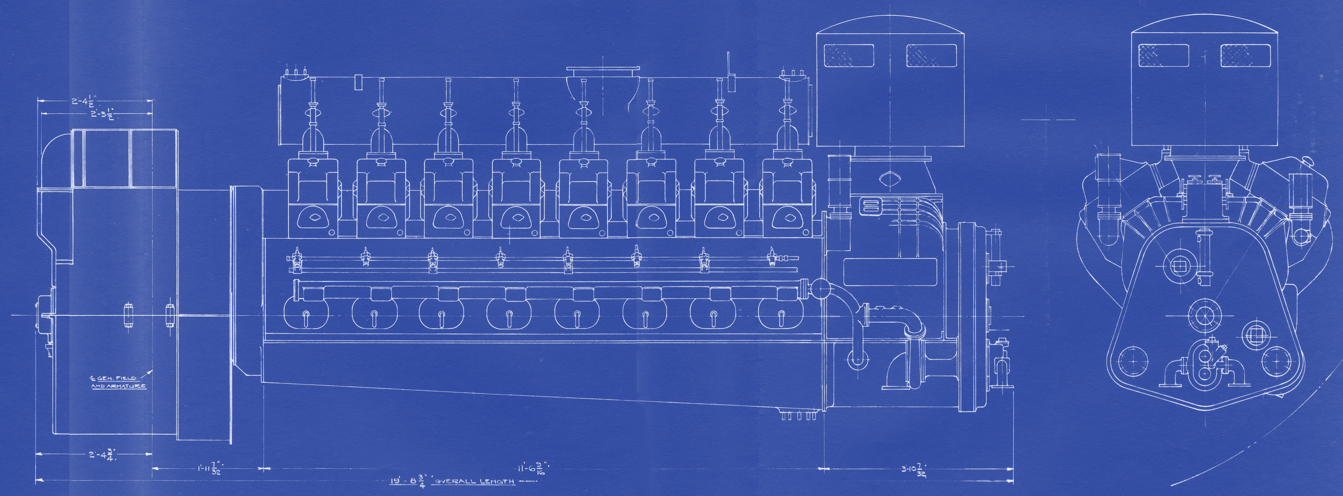
Another survivor on this page, is the engine in the header photo. This Cleveland 16-278A in the Sturgis, Michigan power plant, used to be in Destroyer Escort HMS Kingsmill (later DE-280). After the war the ship was scrapped, and the engine became one of four 278’s in this power plant. The HMS Kingsmill was at Normandy on June 6th doing Patrol work.
As always, thank a Veteran for their services that they performed for our freedoms.
Also, support our museums and museum ships. All over museums are struggling for support, even more so are the maritime related ones. It takes a lotof of effort to keep something afloat, especially when its 75+ years old. Visit, Support, Volunteer.






 Vintage Diesel Design