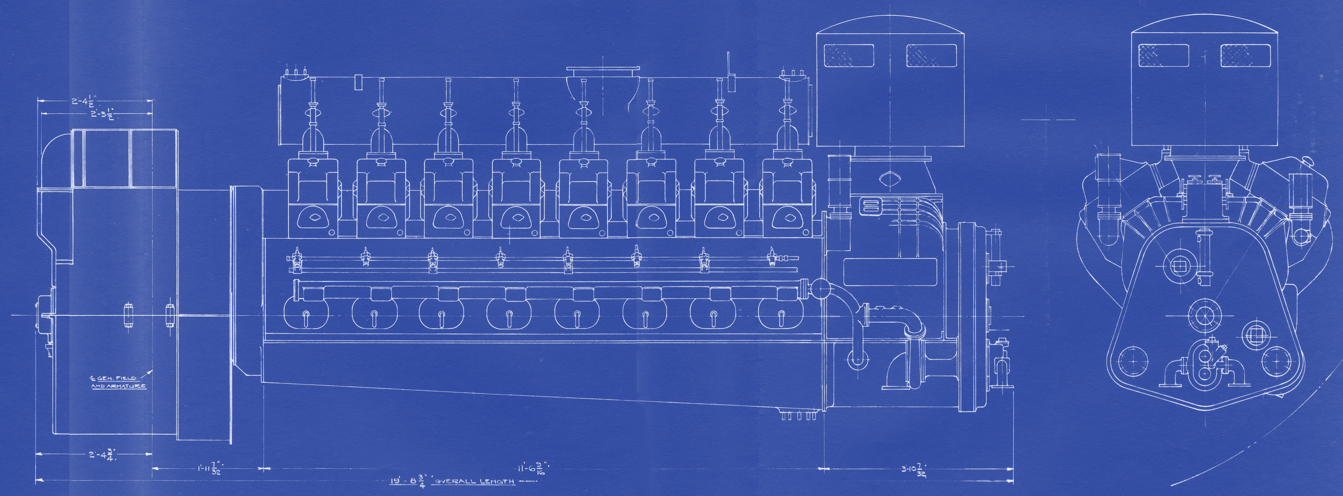
A VDD field trip by Jay Boggess. Photos by the author unless otherwise noted.
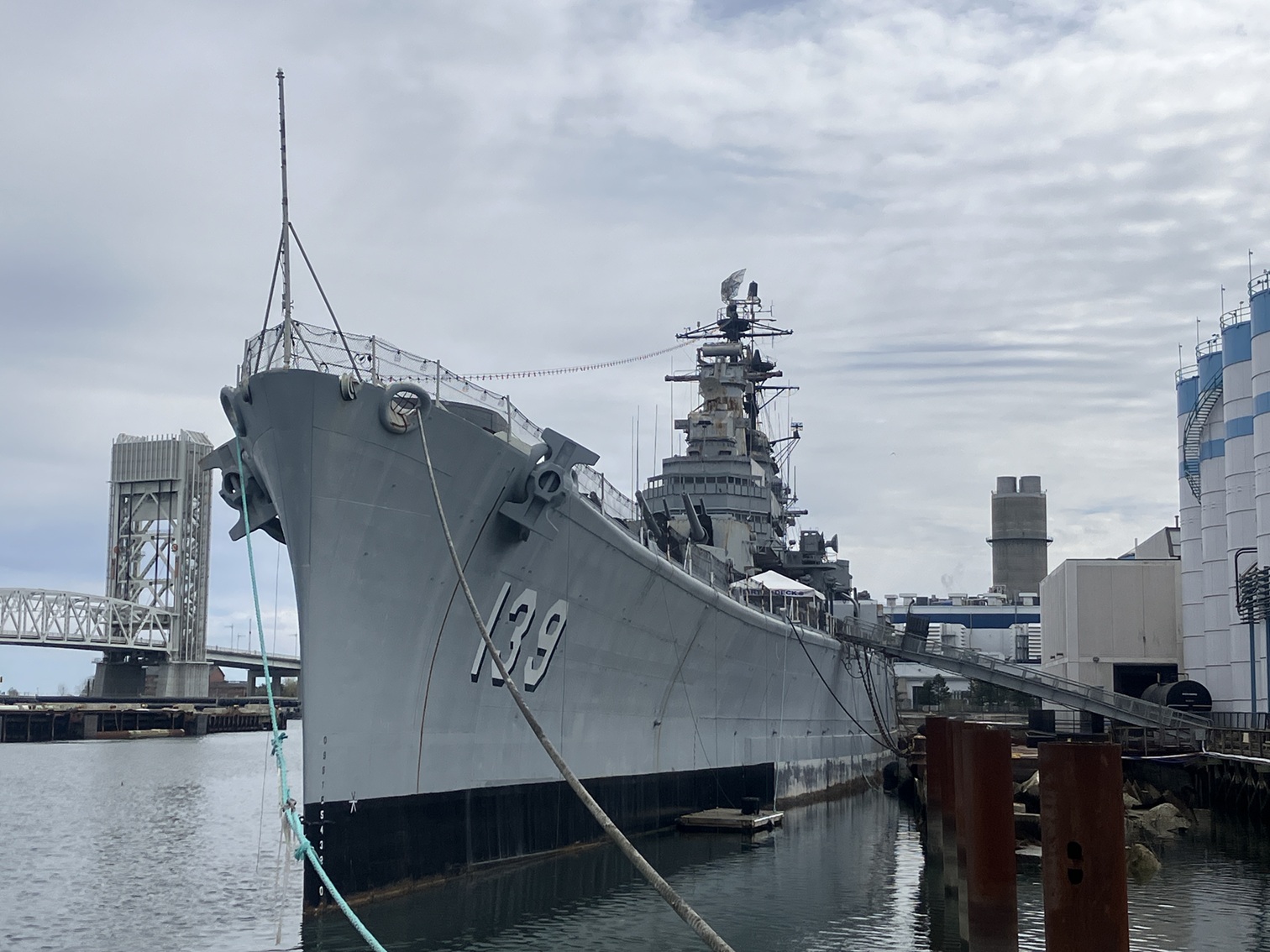
USS Salem & her logo – Fore River Shipyard, Quincy, MA, April 26, 2026
The USS Salem, a WWII-era heavy cruiser with 120,000 steam turbine-supplied horsepower now preserved as museum – what does that have to do with Vintage Diesel Design? The answer is her need for electricity in normal and emergency situations.
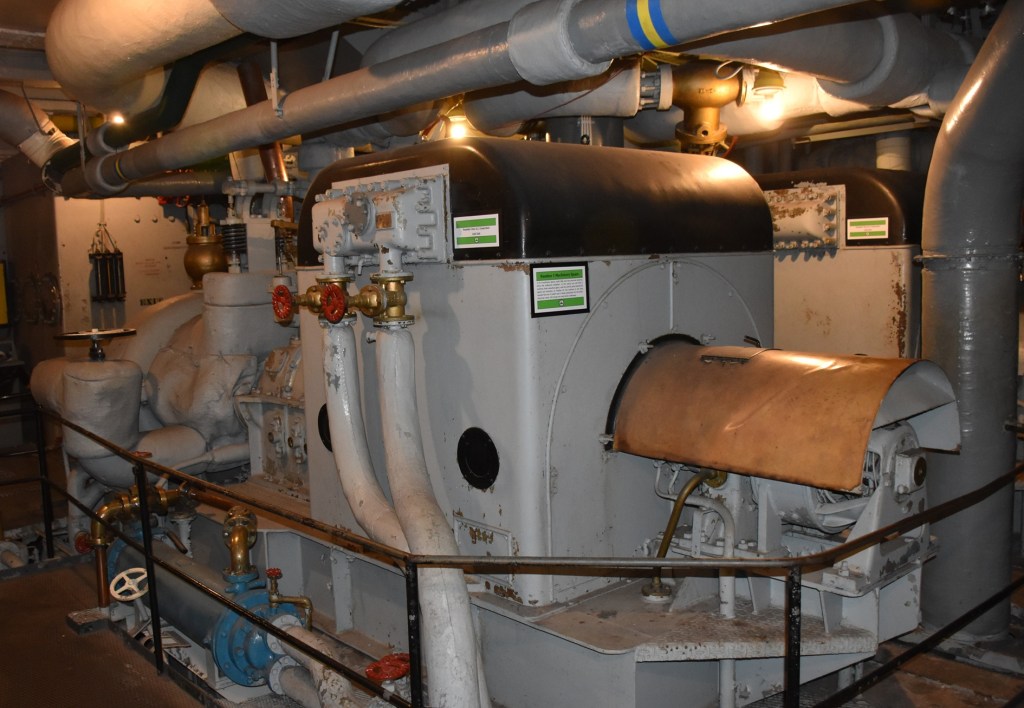
Ships Service Turbo-Generator, Battleship Alabama, 450V 1000 kW – Mobile AL, Dec 2023
In normal situations, electric power to run pumps, blowers, lights, gun turrets, radios & radar and everything else that makes a warship run typically comes from one or many turbogenerator(s), powered by the same steam boilers that run the propulsion plant. When the primary turbo-generator is not available, say during plant start-up or in the heat of combat then emergency diesels step up to the plate. Like aircraft carriers of today (see VDD post Chester Nimitz’s EMD 645’s – Vintage Diesel Design). WWII destroyers, battleships, cruisers and carriers need emergency diesels. Cleveland Diesel Engine Division (CDED) supplied hundreds of them.
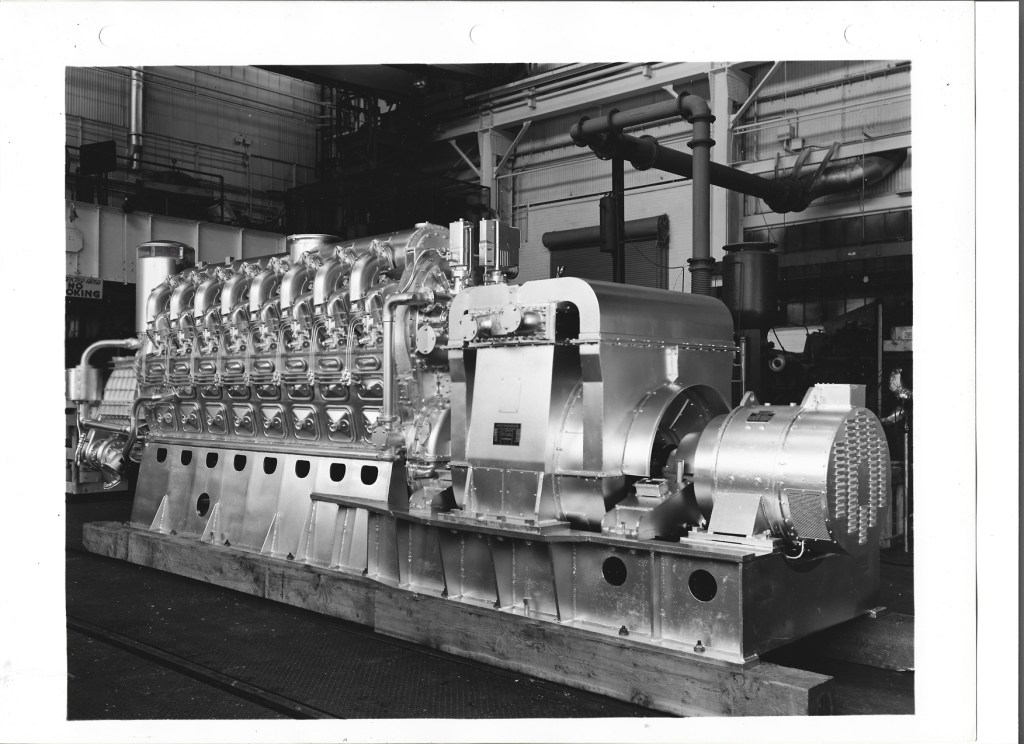
Cleveland Diesel 16-278A with Westinghouse water-cooled AC generator on the CDED shop floor, probably for CVA-16 or CVA-311 . CDED photo, Jay Boggess collection.
The largest emergency diesel in CDED’s catalog is the 16-278A. As a propulsion engine, the 16-278A was used during WWII in 80 submarines, 194 destroyer escorts and 277 LSMs (Landing Ship Medium). After the war, it provided emergency power for 1950’s supercarriers like Forrestal & Ranger, the Atomic Energy Commission’s Savannah River plutonium plant, plus two post-war heavy cruisers; USS Des Moines and USS Newport News. But there’s nothing in the VDD records on 278s installed in USS Salem, sistership to Des Moines and Newport News. Why? This is the mystery this post attempts to address.
Veteran readers of Vintage Diesel Design will note that in previous VDD posts, this author (Jay Boggess) was able to save Cleveland Diesel records from the dumpster. Blog master Paul and I call it the Cleveland Diesel Build Data (CDBD). Here is the story of how CDBD came to be and how we came to save it.
This story begins with anonymous clerks working at 2160 W 106th Street, Cleveland Ohio. The folks at Cleveland Diesel kept amazing and incredibly detailed records. From the 15th engine Winton built in 1916 till the last of 20,000 engines that left Cleveland in 1961, the clerks worked hard to keep track of those engines. Those records were blue-line “diazo” copies of vellum sheets, 15 engine numbers per page. Unknown clerks would update the vellum originals with new information as a ship was sold to new owners or an engine was removed for a different purpose or (for more than a few CDED engines) ended with the cryptic notation “VESSEL LOST DURING WORLD WAR # II”. Those clerks would make new diazo copies, stamp them with a blue-ink date and distribute updates to users. These diazo sheets were compiled into about a dozen denim-covered 3-ring binders. The EMD Service Dept had a set, most likely from when CDED was folded into EMD in November 1961.
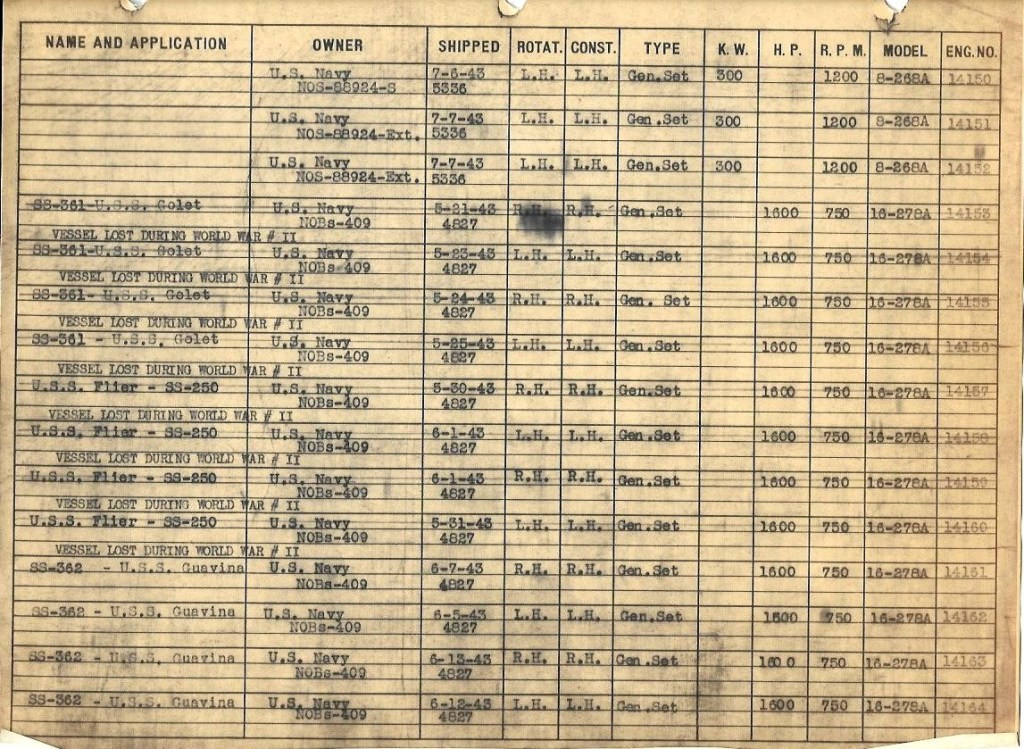
A typical CDED build sheet, this one documenting 278A engines going into submarines in 1943. CDED, VDD collection.
From 1981 till 2004, I was an electrical engineer at Electro-Motive and had caught the CDED bug. After discovering old Cleveland Diesel maintenance manuals on dusty bookshelves left by retirees and wondering about this unknown GM division that build diesels for WWII fleet submarines, I dug deeper. My boss alerted me to Cleveland Diesel records in the Electro-Motive Service Dept vault in the old EMD Admin Building. Fast forward to the 1990’s, Electro-Motive was downsizing and the Service Dept was relocated to the EMD Engineering Building (That Engineering Building is now the headquarters of Progress Rail, and it is the last remaining structure of the massive EMD McCook site. See Preston Cook’s article in Spring Summer 2022 RAILROAD HISTORY, “The Story of EMD’s Plant One”). EMD Plant 1 was facing demolition around 1999. I visited the file area one last time and sure enough, the CDED binders were still there. I moved them to my cubicle and there they sat for at least 4 years. No one ever came looking for them, so when I left EMD in 2004, those binders came with me.
The CDED binders just followed behind me for 5 houses and a dozen years until 2014. Then, through the wildest of co-incidences, I met blog master Paul Strubeck. We found our common interests in tugboats, trains and documenting the history of Cleveland Diesel. I systematically scanned the 3000+ sheets, gave the original binders to Paul, and then started the nearly endless entering the data from those build sheets into a massive Excel spreadsheet. The data entry is still not finished. But there’s enough information to ask some interesting questions and attempt to solve some mysteries. And that is the crux of this story – the emergency diesel engines of USS Salem CA-139.
Heavy Cruisers, the Des Moines Class and USS Salem
America built 27 heavy cruisers during World War II. The term heavy cruisers is a construct of the London Naval Treaty of 1930 and later treaties. Larger than a destroyer, a heavy cruiser has 8-inch guns, a light cruiser has 6-inch guns. Generally, a cruiser was faster than a pre-war battleship, but advances in battleship propulsion narrowed the speed difference. During the war, cruiser roles
evolved into antiaircraft protection for aircraft carrier task forces, and after the war, many cruisers were converted to carry surface to air missiles, again to guard carriers.
The Des Moines class was designed with lessons learned from early WWII. The main 8-inch battery was dramatically improved by “… that the guns were auto loading, giving them a rate of fire of 12 rounds per minute. This allowed a Des Moines class cruiser to expel 3 times the amount of firepower compared to earlier cruisers that had a rate of fire of roughly 4 rounds per minute.”(see: https://www.warhistoryonline.com/guest-bloggers/the-des-moines-class-cruiser.html) Also, the engineering plant was dramatically rearranged as follows:
“The biggest enhancement to the power plant of the Des Moines class was the arrangement of the engines. By rearranging the power plant, the Des Moines was able to trunk all exhaust gases into a single funnel. This had the benefit of greatly improving the firing arcs of all the anti-aircraft weapons. As an added bonus, it became less likely that a torpedo would knock out the engines. This seemingly minor modification increased the ship’s anti-air firepower while also improving its resistance to underwater attacks.” – Ibid
Twelve Des Moines cruisers were planned but only 3 were completed, all after the end of WWII. Below is a table of important dates for those 3 ships:
| Laid Down | Launched | Commissioned | Mothballs | Final Fate | |
| USS Des Moines CA134 | 28-May-1945 | 27-Sep-1946 | 16-Nov-1948 | 6-Jul-1961 | Sold/Scrapped 2005 |
| USS Newport News CA148 | 1-Nov-1945 | 6-Mar-1948 | 29-Jan-1949 | 27-Jun-1975 | Scrapped 1993 |
| USS Salem CA139 | 4-Jul-1945 | 25-Mar-1947 | 9-May-1949 | 30-Jan-1959 | Museum ship 1994 |
Salem was the last ship of the class commissioned and the first to be mothballed. During its active service, it spent most of its career in the Mediterranean, often acting as flagship for the commander of the US 6th Fleet. Mothballed in 1959, she was in the Philadelphia reserve fleet, joined by Des Moines in 1961. USS Newport News remained in active service, serving in Vietnam, joining her sisters in reserve in Philadelphia in 1975. All three were considered for reactivation in 1981 as part of Reagan’s 600-ship navy project, but nothing came of it. Her sisterships eventually being scrapped, Salem returned to the shipyard and the city of her construction – Quincy, MA – in 1994 as a museum ship.
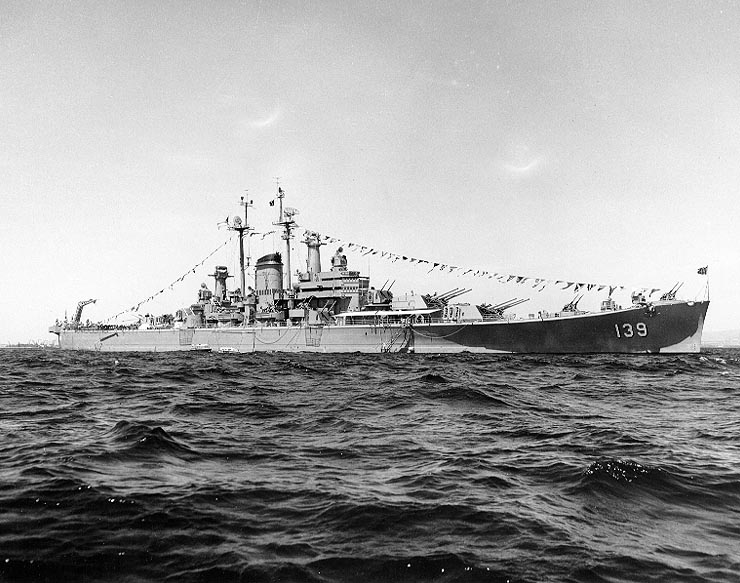
USS Salem at anchor off Sardinia, 19-May-1950. US Navy photo via Wikipedia
What Diesels Does USS Salem Have?
Salem, Des Moines and Newport News are sisterships. Therefore, you’d expect the emergency diesels would be the same as well. The CDBD clearly shows that Des Moines got two 16-278A engines (s/n 55781 and 55782 shipped on 11-16-46 and 11-25-46 respectively). The Newport News got engines s/n 55793 and 55794 on 12-13-46. But there is nothing in the CDBD on Salem. This is not surprising. There are several holes in the build data; None of the post-war “pancake” engines for the SS-563 Tang class submarines are listed nor the horizontal or vertical industrial pancakes show up either. It seemed like a perfect excuse reason for a road trip.
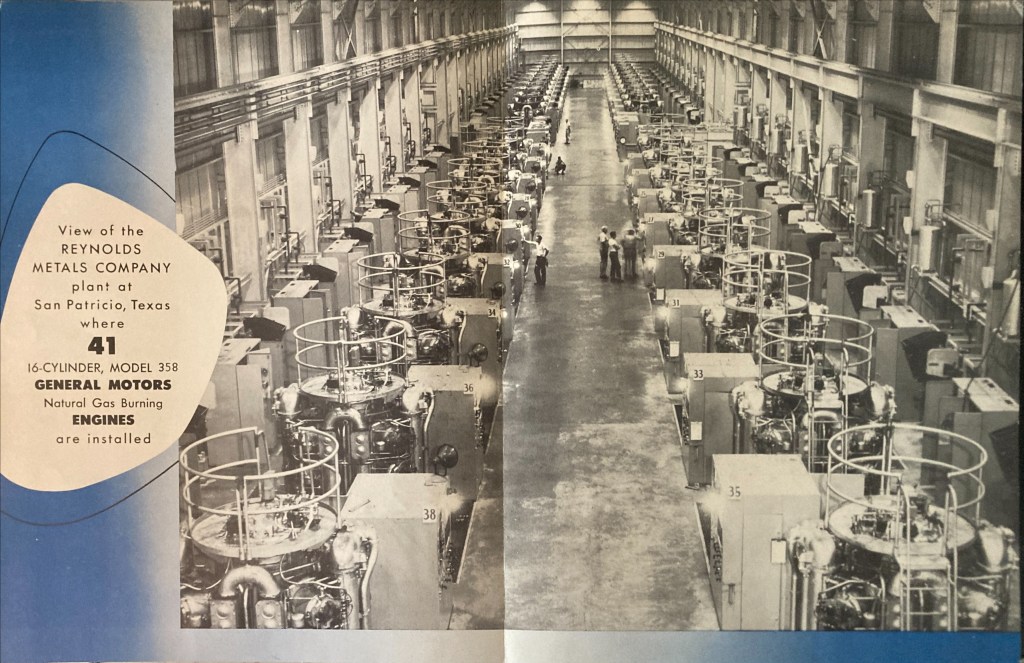
NO RECORD – CDED’s industrial 16-358 pancake diesels, like these 41 engines at this Reynolds Metals plant in Texas from the 1950’s, are not documented in the CDBD. CDED pamphlet, VDD Collection.
Through the networks of Tim Rizzuto and John Epp at USS Slater, I contacted Salem volunteer Aaron Prendergast, who cheerfully organized my visit and scavenger hunt for Salem’s diesel generators for Sunday, April 26th.
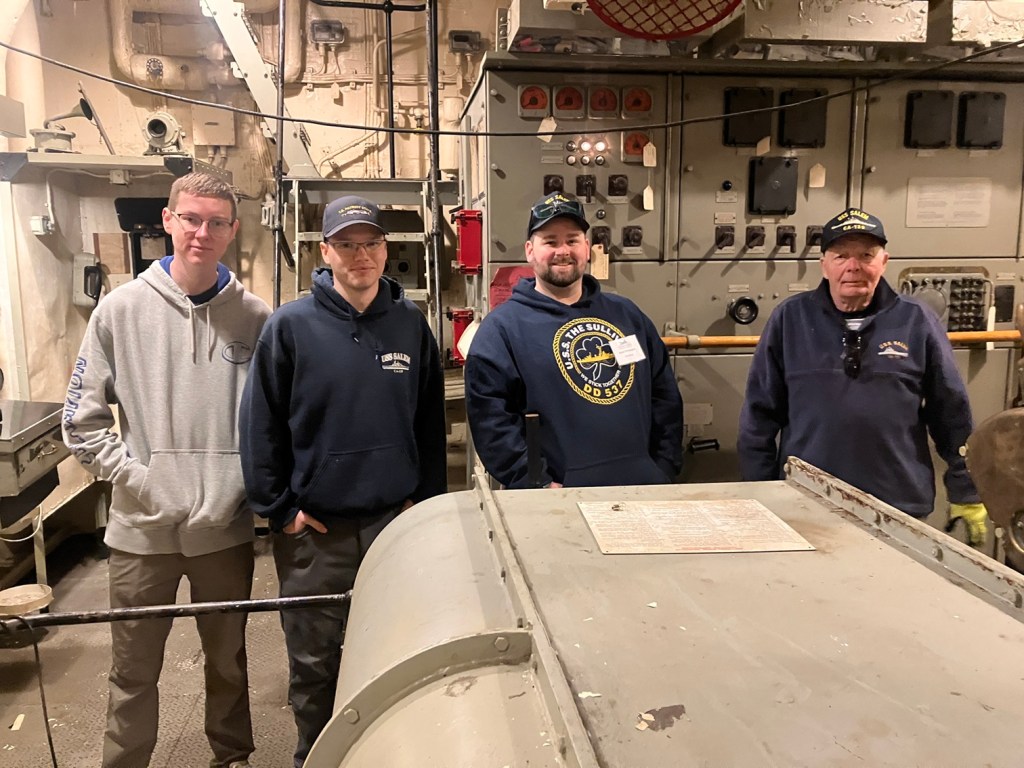
The Salem crew of volunteers – l-r: Billy Strachan & James Ayers (both students at the Massachusetts Maritime Academy), Aaron Prendergast (my contact) and Jeff Gillman (Navy electrician 1964-68 on the carrier FDR), all incredibly knowledgeable and friendly folks.
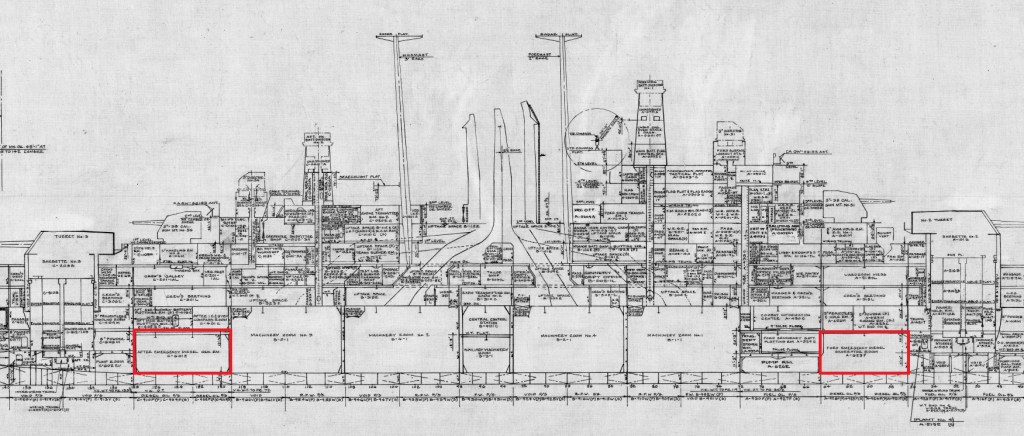
USS Salem inboard section excerpt. The forward emergency generator room is outlined in red, aft of the No.2 turret barbette and the Plotting Rooms. Original drawing from the Internet Archive (https://archive.org – search for ca139bogp1949)
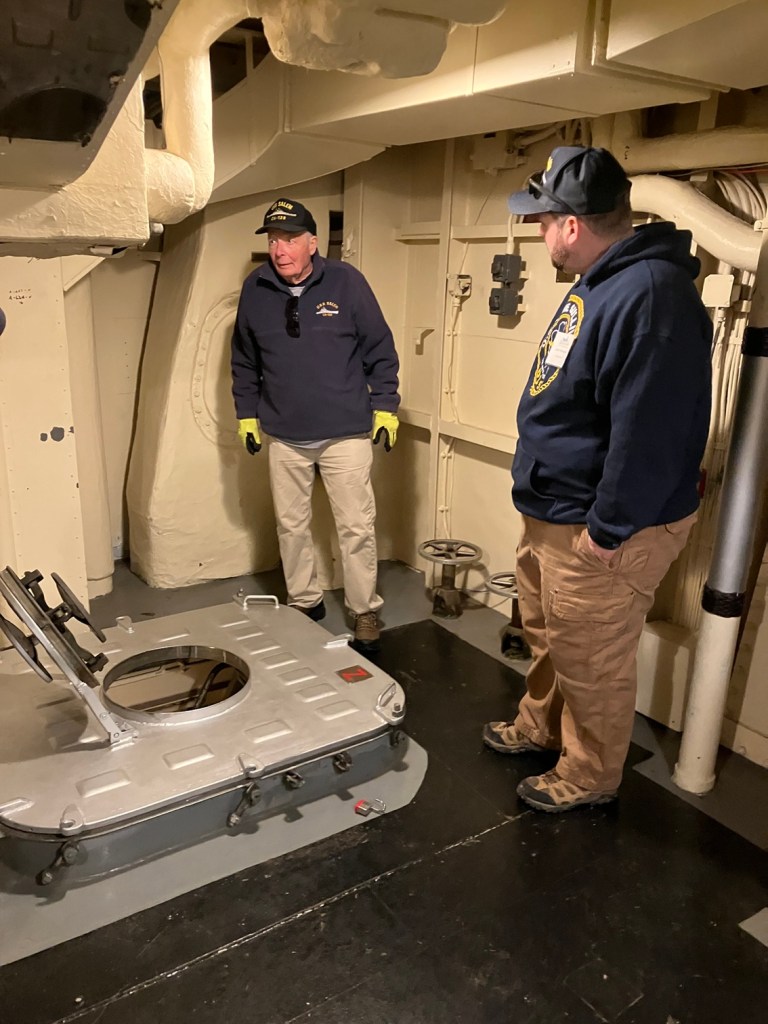
Here, Jeff & Aaron plan our deep dive into the bowels of Salem’s lower deck spaces.
From the 2nd Deck, we wiggled down to the 3rd Deck, then down further through the 3.5” armor deck, then still deeper into the bowels of the ship (I lost count) till we ended up in the forward diesel generator room, just ahead of the #1 Machinery Room and just above the triple bottom. And here lay the holy grail of our quest– Cleveland Diesel 16-278A, serial number 55783, 1192HP, 720 RPM.
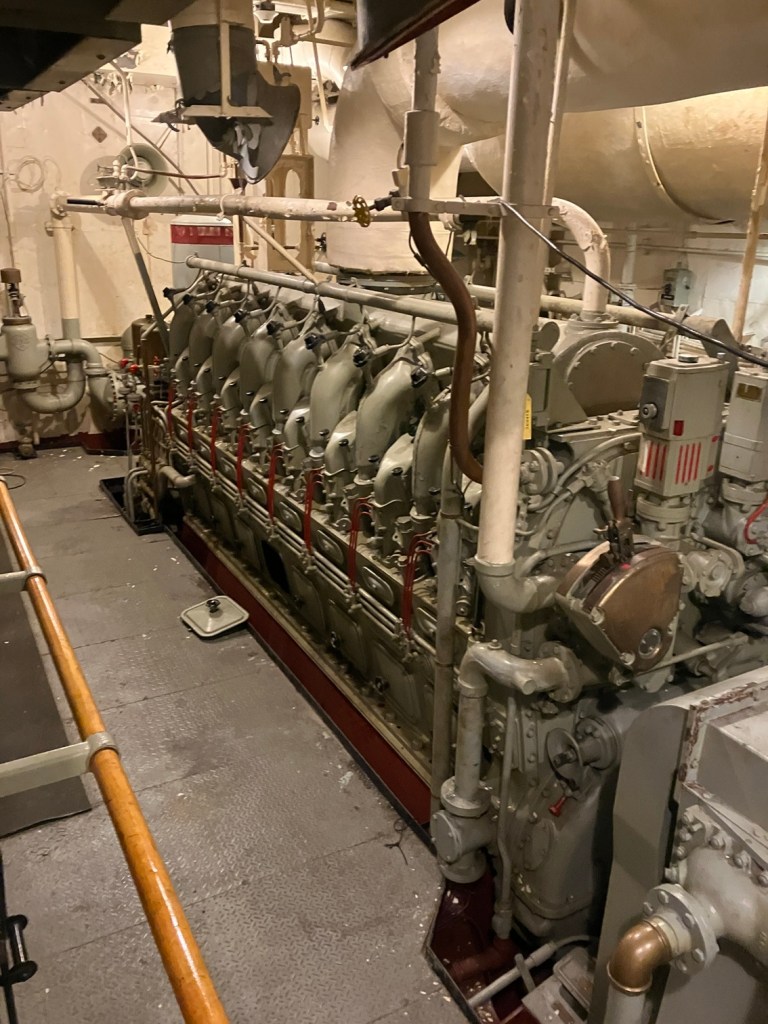
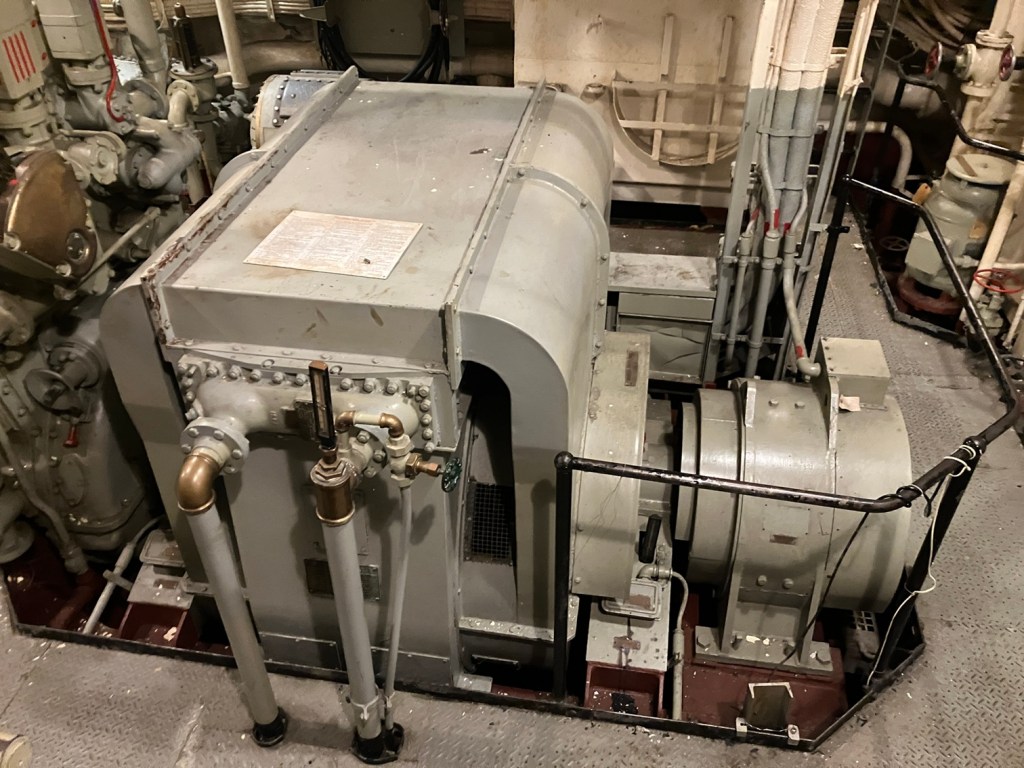
When an engine/generator is shoe-horned into a small compartment, it’s difficult to get the whole thing in one photo.
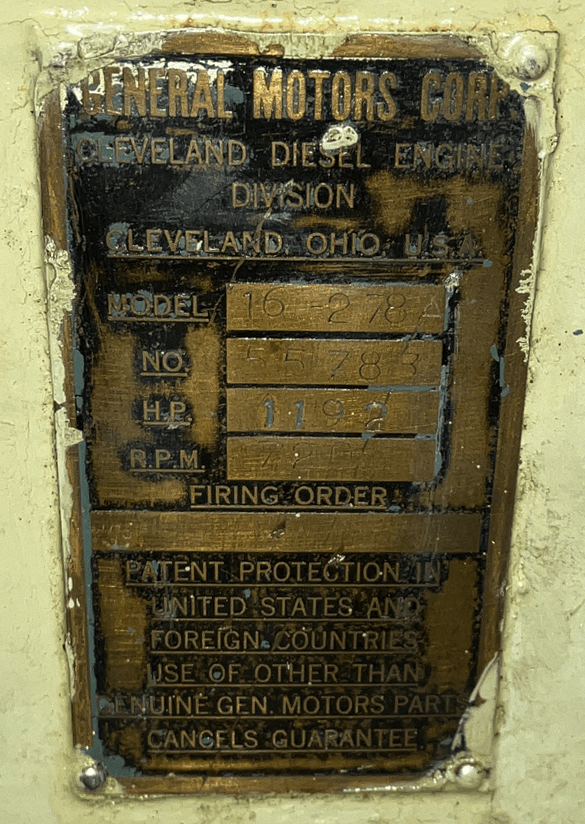
If you zoom in to the serial number plate, it says 55873. WHICH totally conflicts with the build sheet below. It says that engine 55873 was assigned to a SOCONY (Standard Oil Company of New York) tanker, SS Sacona. Why a steam powered tanker (“SS”) would have a pair of 1500-HP diesels is a mystery to me and my cohorts. But we’ve seen lots of wandering engines in this game of Cleveland Diesel duck-duck goose that my cohorts have been playing for a few years now.
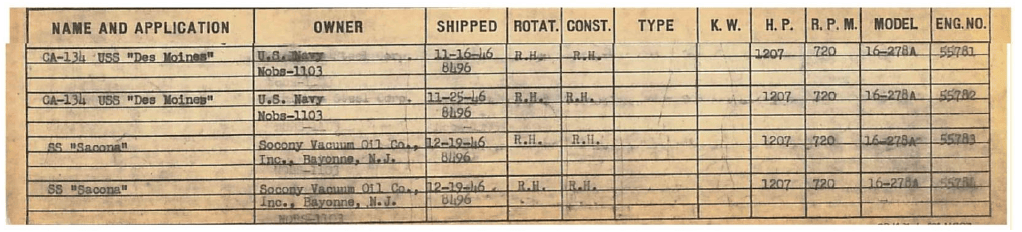
CDBD build sheet with Des Moines’ engines and Salem’s forward emergency diesel, assigned to the mysterious SS Sacona but clearly spotted in the forward generator space. VDD Collection.
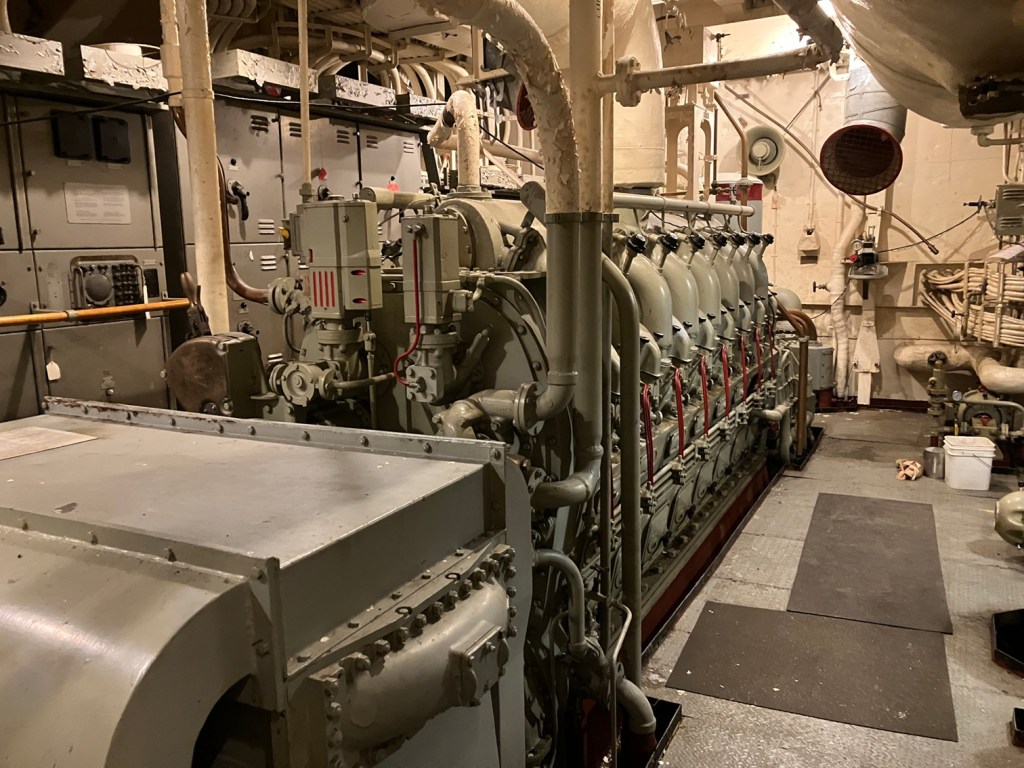
Portside view of Salem’s forward diesel generator.
Here’s how Salem’s forward generator is wedged in between the Machinery Spaces and the No.2 turret:
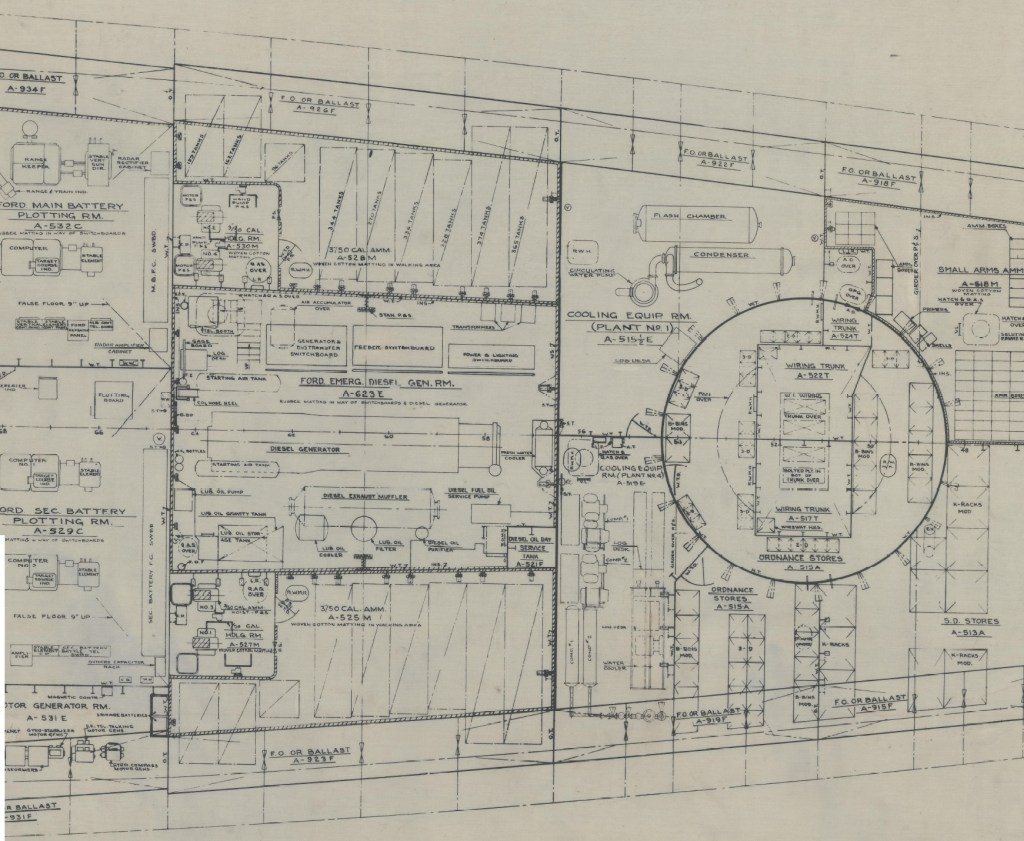
Wished I’d found these before my visit to Salem. A little bit of Googling uncovered great scans of the ship at the Internet Archive ( https://archive.org – search for ca139ga1949). The generator is wedged between three-inch antiaircraft ammunition magazines on either side of the compartment, the 8-inch barbette ahead and the main and secondary battery directly aft (with the machinery spaces aft of that).
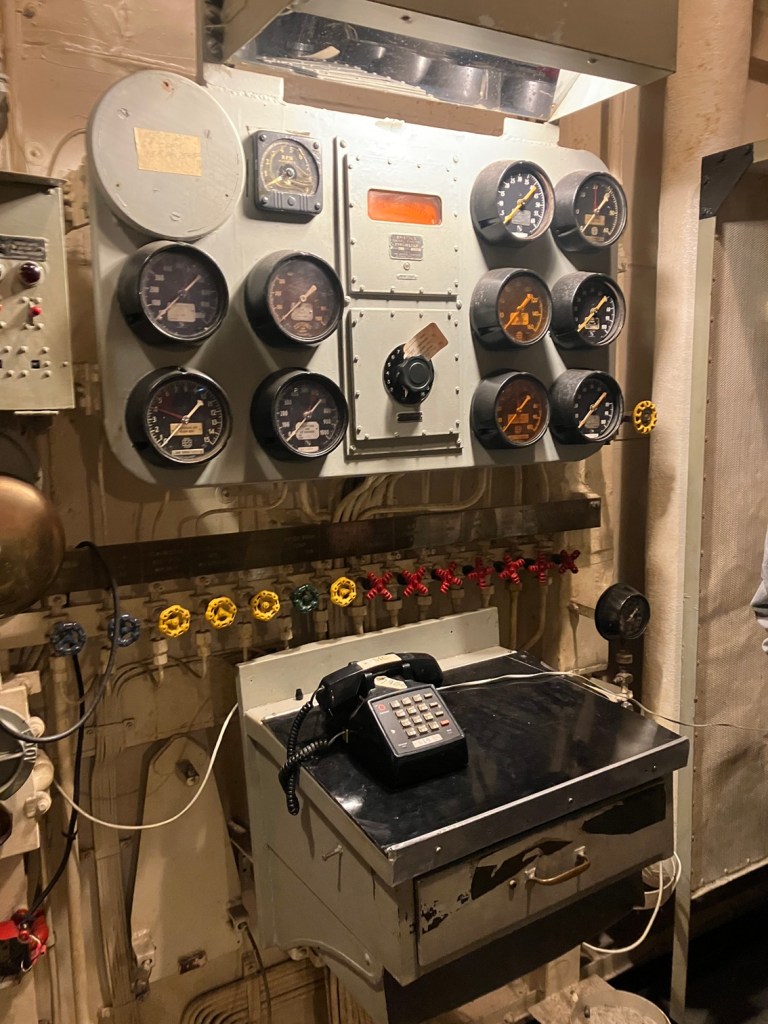
Gen set pressure and temperature gauges.
Air intake & blower, with circuit breakers.
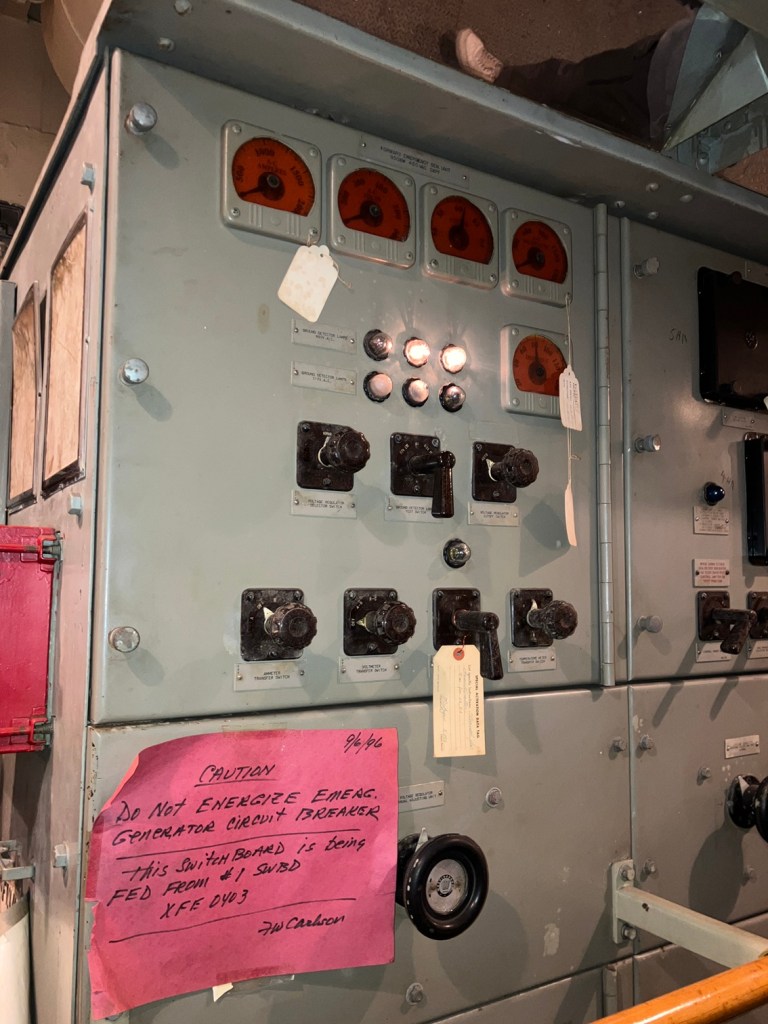
Generator electrical meters and controls.
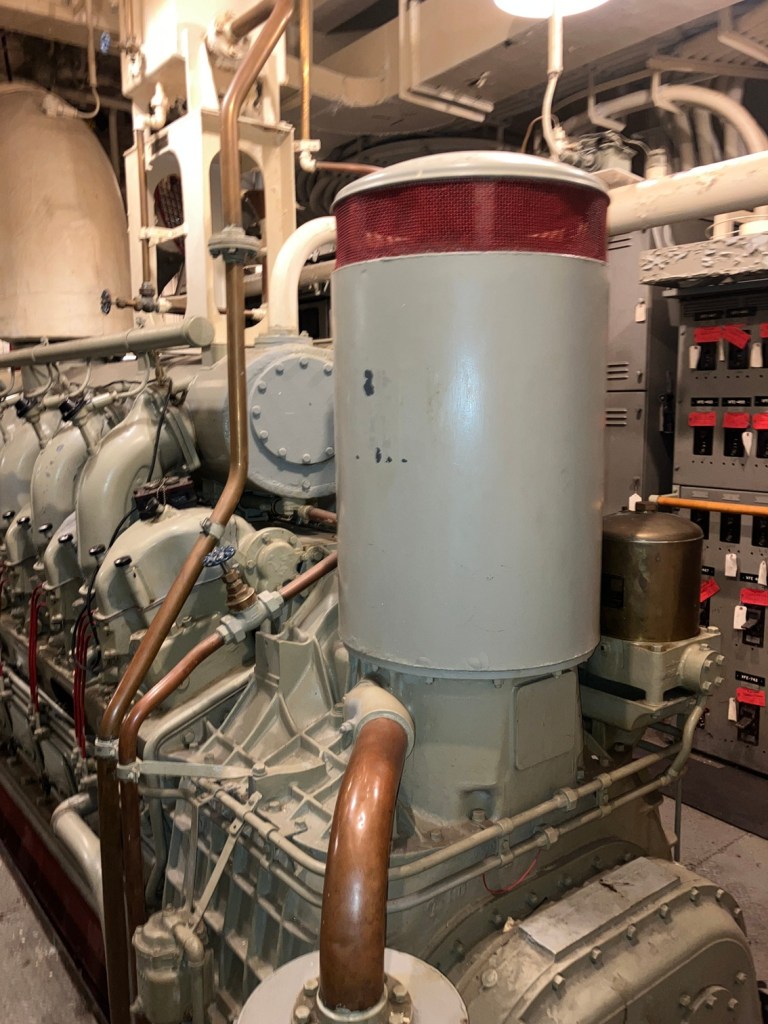
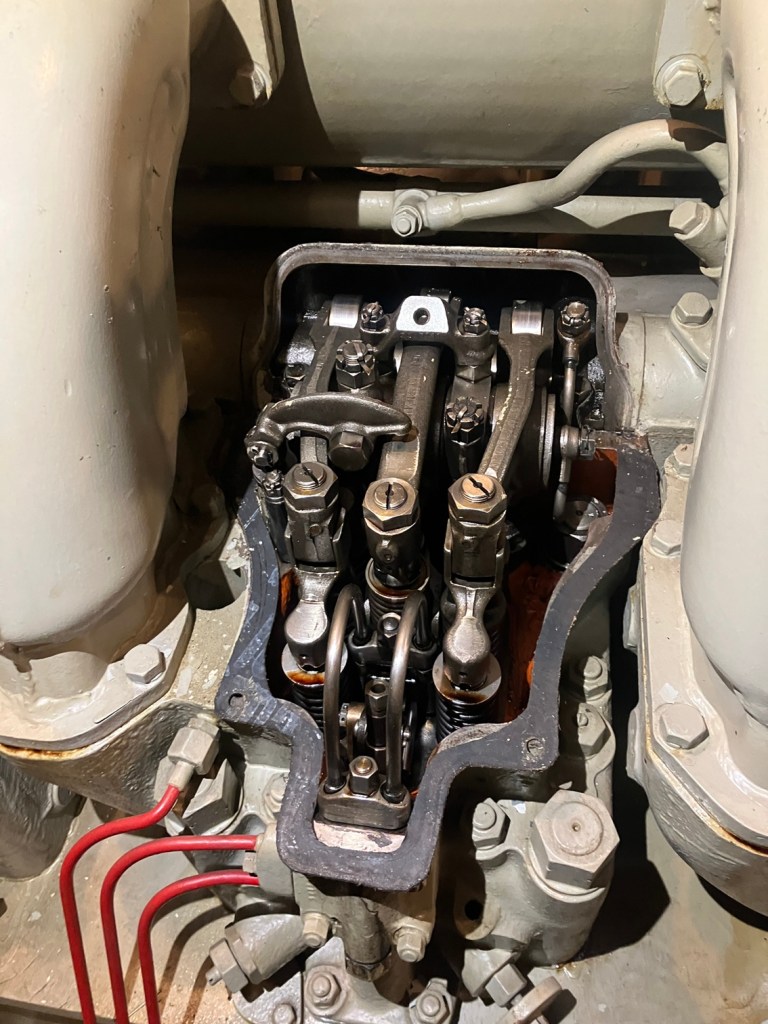
278A Cylinder with valve cover removed.
So, what have we learned here?
–Salem has Cleveland Diesel emergency generators, like her sisters Des Moines & Newport News.
-Goodness knows what diesels SS Sacona received or if she ever got any diesels.
-The anonymous clerks of CDED are not the Pope; they are fallible. But they kept great
records that Paul & I use today, 64 years after the CDBD was last updated.
-Finally, Salem is an interesting and fascinating museum ship and worthy of a visit.
A USS Salem Photo Album
Here is a collection of Salem photos from my visit in April 2026.
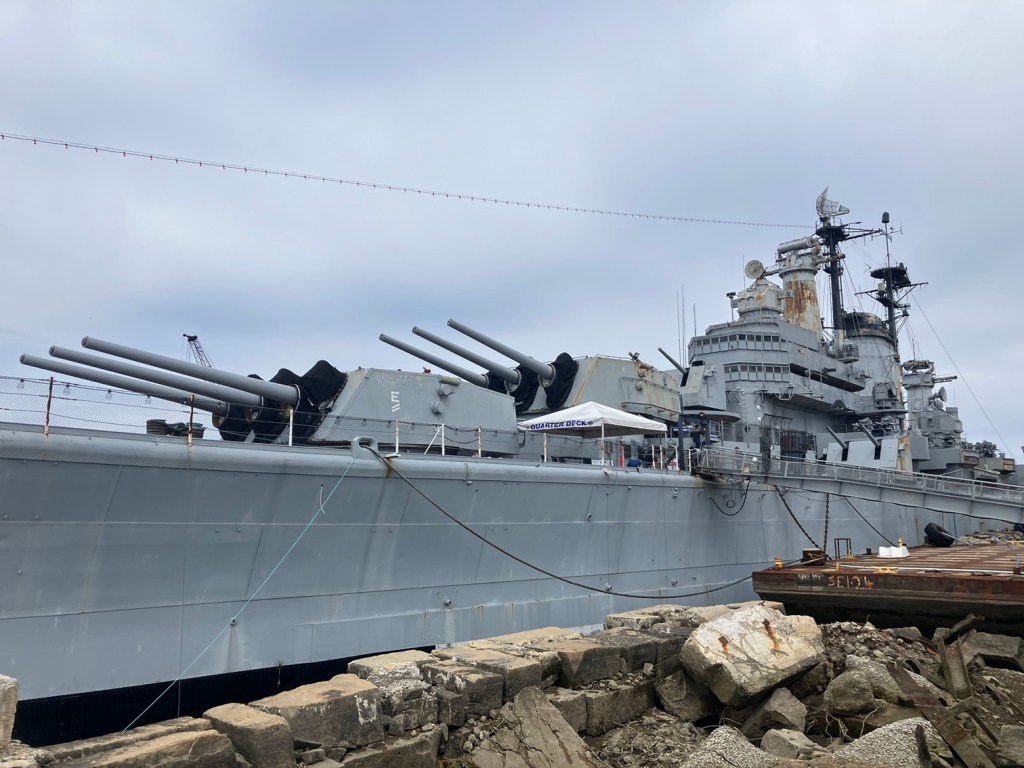
Salem’s No.1 and No.2 8-inch turrets, plus two of her 5-inch dual-purpose gun mounts. She was built with three 8-inch turrets, six twin 5-inch gun mounts plus twelve twin 3-inch open gun mounts. Antiaircraft protection for a carrier task force became the primary mission for cruisers in WWII and afterwards.
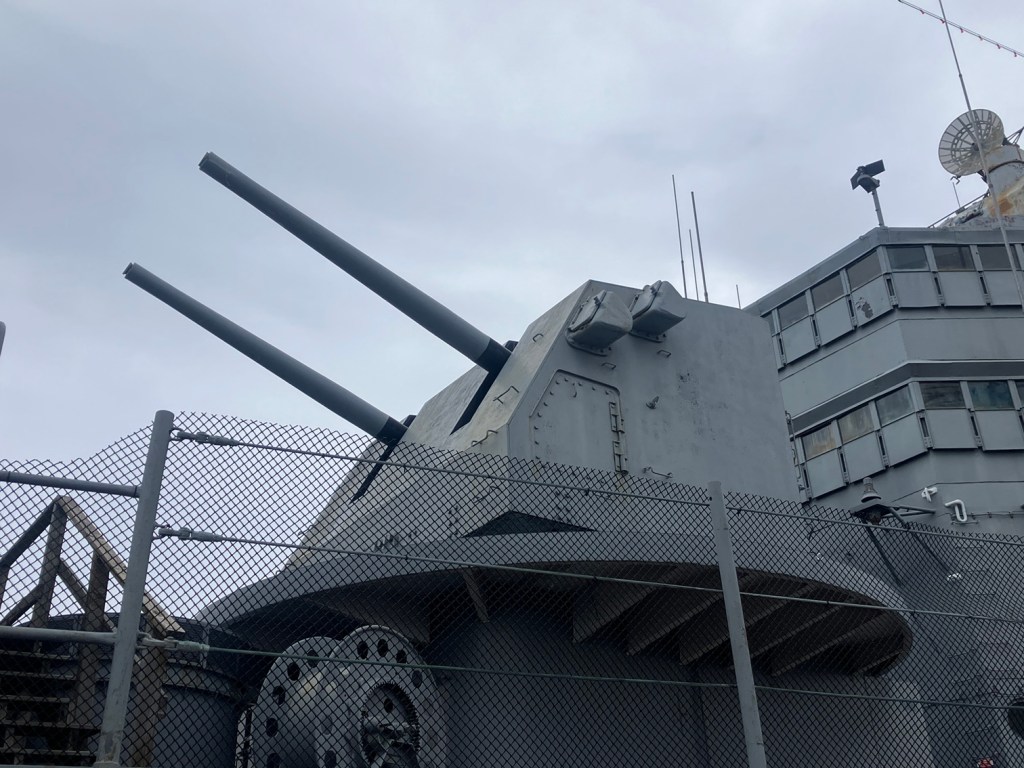
One of Salem’s 5-inch gun mounts. Identical to a battleship’s secondary battery or a Gearing/Sumner-class destroyer’s primary battery.
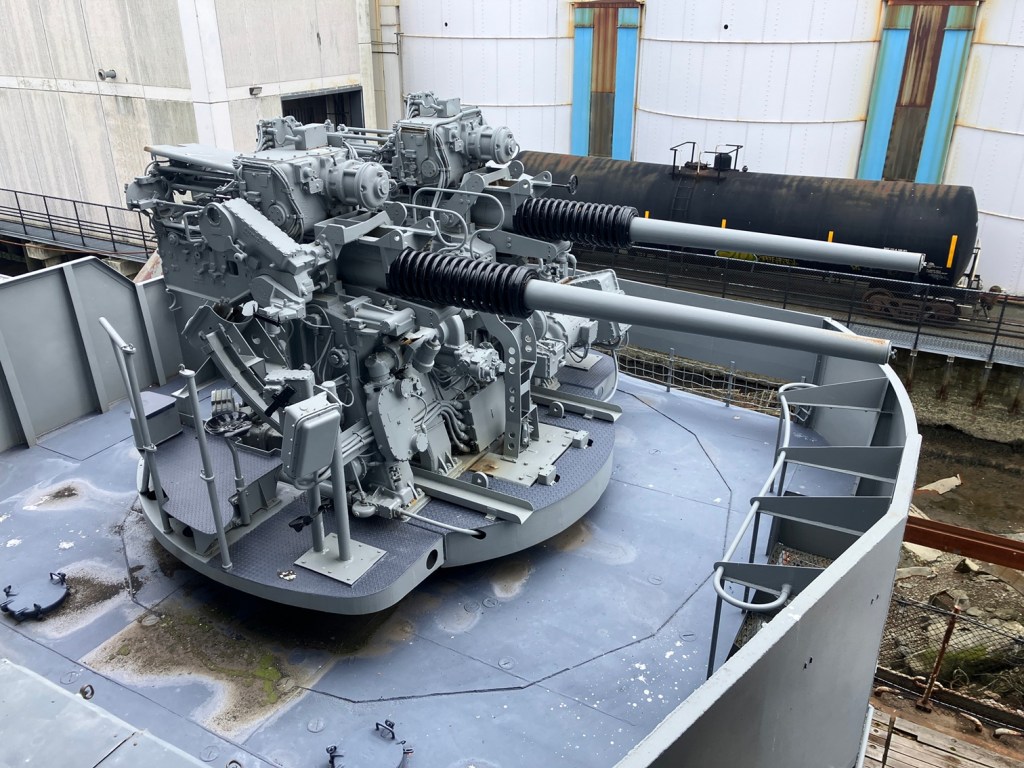
One of Salem’s twin 3-inch gun mounts. This is a post-WWII design that replaced the 40mm Bofors mount so common in WWII.
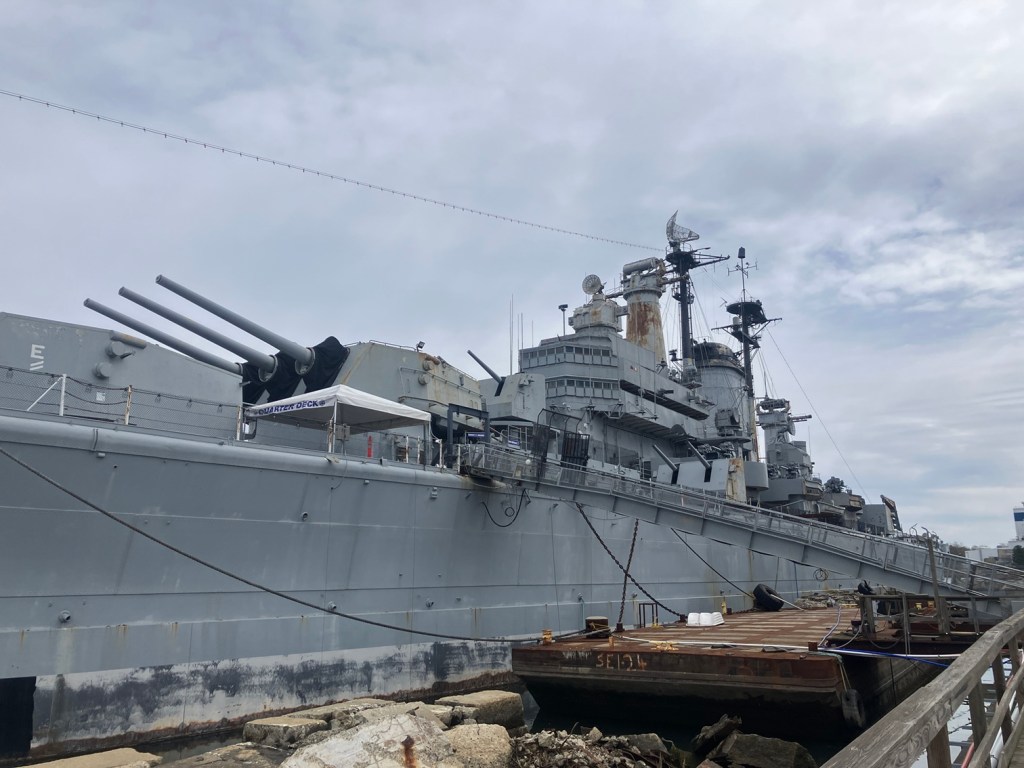
Close up of Salem’s No.2 turret. In 1972 off Vietnam, Salem’s sistership USS Newport News suffered a bore explosion of the center gun. Twenty sailors were killed. Newport News veterans restored Salem’s No.2 turret to honor those fallen shipmates.
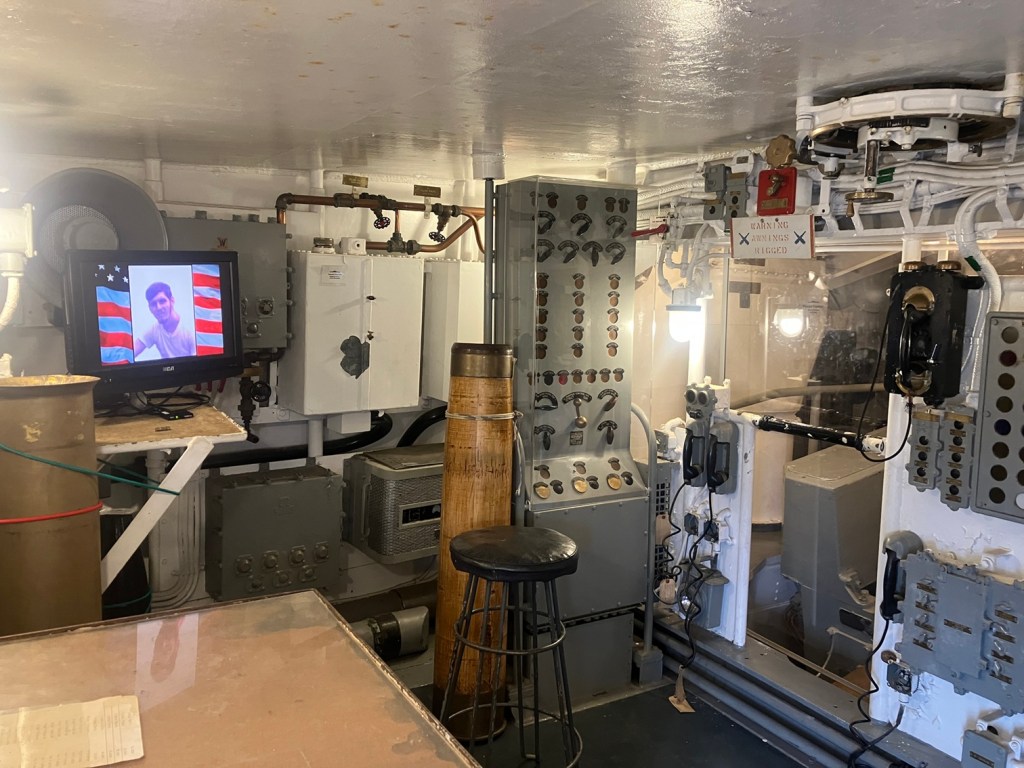
Inside Salem’s restored No.2 turret. The TV on the left runs a loop of the story of the Newport News and its very bad day off Vietnam in 1972.
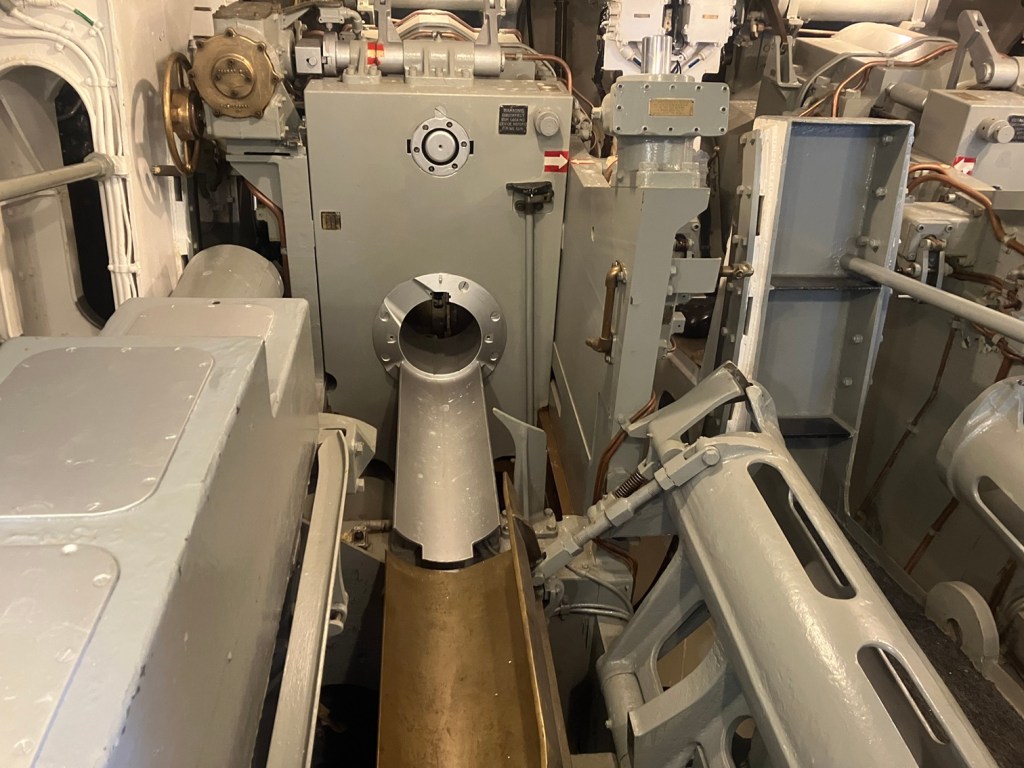
One of the 8” rapid fire breeches. Projectiles and brass power cases were automatically loaded, even when the guns were elevated.
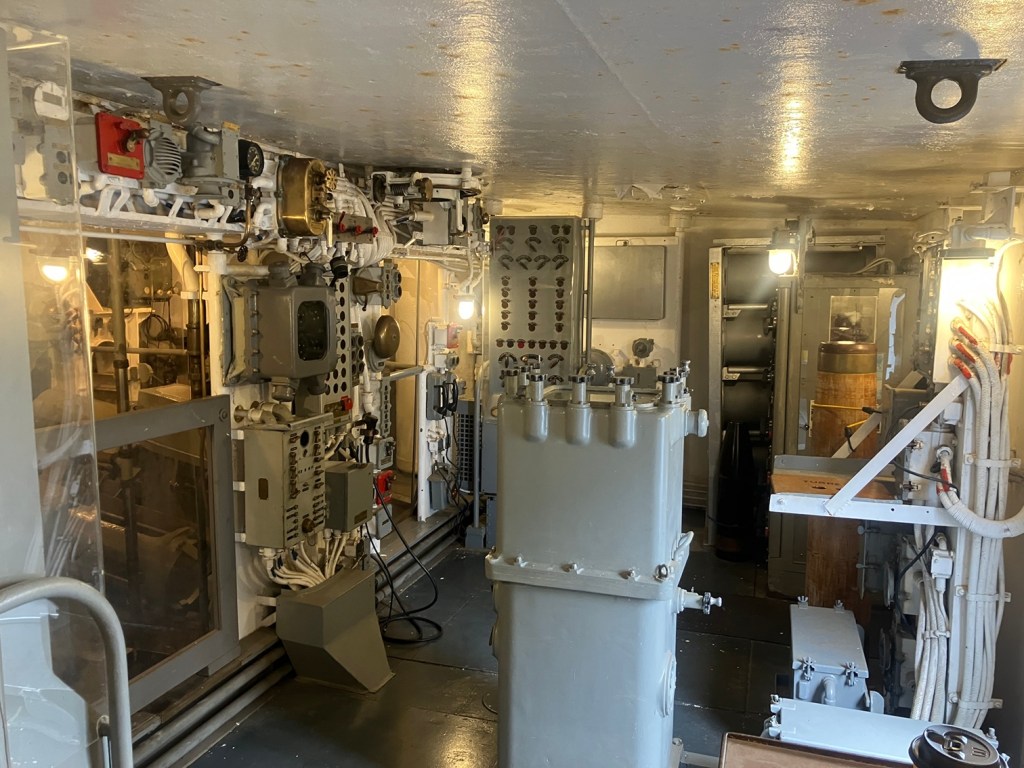
Another view inside the turret. The pedestal in the center is the Rangekeeper, below:
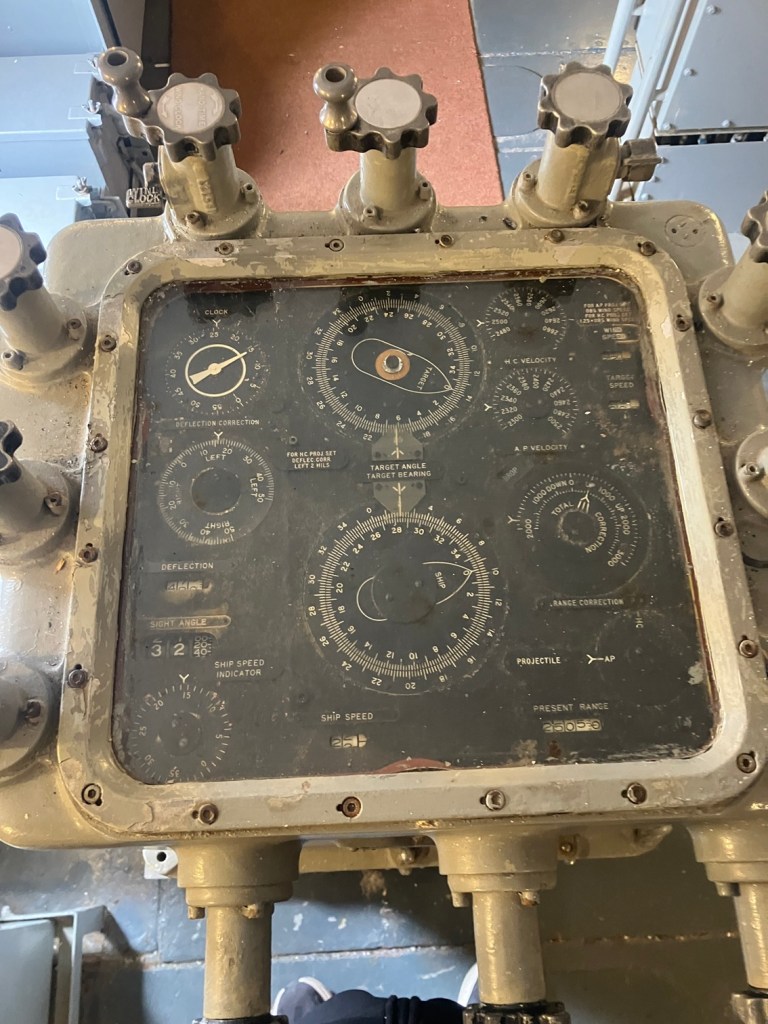
The Rangekeeper “display” – turning the hand cranks to input the ship’s speed and course and target speed and course. It keeps track of the everchanging range and bearing between ship and target and then calculates corrections for range and deflection to hit the target.
No.3 Machinery Room Photos
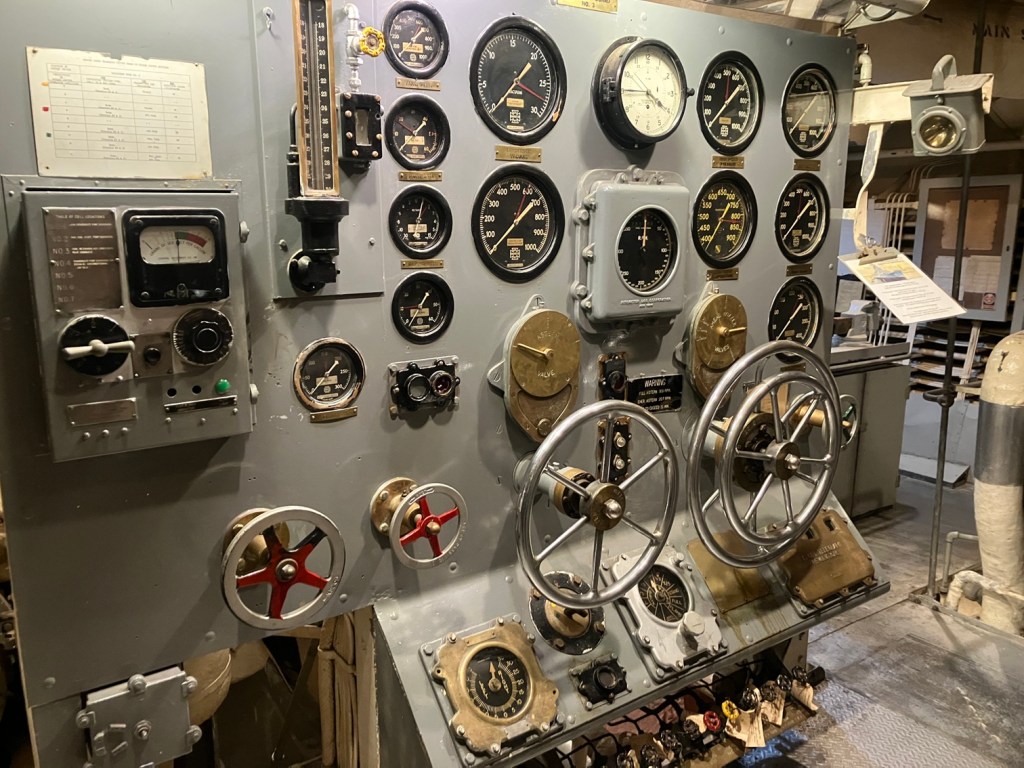
No.3 Machinery Space Control Board – The large handwheels are the ahead and astern throttles for the steam turbine.
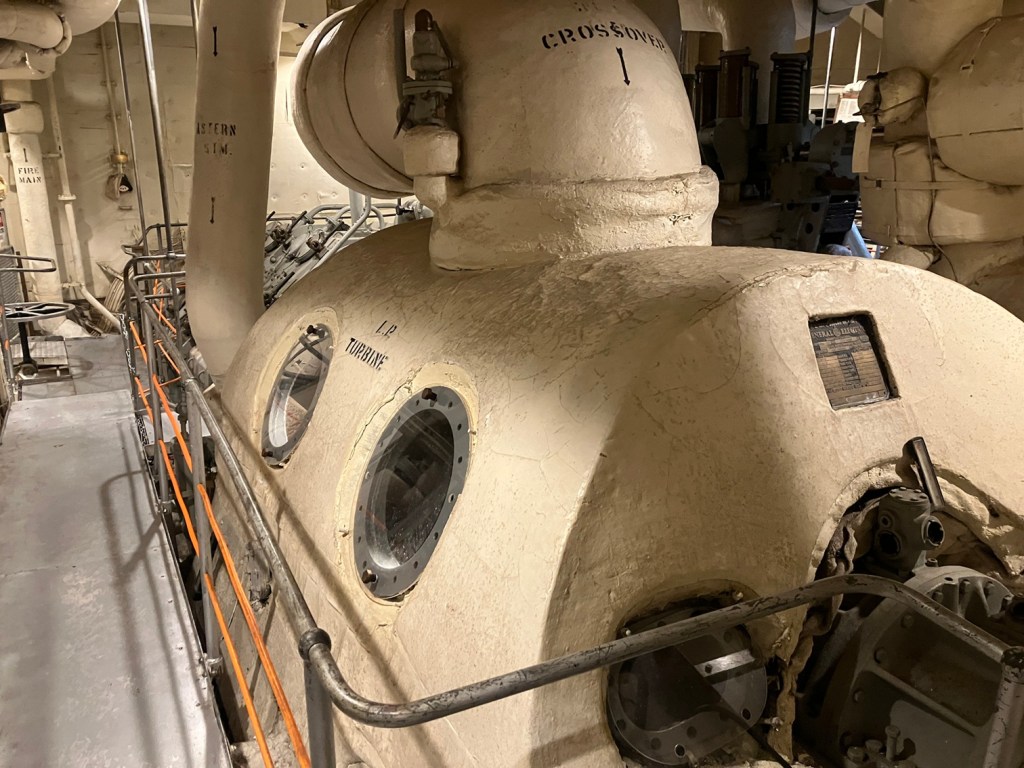
No.3 Low-Pressure Turbine. At maximum power, this turbine produces about half of the power to the No. 3 propeller. Note the Plexiglas windows so that visitors can see the turbine blades inside the casing.
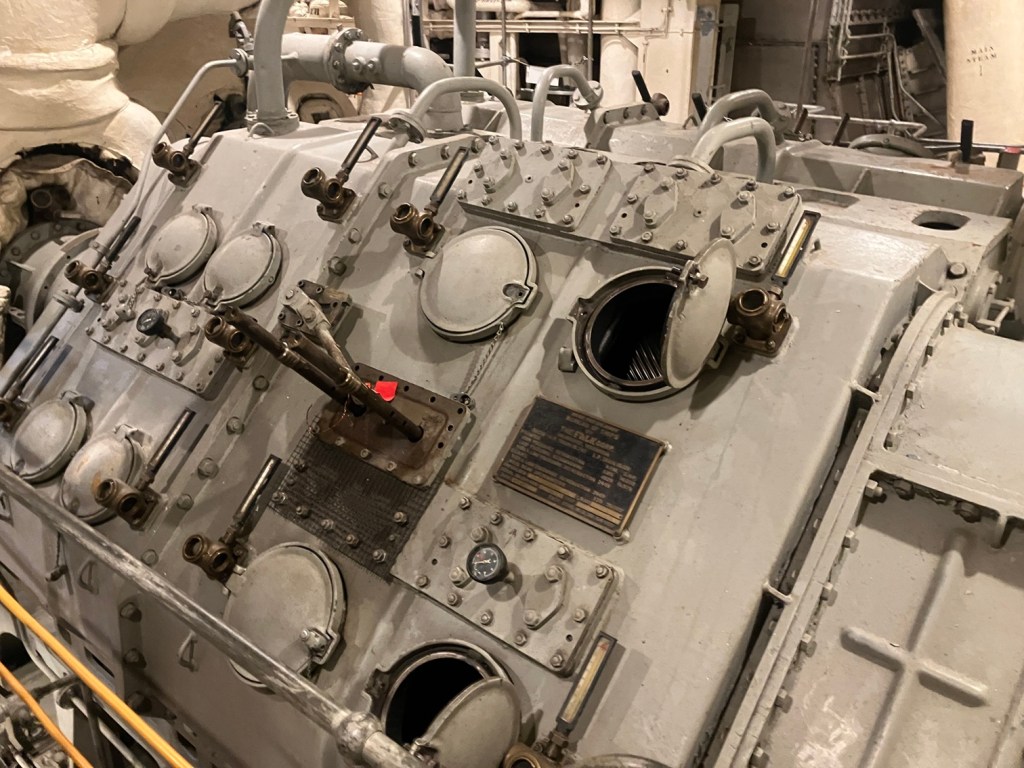
No. 3 Reduction Gear – This translates 6015 rpm of the High-Pressure Turbine and 4829 rpm of the Low-Pressure Turbine to the 320 rpm of the propeller.
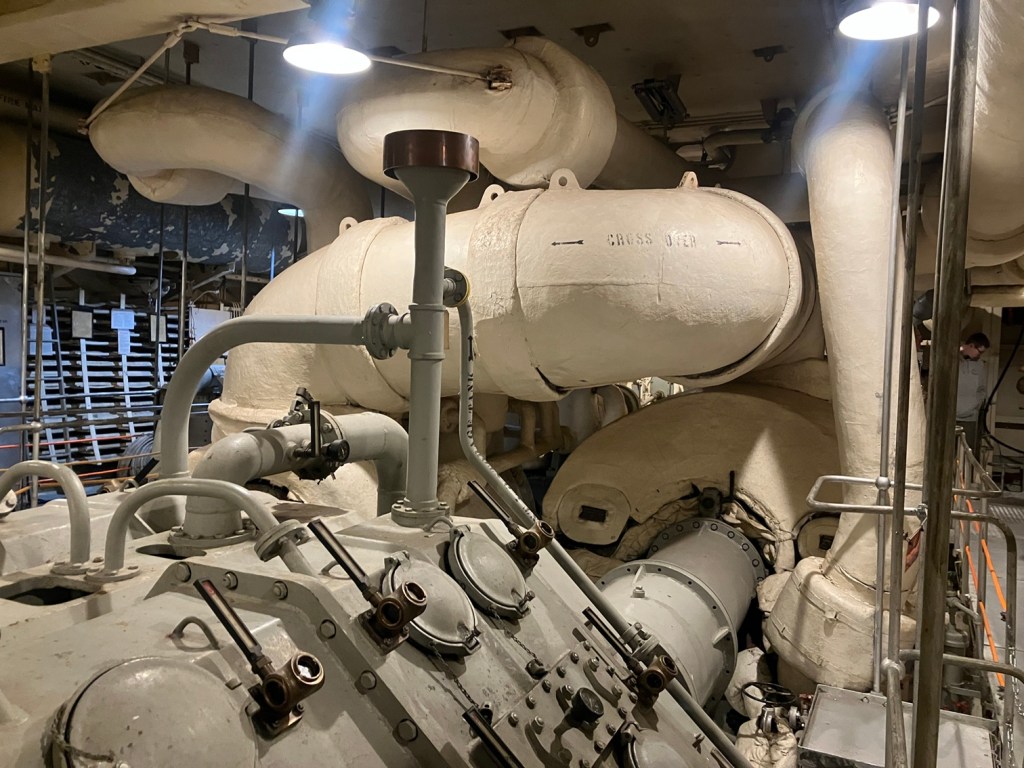
Another view of the reduction gear, the exhaust crossover of the High-Pressure Turbine feeding to the inlet of the Low-Pressure Turbine. This setup is rated for 30,000 horsepower, equivalent to 10 diesel locomotives. Salem has four Machinery Rooms.
And now, time for a shameless plug for USS Salem
Go see Salem! She is open only on weekends from April until November and on Fridays in July and August, as that’s when they can get volunteers. A unique ship, Salem bridges a gap in museum ships between the carriers and battleships at one end of the spectrum and the submarines and destroyers at the other. She’s located in Quincy MA, just south of Boston and is managed by the United States Naval Shipbuilding Museum (https://www.uss-salem.org).
Acknowledgements
I’d like to thank volunteers Aaron, Jeff, Billy and James for their hospitality leading me through Salem. I could have easily spent until sundown exploring their ship. Also, John Epp and Tim Rizzuto of Slater for connecting me with the Salem gang, Chis Williams for strongly encouraging me to visit Salem and Doug Ellison for feeding me with a title for this post and improving my writing skills. Finally, blog master Paul Strubeck for running VDD and providing an outlet for my field explorations.
Jay Boggess
20-May-2026

