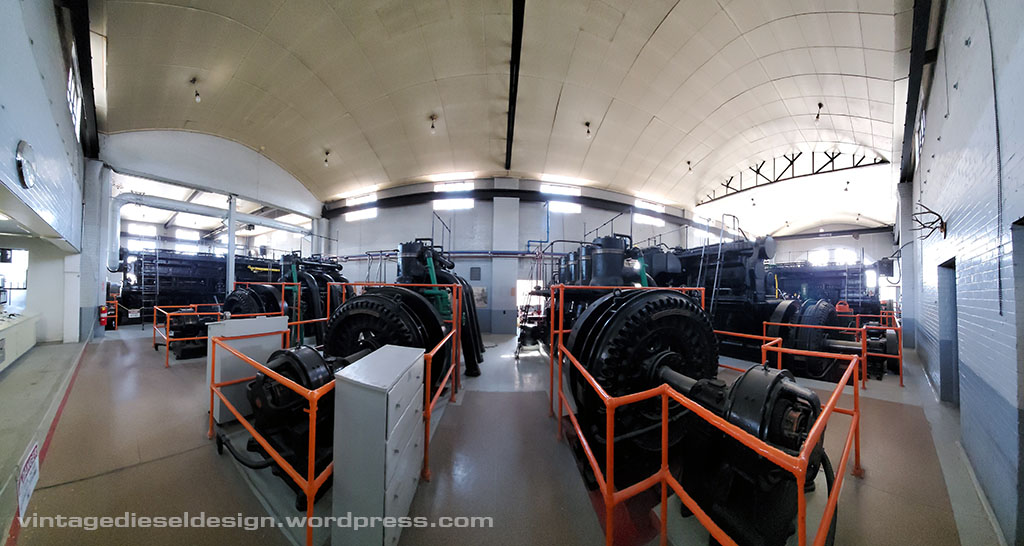
I am way behind in posts as usual, so here we are continuing with the Delta series, this week highlighting the 32E engines, the original engines at the plant.
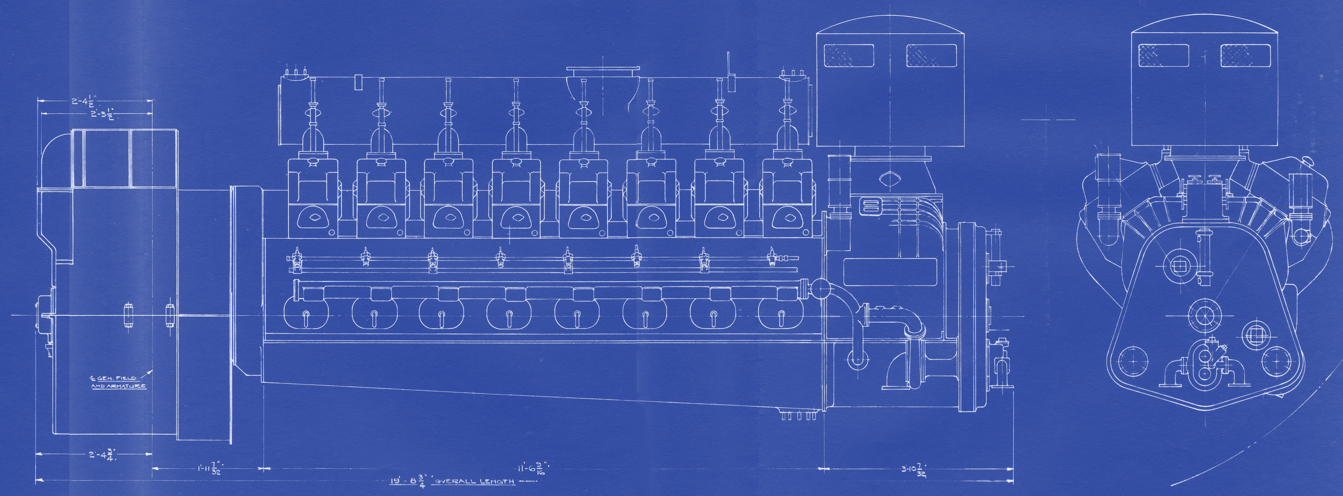
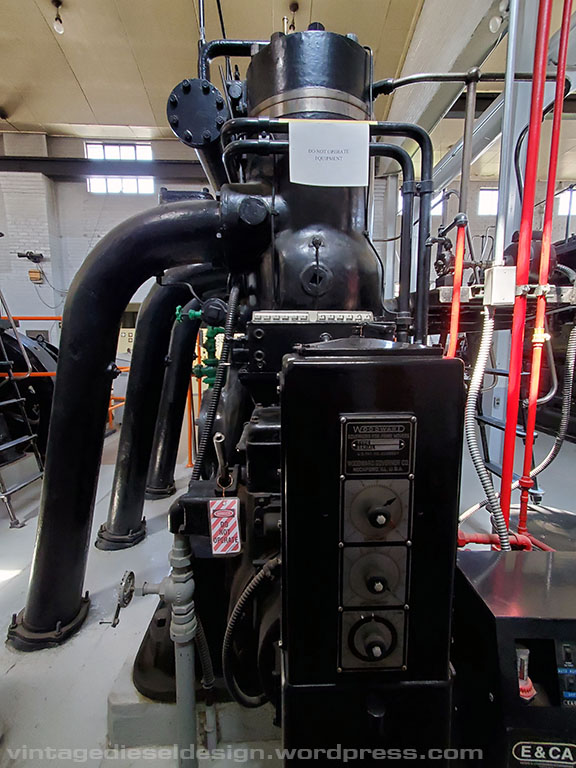
Moving down the line of engines we get to engines #3, 4 and 5, all of which are Fairbanks-Morse 32E14 engines. The 32E was a descendent of the model Y engine, first introduced in 1923, and subsequently went through several upgrades over the years. The engine, offered in two sizes: A 12″x15″ and a 14″x17″. The engines were identical, other then the bore and stroke, with the 12″ offered in 1, 2 and 3 cylinder models, and the larger 14″ in 1, 2, 3, 4, 5 and 6 cylinder options. The 32E engine is a 2 stroke Diesel, and used a unique backflow scavenging, in which on the up stroke of the piston, air is pulled into the crankcase through a simple air valve on the crankcase door, is compressed on the downstroke, and when the piston uncovers the exhaust and intake ports on the liner, the compressed air forces the exhaust out, a very simple and effective method, requiring no camshaft operated valves in the cylinder head. An oil pump kept a force feed lubricator full, which handled the oiling on the cylinder walls, wrist pins and crank pins, as well as keeping a certain oil level maintained at each of the main bearings using a series of drilled passageways. The engine had no water pump of its own, relying on an external pump in the plant. A plunger type fuel pump was operated by a camshaft on the governor drive. The engines originally used a very basic FM flyweight style governor, and later used a Woodward IC unit. The 32 line would become one of the most popular engines of its time, powering numerous rural communities and small business (be it power generation or through a line shaft).
Click on all photos below for a larger version.
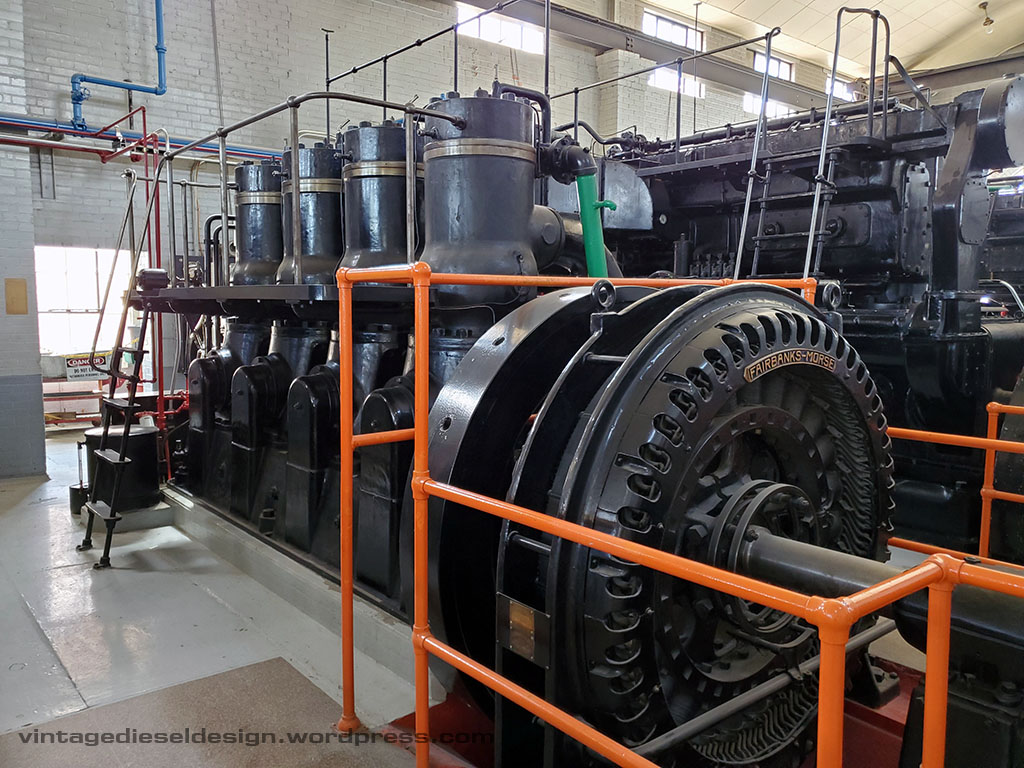
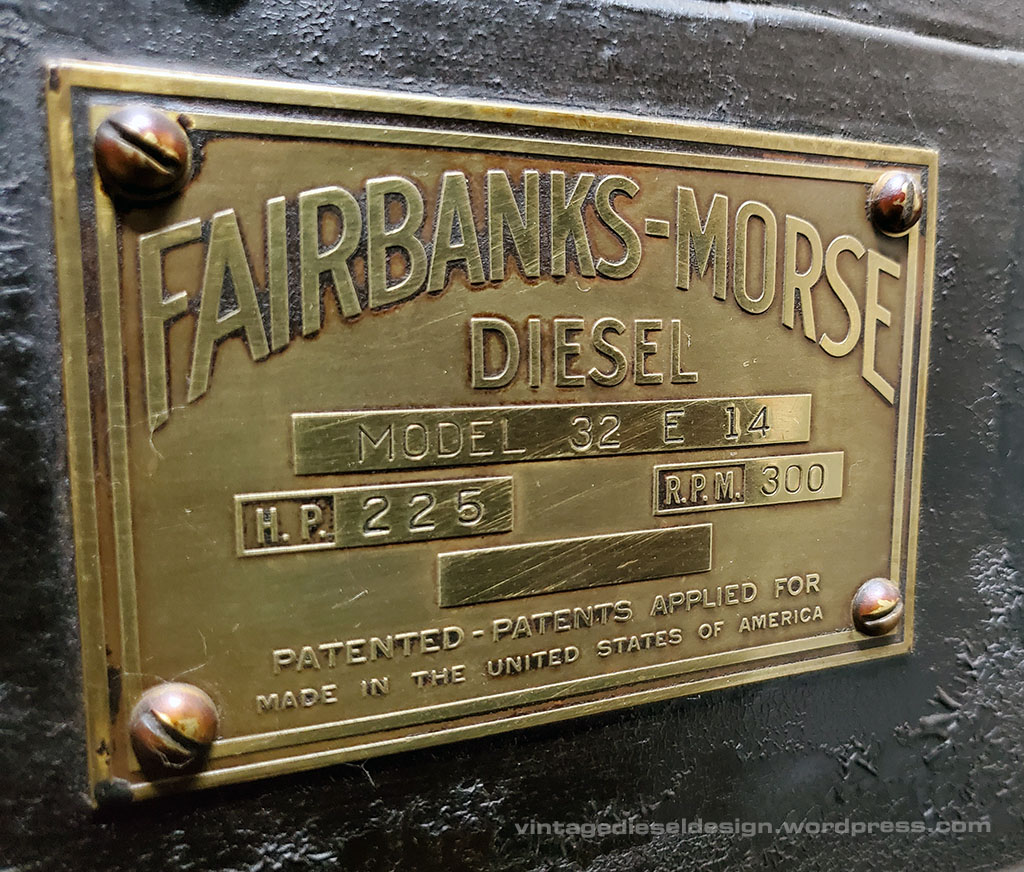
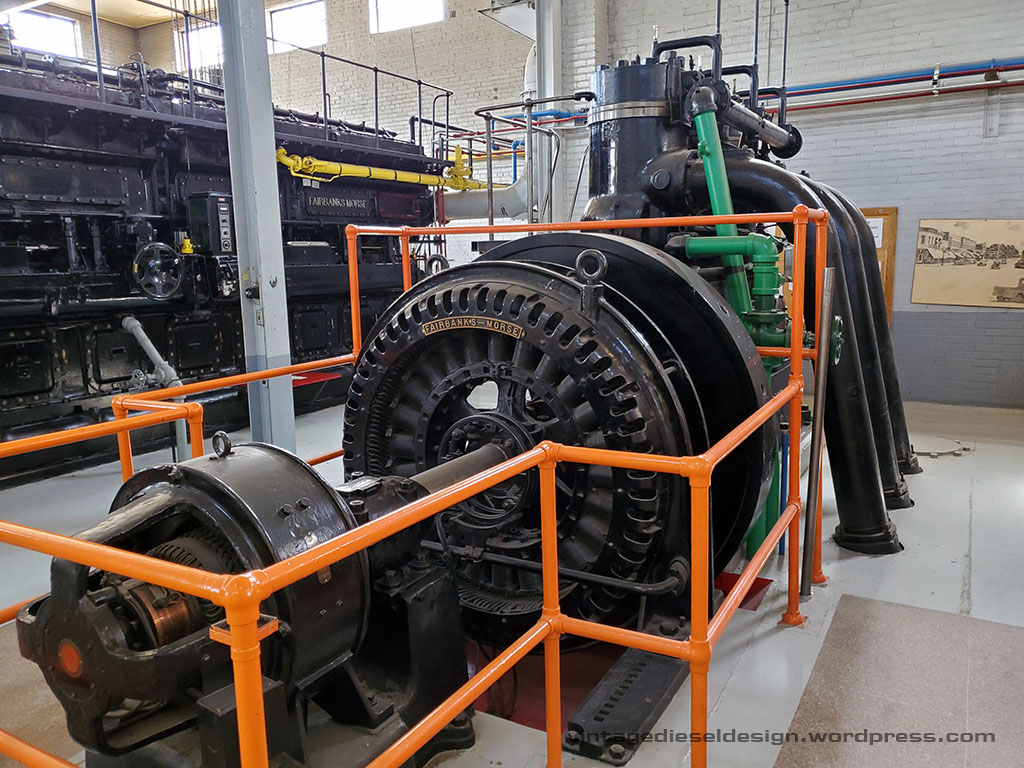
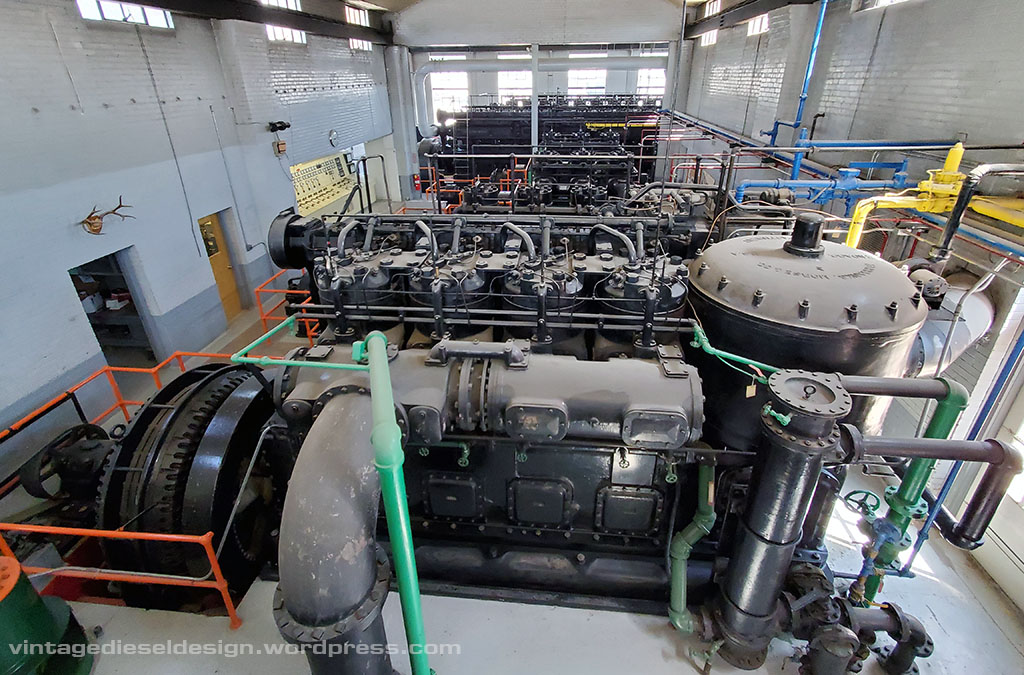
Engine #4 is a 300HP engine at only 300RPM, driving a 148kW alternator.
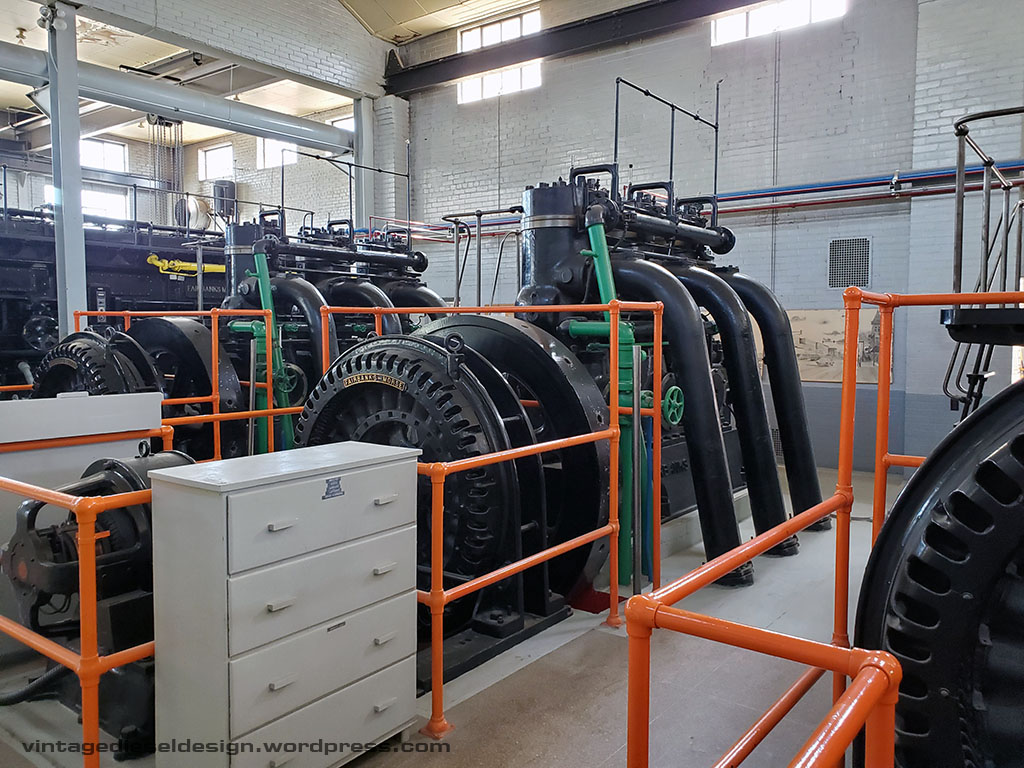
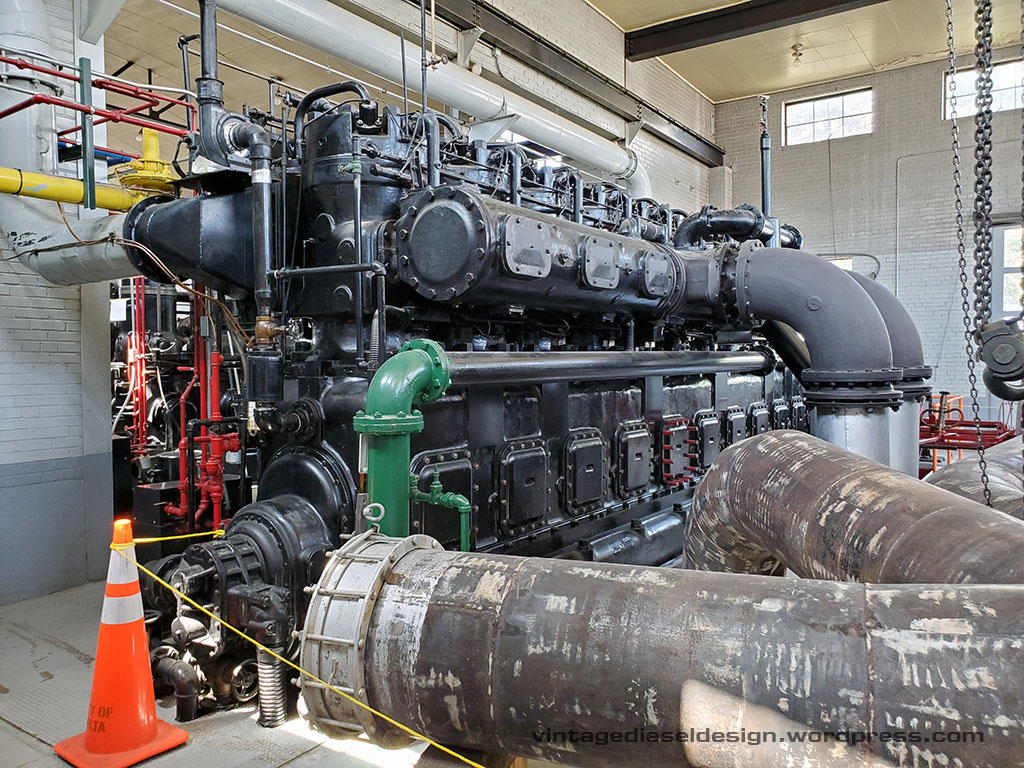
The 32E engine commonly used a very basic exhaust system, where each cylinder simple exhaust into a downward pipe, that tie into a chamber under the floor that runs outside to the muffler.
Engines #4 and 5 are smaller 3 cylinder, 225HP engines. Unfortunately, I did not get the size of the alternators that they drive.
The pipe above the exhaust manifolds is the upper water header. These are extremely basic engines, and while today are tiny in terms of ratings, several are still in service all around the country, not only in their original plants, but many preserved at old engine clubs.
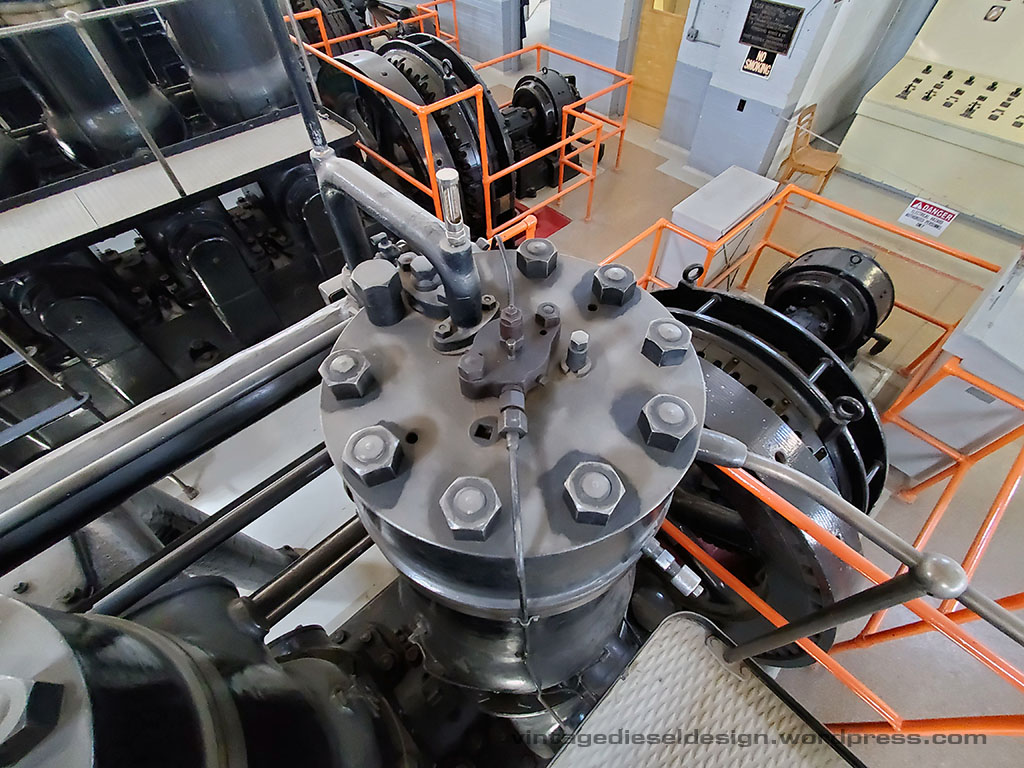
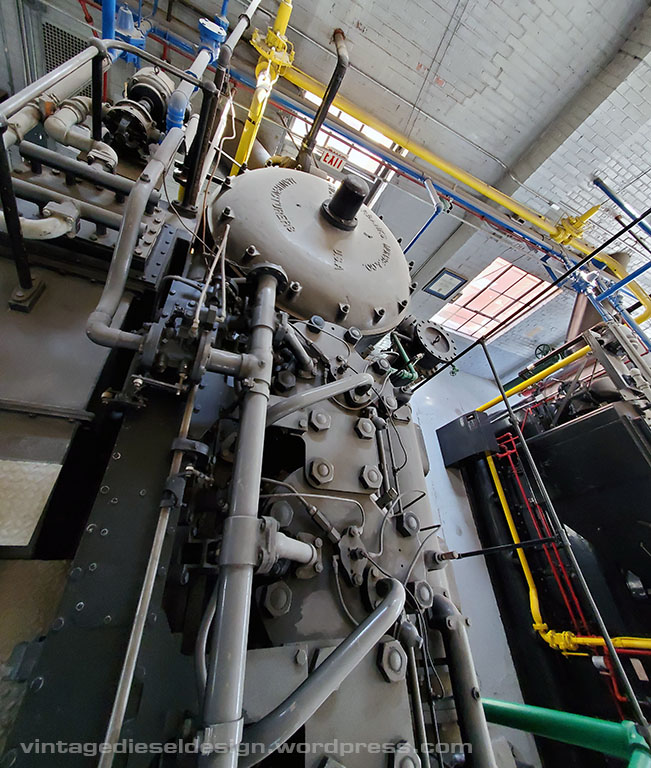
Looking down on the cylinder head, we see the fuel injection nozzle in the center, as well as the jacket water exit.
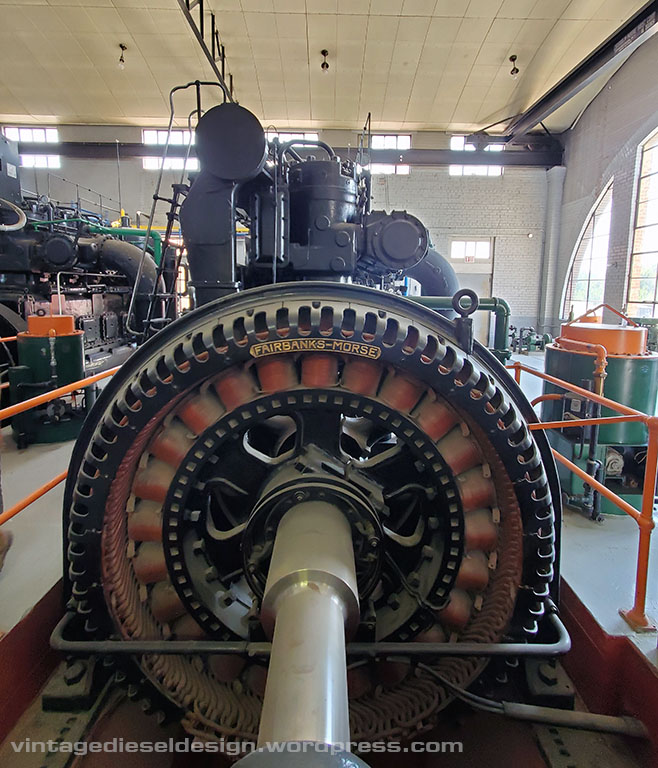
Behind each alternator, the same shaft also turns the excitation generator.
Next week will be the final part of the Delta series, covering the biggest engine in the plant, the 31A18. After that we will start a new series, Historic Boat Profiles, as well as returning to vintage advertising and some great articles which have been in the works for several months behind the scenes.
The Delta plant is home to a trio of F-M model 33 engines. Before we get to those, here is a little background on the Model 33 engine.
The Model 33 engine was the next model in line after the 32 series, and was introduced around 1930. The engine was ultimately offered in 3 bore sizes – a 12″, 14″ and 16″. The engine was FM’s first pump scavenged engine, moving up from the older crankcase scavenged 32. Like the predecessor, these were rather simple engines. No intake or exhaust valves, mechanical fuel injection (in a time when air injection was still somewhat common) and a split lubrication system using both an engine driven pressure pump and a force feed mechanical lubricator.
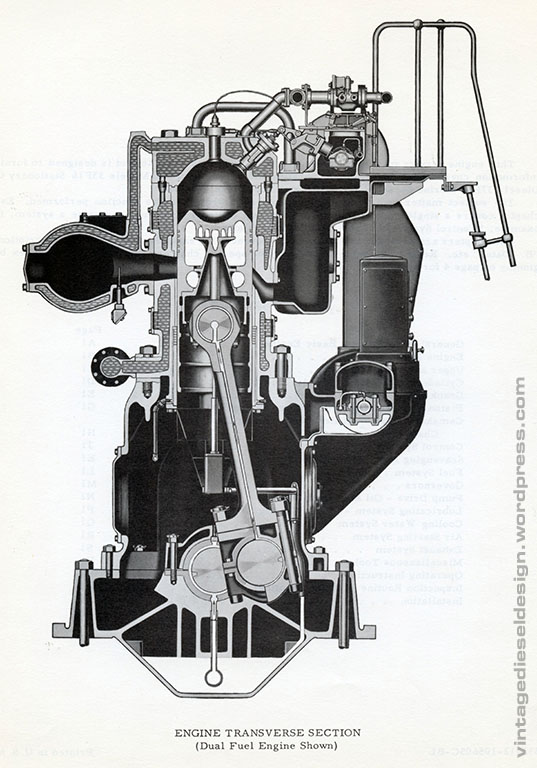
In the case of this post, we will be describing the 16″ bore model, which has a 20″ stroke rated at 300RPM. FM offered these engines in 4, 5, 6, 7, 8 and 10 cylinder sizes. The engine was available with a dual fuel option, meaning it could run on Diesel, or Natural Gas with Diesel acting as a pilot fuel. A second upper camshaft drives a series of gas valves at each cylinder head. The Delta plant has 3 of these engines:
Unfortunately I did not ask as to the chronological history as to just when these engines were installed.
Lets start at Engine #1 – Click on images for larger versions
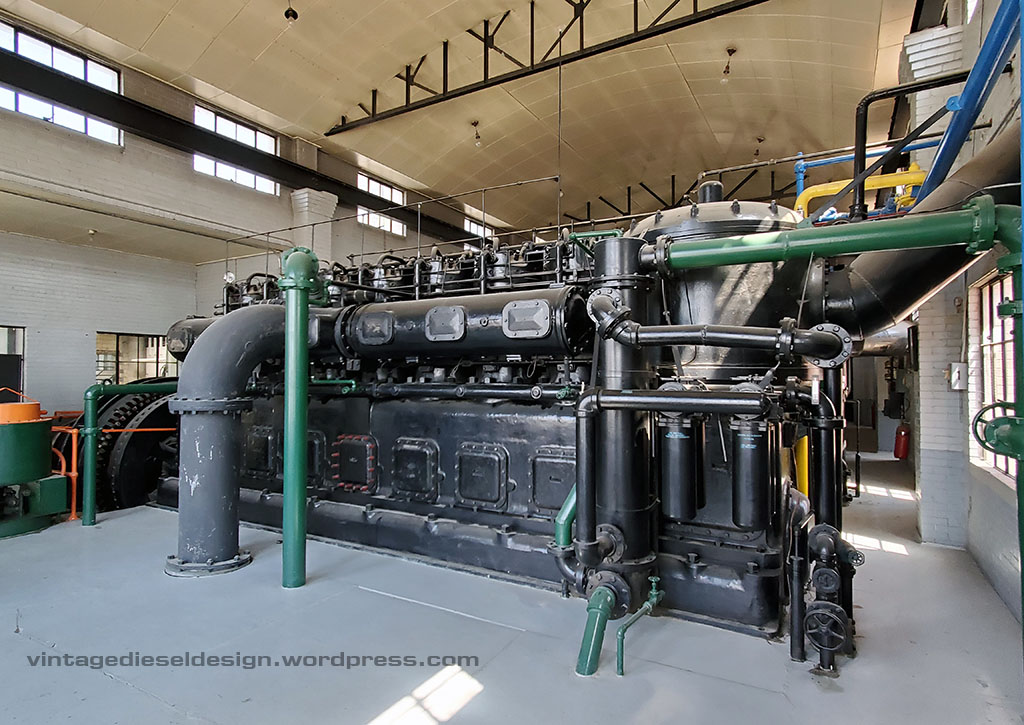
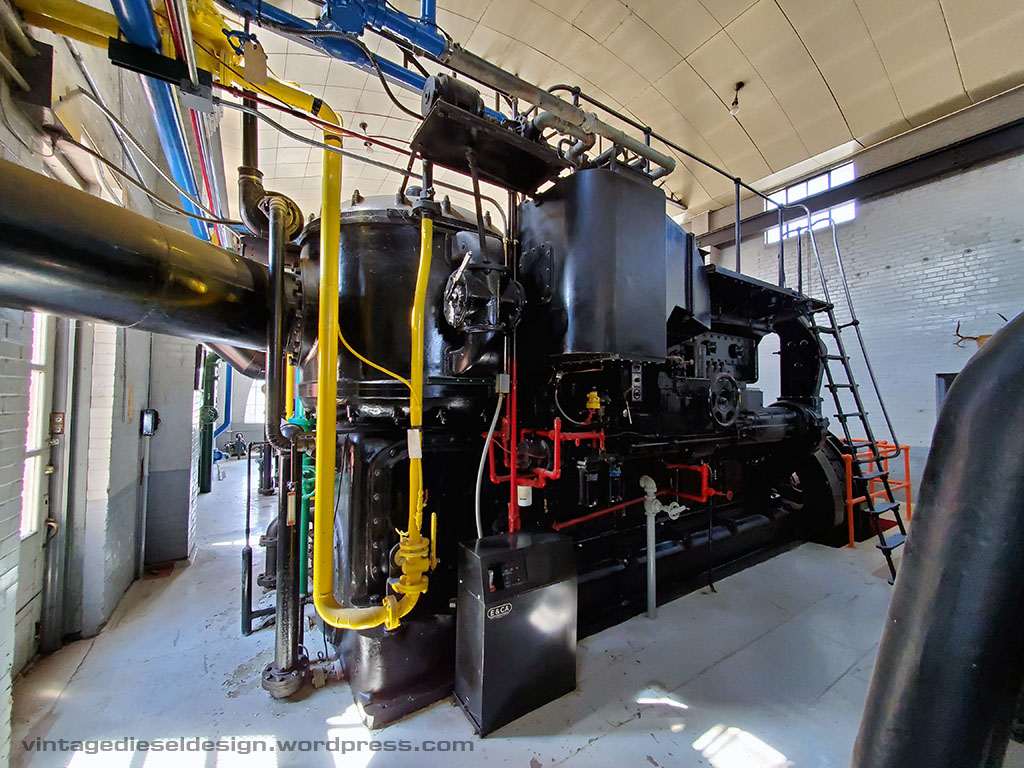
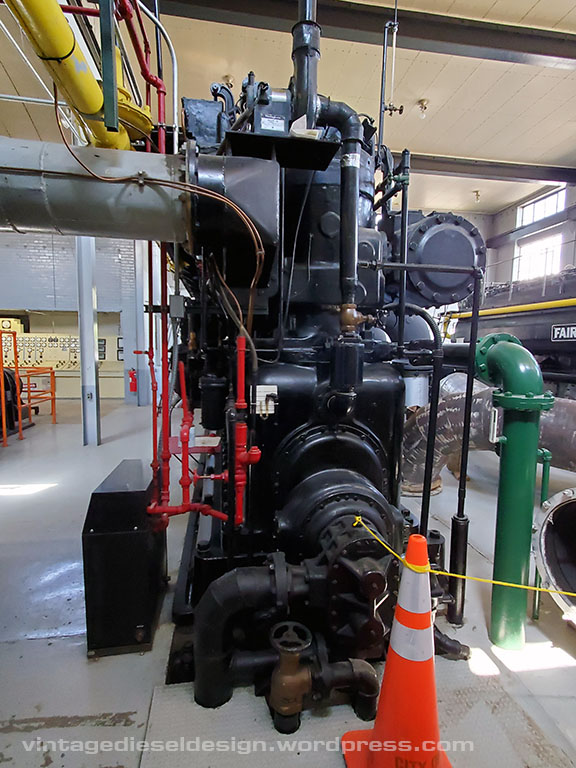
Looking at #1, we see the main exhaust leading into the floor, where it then heads outside into the muffler. Mounted on the side of the scavenging pump is the lube oil heat exchanger, as well as a set of oil strainers.
On the side of the engine is the starting hand wheel, fuel injection pumps, and the Woodward governor.
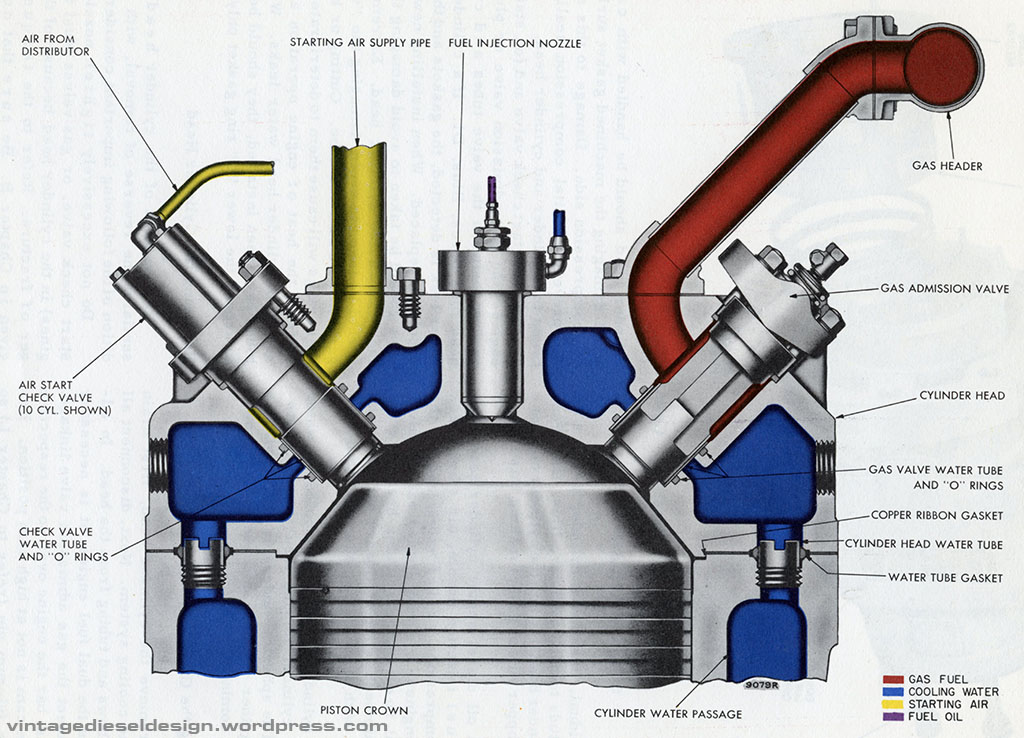
On the left side is the Natural Gas header pipe, with the starting air pipe being the other large pipe going into the head. In the center is the fuel injection nozzle.
A look at the cylinder head cross section.
Top of the scavenging pump.
Control side of the engine. I honestly do not know what the additional box is between the scavenging pump and the intake belt is, but I do believe it is an intercooler of sort. I have not seen this on any other FM engine, and I did not notice it to ask when I was there. I imagine it has to do with emissions.
The engine drives an 835kW AC Alternator. F-M supplied all of the electrical gear to the plant as well.
Straight on side view of the engine. This engine in marine form was known as the model 37F16, a direct reversible engine common to tugboats in the 1950’s. A final look at Engine #1.
Engine #2
Engine #2 is a small, 4 cylinder 33D16 engine. F-M would upgrade the letter designation as the engines advanced through the years, thus this is the older of the trio, being a “D” engine.
Other then being short 2 cylinders, the engine is exactly the same as #1 above.
What is interesting is the additional plates between the cylinder heads. I have never seen these on a marine engine.
While I thought I thought I got photos of everything, I missed getting a photo of several data plates, thus I do not know how large the Alternator is that this engine drives.
Engine # 6
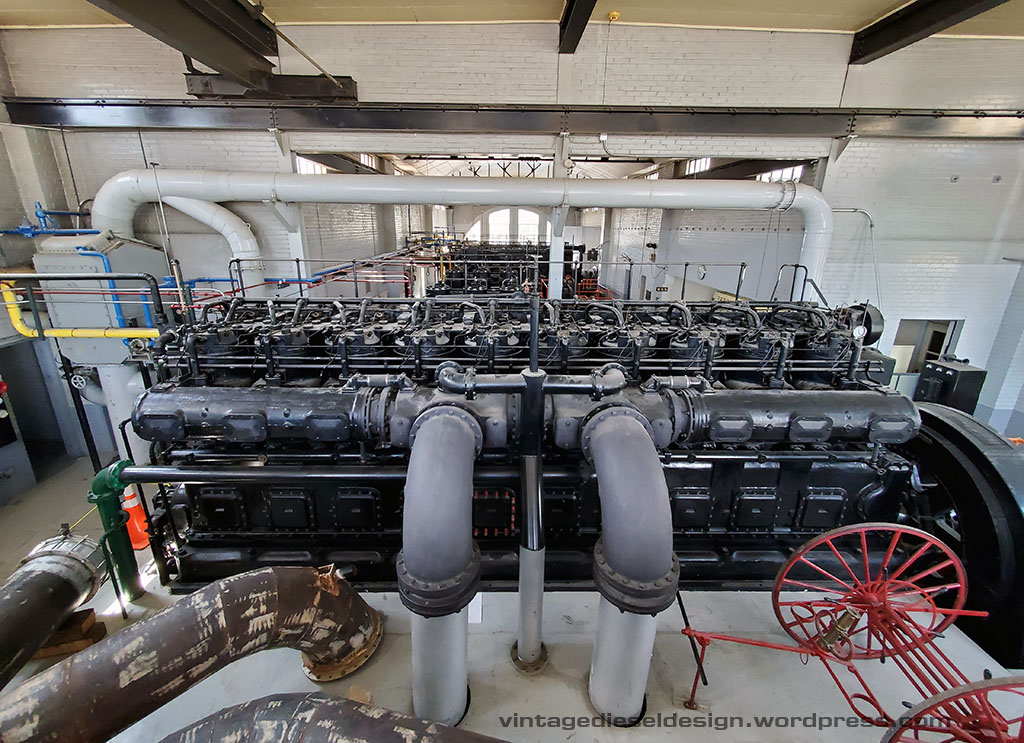
Engine #6 at Delta is the 2nd largest engine of the plant, rated at 2,000HP.
Notice anything missing? No scavenging pump! The 10 cylinder model utilized a motor driven centrifugal blower, mounted externally. We will discuss these more when we get to the 31A18.On the front of the engine is the main lube oil pump. Again, standard controls like the previous engines. Note that this one is the opposite rotation though. The gauge board. Note the feed lines coming up from the floor. The exhaust side of the engine. Note the large grey pipe in the background – this is the scavenging air intake. This engine drives a 1200kW alternator, at 60 cycles.
In the next part we will go over the trio of 32E14 engines at the plant.
This week’s column is by Jay Boggess. Next week we will return to the Delta Municipal Power Plant for Part II.
Pretty quickly, early on – when it comes to diesel engines, you hear the word “Roots Blower”. But who IS Roots? Today in the era of Wikipedia, this is an easy question to answer, but not when I was a kid.
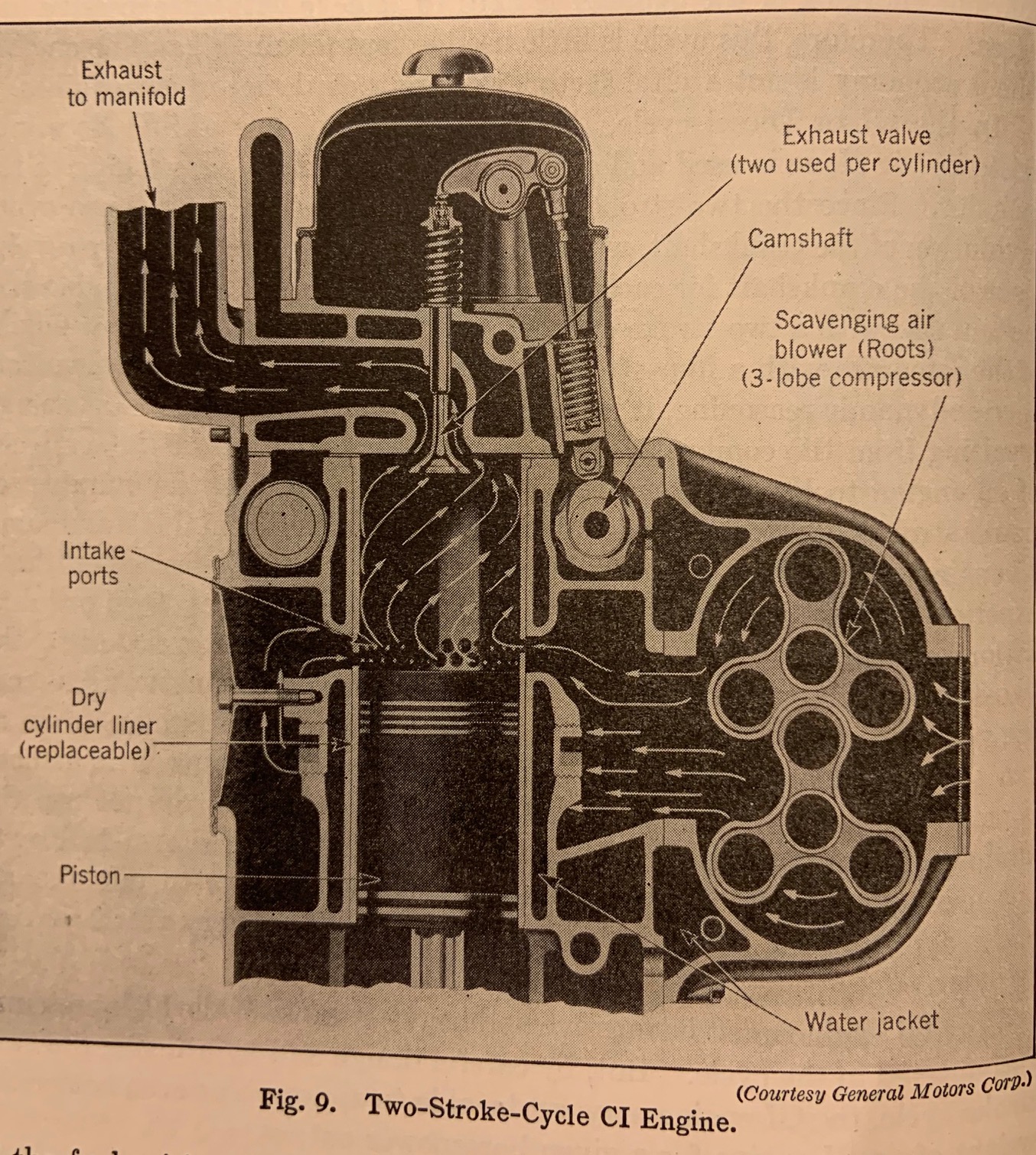
I’d first heard of the “GMC Roots Blower” associated with supercharged dragsters & hot rods. Later, while reading my father’s 1944 textbook “Internal Combustion Engines – Analysis & Practice”, I discovered a cutaway section of the General Motors 2-stoke CI (compression ignition or diesel) engine, below:
Later, I learned that Cleveland Diesel, Fairbanks-Morse and Electro Motive Division diesel engines all had Roots Blowers, but no one ever explained why it was called the Roots Blower.
In 2003, a random visit to the History Colorado Museum in Denver came across this artifact:
Click for larger – History Colorado Museum – Jay Boggess photo – 2003
A mine ventilation blower for ventilating underground hard-rock mines, built by the P.H. & F.M. Roots Company, Connersville, Indiana. The placard listed a date, but the low-res digital pics of the era do not allow me to zoom in – other sources point to the mid 1880’s or so.
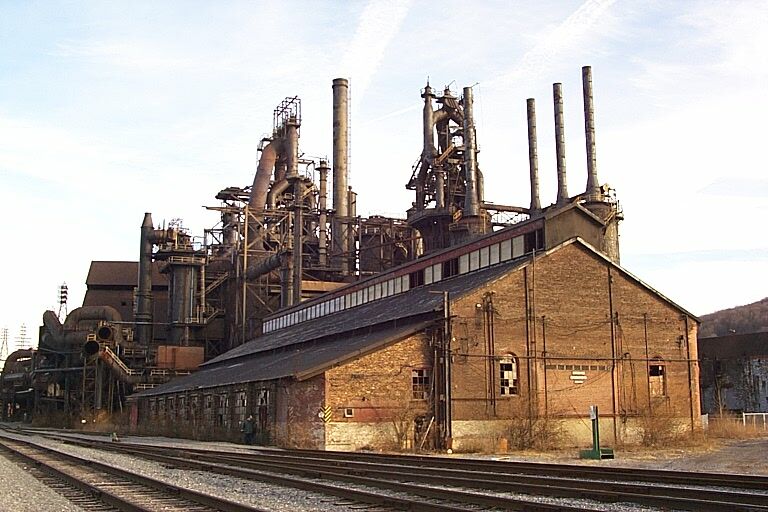
Another datapoint came from another random visit, this time to the nearly preserved Bethlehem Steel blast furnaces in Bethlehem, PA (thanks to my former EMD colleague Mark Duve, who insisted we stop).
Click for larger – Bethlehem Steel blast furnaces – Bethlehem, PA 2004 – Jay Boggess photo
The building in the foreground of the photo was unlocked, we ventured inside and discovered these:
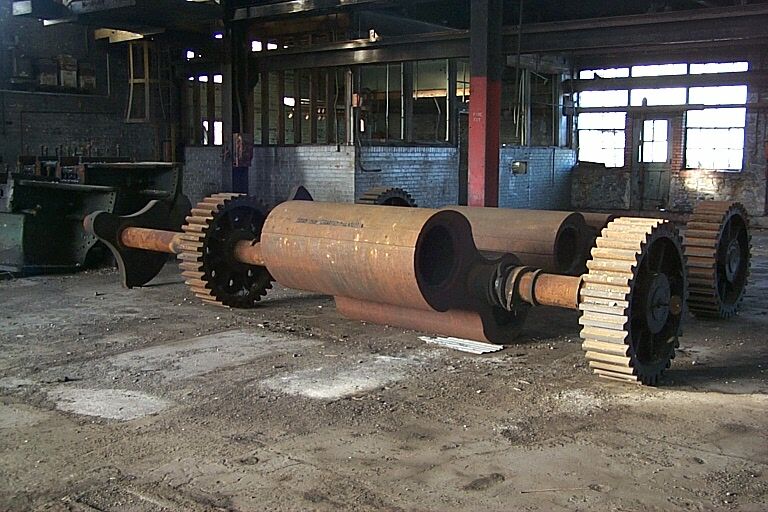
Bethlehem Steel blast furnace blower rotors – Bethlehem, PA 2004 – Jay Boggess photo
Very distinctive, two-lobed Roots Blower rotors – look carefully and you will see counter-weighted steam engine eccentrics on the end of the rotors. Inside the same building were the matching horizontal steam engine cylinders for driving these rotors (I took photos but the passage of 16 years has lost those). I later learned that blast furnace blast supply was one of the first uses of Roots Blowers.
So who were P.H. & F.M. Roots? Wikipedia points to a 1931 book, “Indiana One Hundred And Fifty Years of American Development” which provides most of the answers. Philander Higley and Francis Marion Roots were brothers. Francis was the youngest brother, born in 1824, went searching for gold in California in 1849, came home in 1850 and started working with his brother Philander in manufacturing. They patented the “Roots Positive Blast Blower” in 1866. Francis passed away in 1889, Philander passed in 1879. Their company was purchased by Dresser Industries in 1931, and renamed the Roots-Connersville Blower Company. In WWII, they produced low-pressure blowers for blowing ballast tanks in U.S. Submarines, as well as centrifugal blowers for various low-pressure/ high-volume uses, eventually submerged in the vast Dresser product line.
Roots Blower Applications:
Submarine Ballast Tank Blower:
Click for larger – collection of the Bowfin Museum, Pearl Harbor, HI – Jay Boggess photo
Roots blower on USS Bowfin, Pearl Harbor, HI – Jay Boggess photo
This is listed on the drawing as a 1600 CFM blower, designed and built by the Roots-Connersville Blower Corporation, Connersville, Indiana. The driving motor is a 1750 RPM, 90 horsepower, intermittent-duty DC motor.
To digress extensively – WWII submarines had two systems to blow their ballast tanks – 3000-PSI stored compressed air reduced down to 600 PSI to start the surfacing process and 10-PSI low pressure air supplied by blowers to finish the job once a submarine surfaced. It was this low-pressure job that either Roots Blowers or centrifugal blowers were utilized. Another interesting use was that when a sub is submerged, various tanks are vented inboard the sub, raising the internal pressure of the boat several PSI above atmospheric pressure. If the hatch were immediately opened, the rush of air was known to launch sailors overboard. Instead, the hatch between the conning tower and control room would be shut, the boat surfaced and the bridge hatch opened. While the captain checked to see if the coast was clear, the low-pressure blower is started finishing the blow of the ballast tanks and reducing the excess air pressure inside the rest of the boat.
Fairbanks-Morse Opposed Piston 38D Engine:
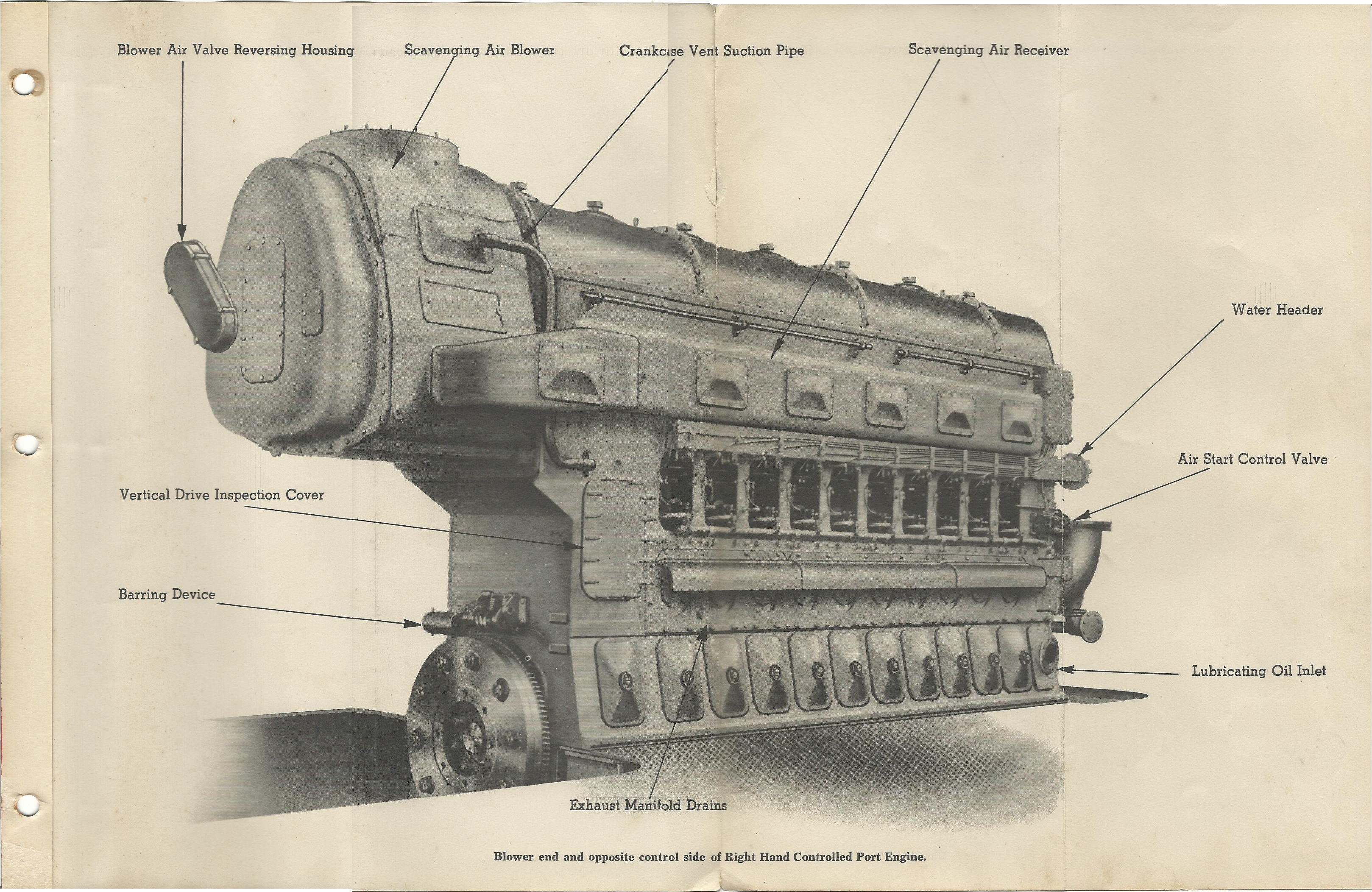
Click for larger – From the Fairbanks-Morse LSM 38D 8 1/8 Manual – collection of Paul Strubeck
The WWII era FM 38D manual does not use the word “Roots Blower” but instead refers to it as a “Scavenging Air Blower”. The FM 38D blower spins at 1450 rpm and provides 6000 CFM at about 2 to 4 PSI. The Direct Reversing version of this engine used a set of linkage and air valves on the blower in order to direct the air in the proper direction when the engine is running astern, thus the blower is running backwards.
General Motors Cleveland Diesel Engine Division (CDED) 278A Marine Diesel:
Cleveland Diesel Engine Division Diagrams – Click for larger
Click for larger – Cleveland Diesel Engine Division Photo – Collection of Jay Boggess
Cleveland Diesel mounted their single Roots Blower on the front of their engine, essentially shortening or lengthening the blower to fit the air flow of the 6, 8, 12- or 16-cylinder models of the 278A, as the photos and following table illustrates.
Cleveland Diesel Engine Division Photo – Collection of Scott D. Zelinka
Cleveland Diesel Engine Division Photo – Collection of Scott D. Zelinka
Thanks to Scott Zelinka for the above Cleveland photos showing a pair of the Spiral rotors used by CDED. The clearances between the rotors is set at .024″ (on the 12 and 16 Cyl) and .018″ on the smaller engines. I find it downright amazing that something with this complex of a shape – and interlocking none the less, could be machined so exacting by hand, and mass produced at that, long before computers and CNC.
With the new Cleveland Diesel 498 engine, a small Roots blower was used in conjunction with the exhaust driven turbocharger to provide for lower RPM scavenging. EMD would solve this issue with their own turbocharger on the 567. A centrifugal clutch drives the blower off of the timing gears that would disengage at a certain RPM and allow the turbocharger to freewheel.
Cleveland 498 diagram
Click for larger – The blower is in the same location as the 278A series, behind the intercooler here.
EMD 567/645 Roots Blown Engines
Electro-Motive answered the Roots Blower question in a totally different way than its GM sister division CDED. EMD also had four different engines to support: 6 – 8 – 12 – 16 cylinders. EMD picked one design of blower, then used that one blower for the 6 and 8 cylinders model and a pair of blowers for the 12 and 16 cylinders, changing the blower gear ratio (and blower RPM) between 6 and 8, and 12 and 16 engines, gaining economics of scale and fewer replacement parts to support.
Below is the 8-cylinder 567 model:
Click for larger – Cleveland Diesel engine manual photo – WWII Army ST tug – collection of Jay Boggess
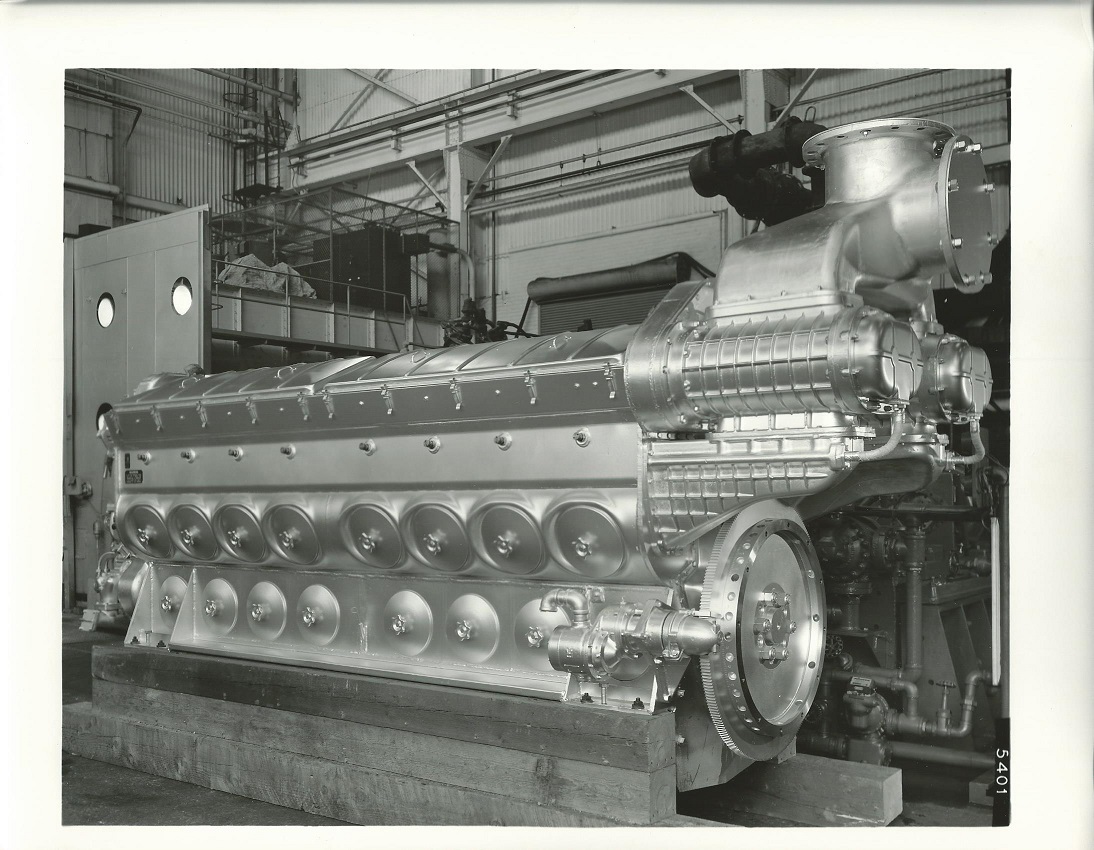
And here is the mid-1950’s 16-567C model. Note the directional air intake, a sign that this engine was likely built for stationary power generation.
Click for larger – Cleveland Diesel Engine Division Photo – Jay Boggess Collection
The 16-567C pic illustrates another clever design feature that EMD incorporated. By placing the Roots Blowers high above the crankshaft (driven by the engine’s camshaft drives), EMD designers provided a niche for a generator underneath the blowers, saving overall length of the engine/generator and thus overall length of the locomotive.
These are just a few short uses of the Roots Blower – several other manufacturers have used them, and coming in one of the next parts on the Delta Municipal Power Plant, we will see a giant Roots-Connersville centrifugal blower used to feed the big 31A18 engine. Roots Blowers are common on many different industrial uses outside of engines.
While many thousands of Roots Blowers have been built, I believe their day in the sun has passed. From my days at the Alaska Railroad, EPA emissions regulations were starting to close in on the Roots Blown engine. I do not know the specifics, but the GP38-2s AkRR owned had to be de-tuned for better emissions, which gave lower fuel economy. And even then, the EPA wasn’t very happy about it (that is, the EPA Tier 0/1/2/3 regulations only allowed de-tuning for existing engines and would not be applicable to a new Roots-blown EMD engine).
So, when you hear an older EMD go by, be it a GP7 or GP9 or 38, think of Philander Higley and Francis Marion Roots and what they invented 150 years ago.
Sidebar – Roots Blower Or Roots Supercharger?
Blogmaster Paul Strubeck has uncovered somewhat heated discussions between the terms “Roots Blower” and “Roots Supercharger”. Both terms can be correct – I will attempt to clarify, but I will preface my comments that I am an electrical engineer by training / experience and only an “armchair” engine guy (from hanging around my father and the many, many gear-heads at Electro-Motive over 22 years).
Supercharging is defined as jamming more air than atmospheric pressure into each cylinder before compression by the piston begins. My 1944 internal combustion textbook notes by providing some form of air pump, you can get more power for the same engine weight or thin-air compensation for an aircraft engine at high altitude.
In the two-cycle diesel engines (FM, Detroit Diesel, CDED, EMD), the Roots Blower acts primarily to scavenge exhaust gases from the cylinder after each power stroke. If the exhaust valves close before intake ports (in the case of a GM 2-cycle diesel), then some supercharging will take place. But the primary purpose is to get exhaust gases out.
If the air pump is driven by a turbine attached to the exhaust manifold, then the arrangement is termed a turbocharger. The turbocharged EMD 645E3 engine provides 3000 THP in the GP40/SD40, while the Roots-blown 645E engine of the GP38 provides only 2000 THP. The Wright radial engine of the Boeing B-17 of WWII used a turbo-supercharger so that it could fly at 25,000 feet over Germany, with each engine producing 750 HP at altitude.
Barney Navarro was the first hot rodder to put a Roots Blower with Detroit Diesel history on a car engine in the 1950’s. The blower, from a Detroit Diesel 3-71 was belt driven off of the crankshaft and made 16PSI of boost in the engine. After that the doors opened and the Roots style blower became a choice power added for race cars (typically drag cars). Today, they are still referred to an x-71 style (in different sizes, including a 14-71, an engine never made), however they are specific made for the application, and not WWII surplus! Supercharging on gasoline/car engines is a much larger topic that literally has had books written on it.























 Vintage Diesel Design