Last year, I was able to purchase an original EMD file on the Landing Ship Tanks – containing several original photos that EMD kept for use in various promotional material and whatnot.
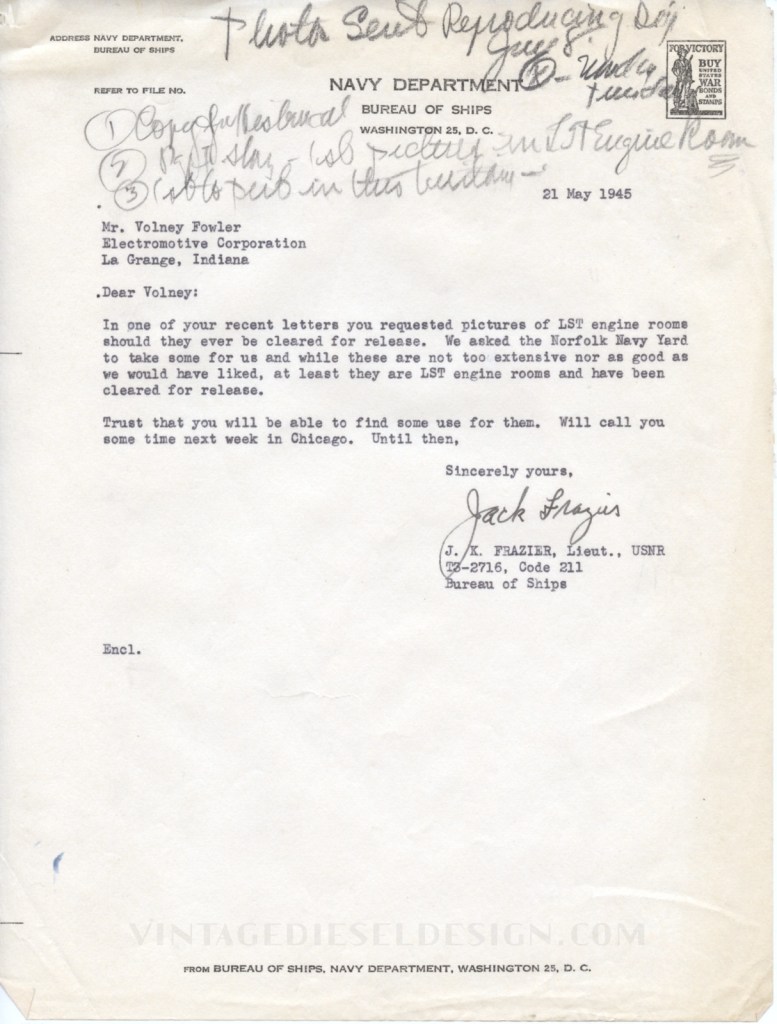
Not even 2 weeks after VE Day, the Navy Department responded to an EMD (note that the letter references EMC, the changeover having occurred 4 years prior!) request for photos of a completed LST engine room.
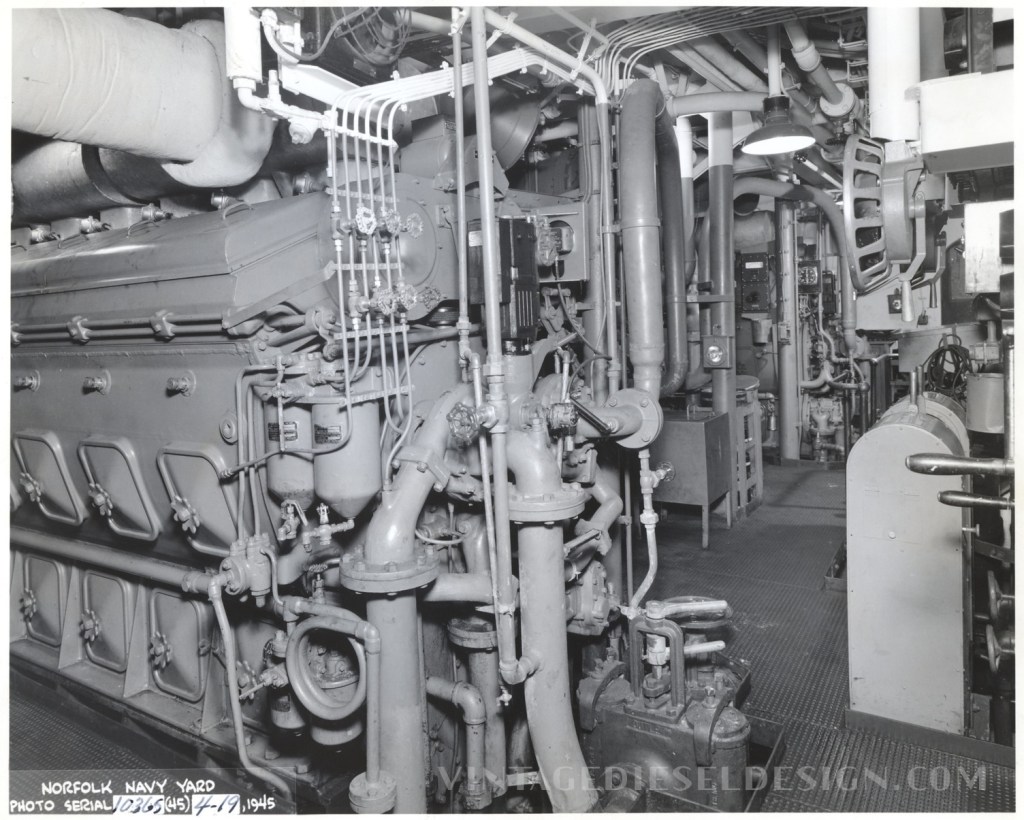
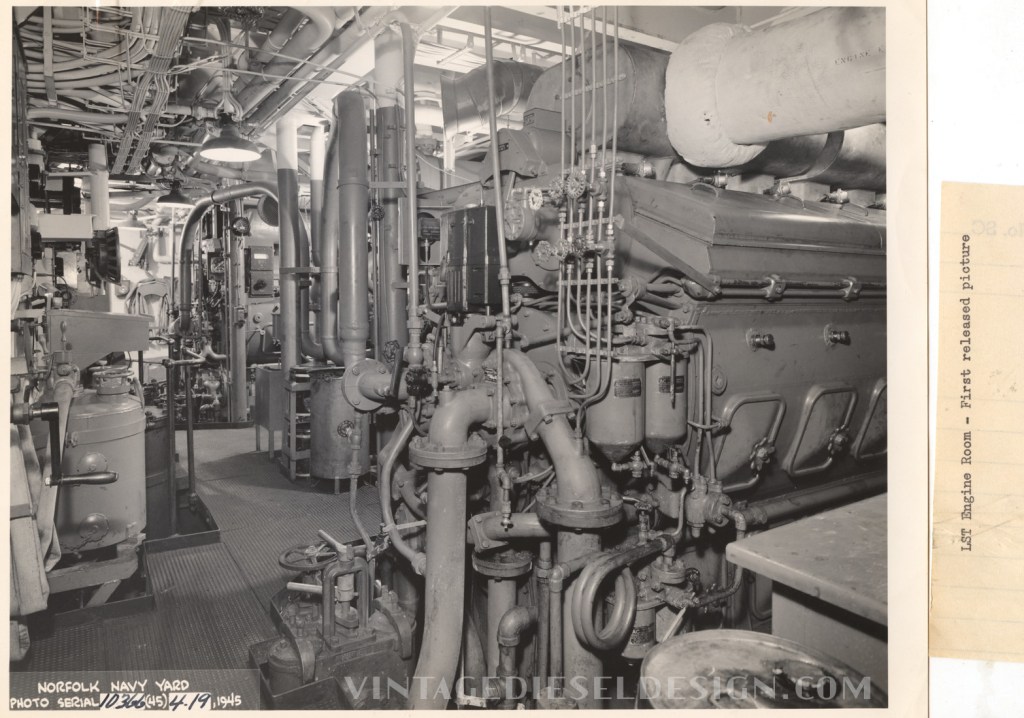
The Navy responded with the above two fantastic photos showing the front end of a recently completed LST’s engine room. Along with the above, there was also a large set of photos showing the engines in the shop, as well as the installation of one of the engines. Some of these photos have been seen before in EMD literature including the EMD book Diesel War Power.
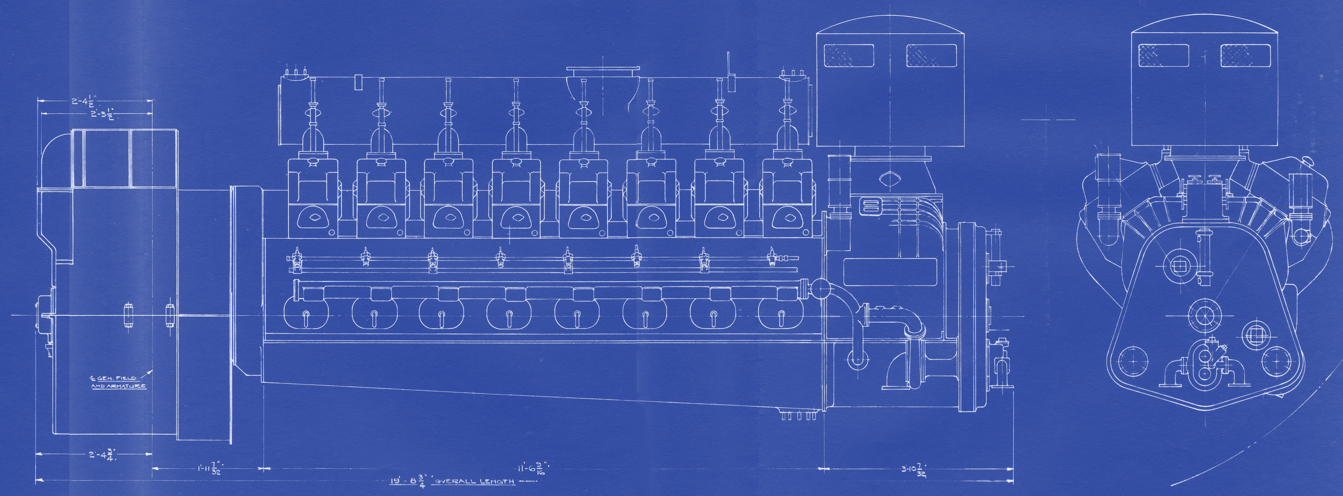
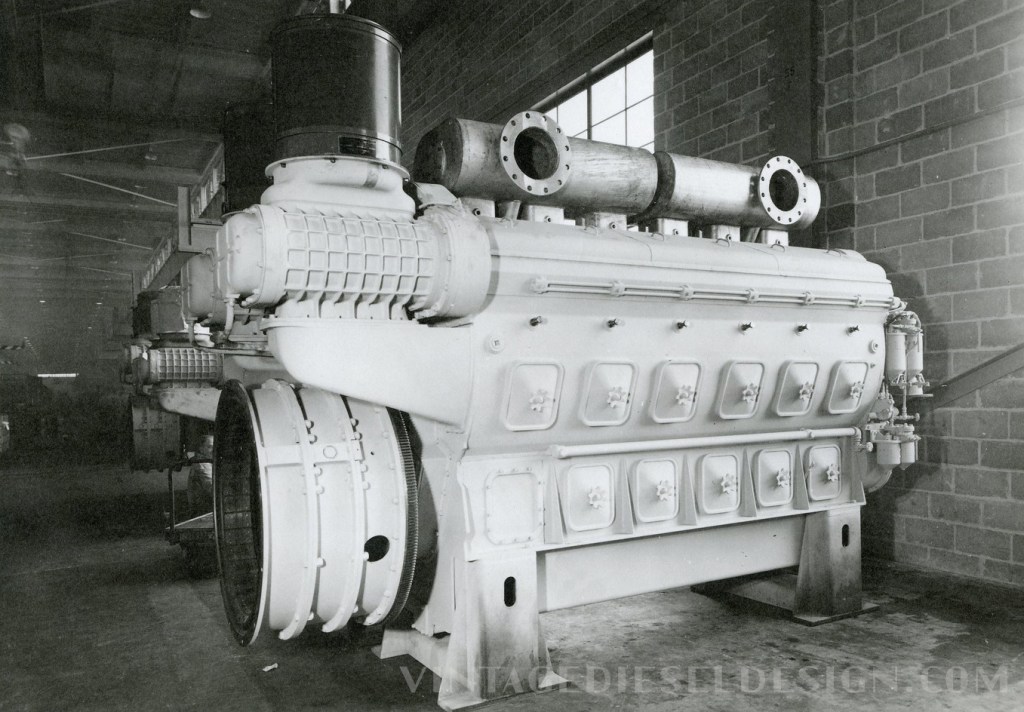
Fresh off the assembly line, this 567 has not been installed on its subframe yet, however the Falk clutch drum has been installed on the flywheel.
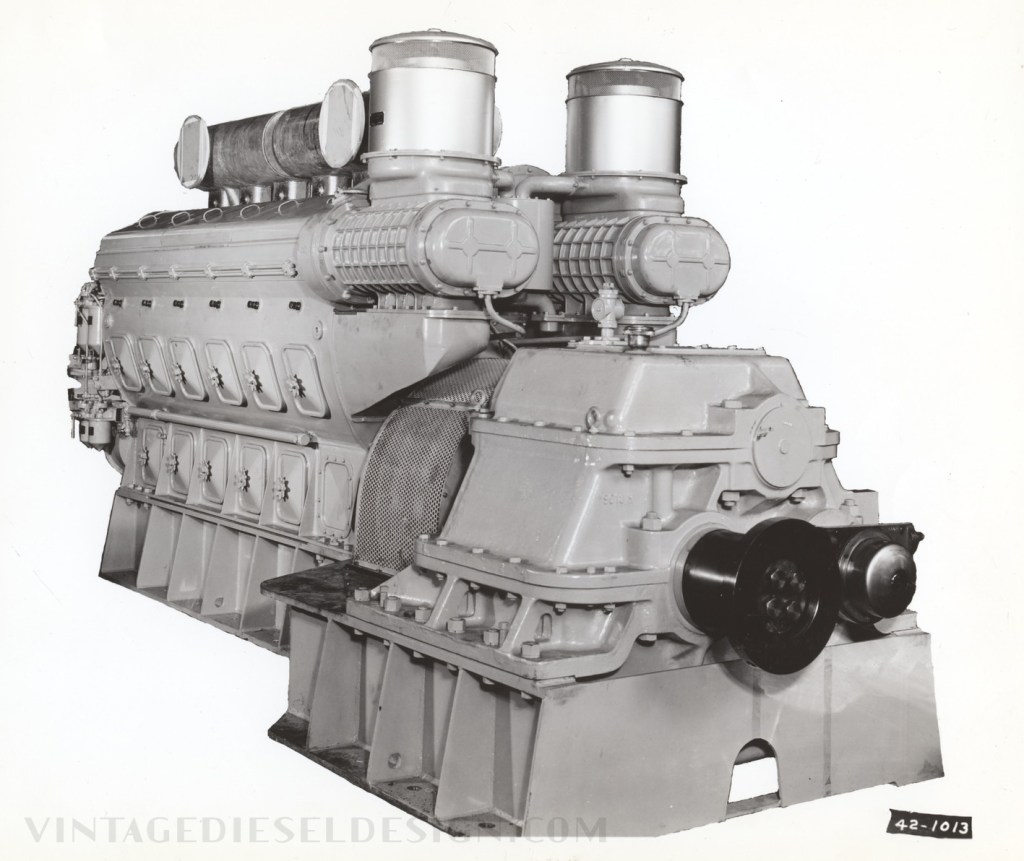
A completed 567ATLP. This photo, with the background whited out, was used in the engine manual (see Part I).
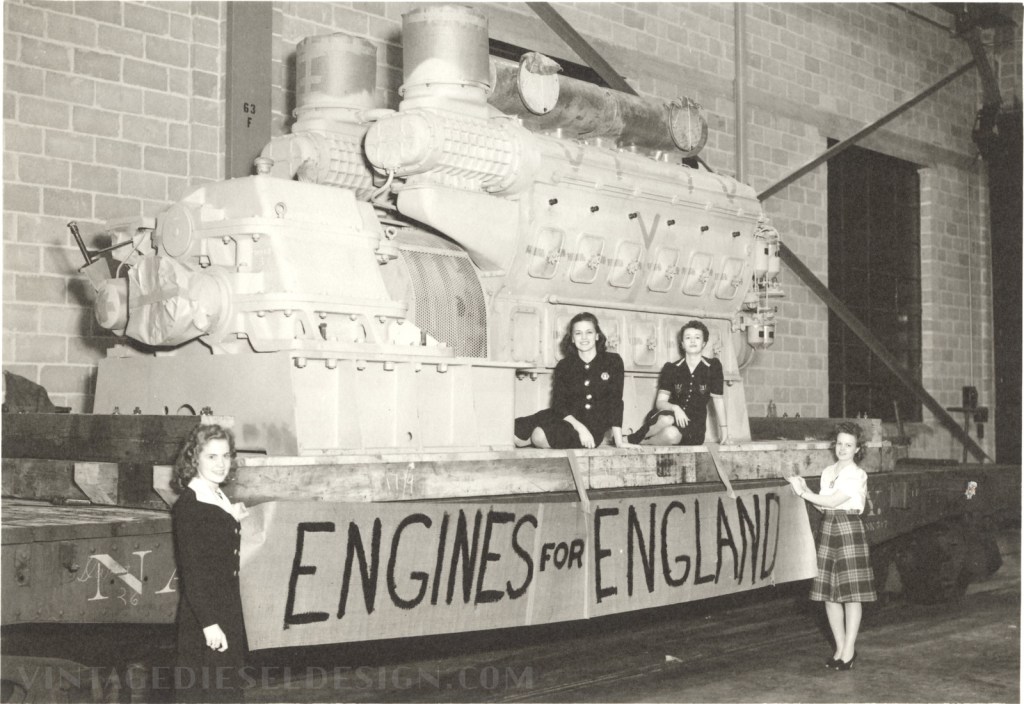
A completed engine is loaded on a flatcar ready for shipment to a shipyard.
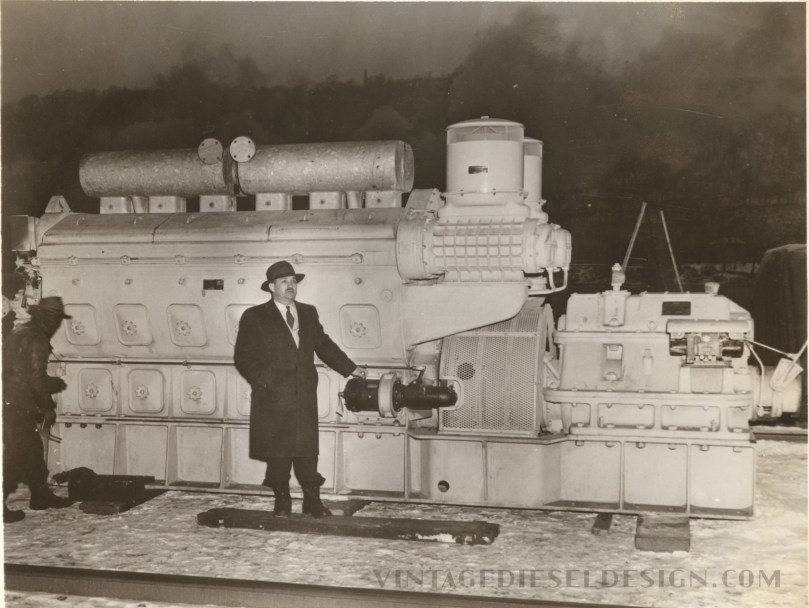
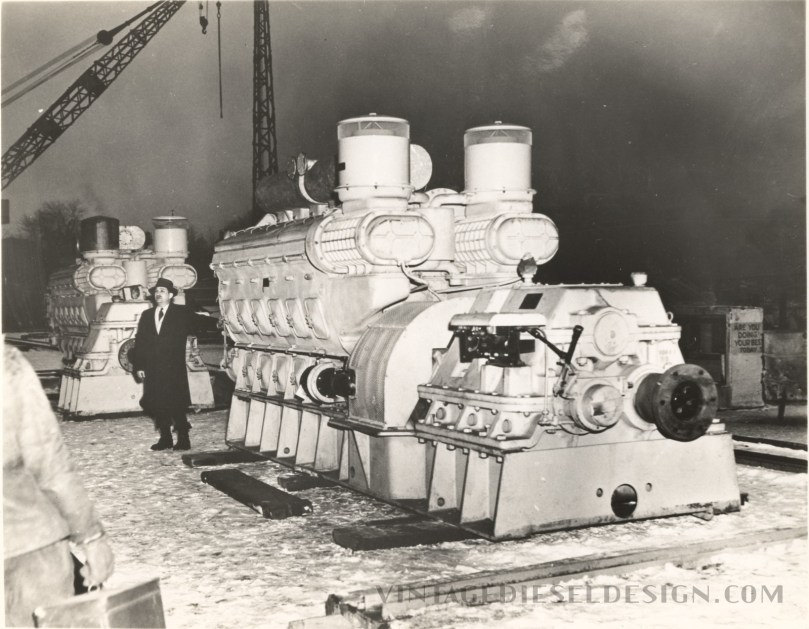
An ATLS engine has arrived at the shipyard, and an unknown dignitary is posed for photos alongside the engine.
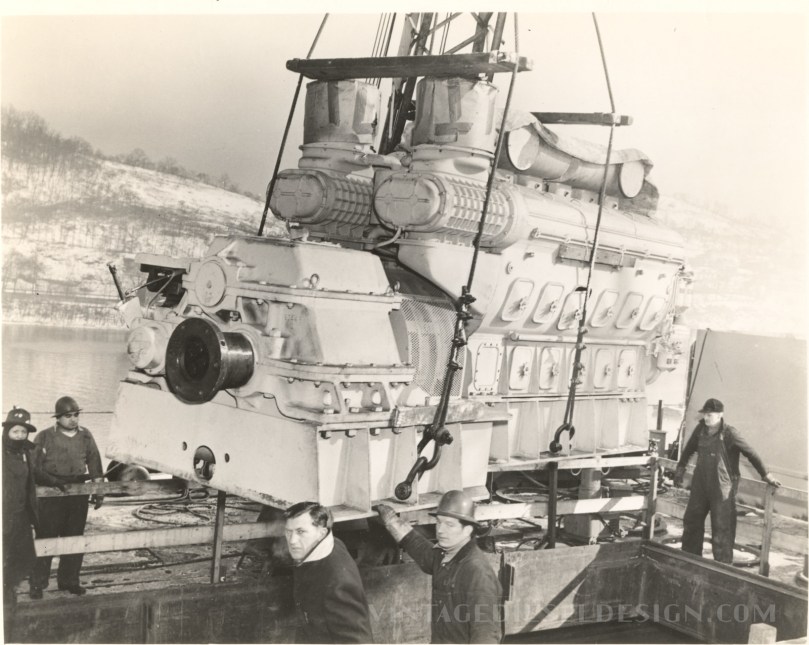
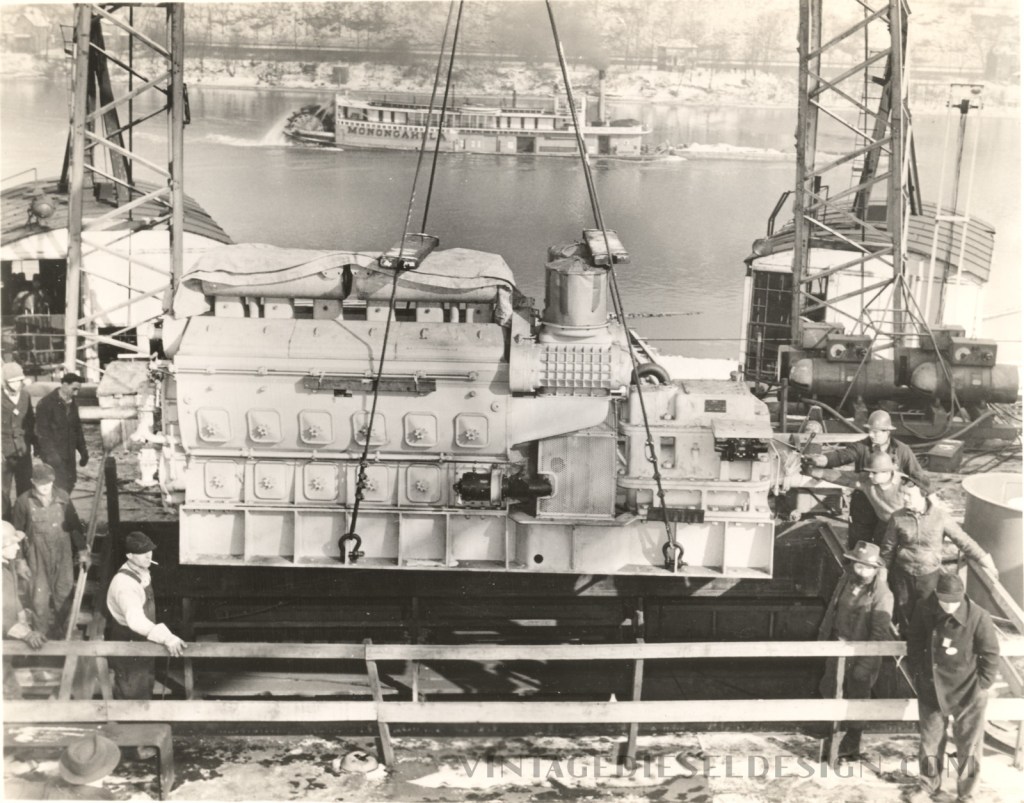
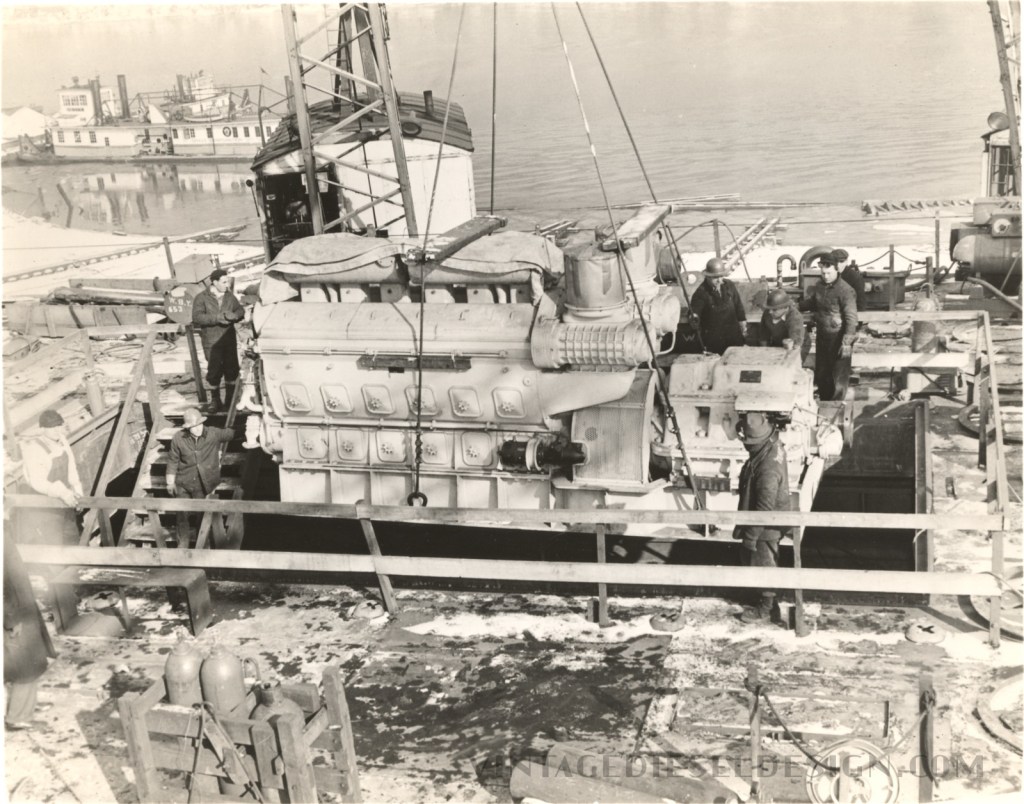
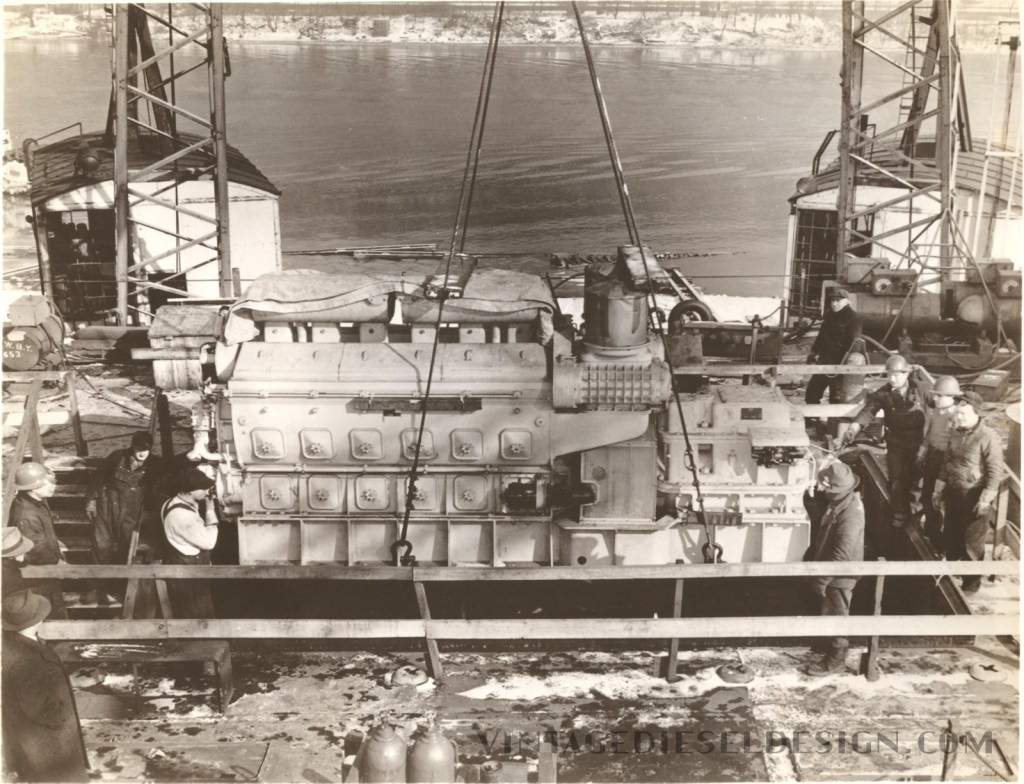
The engine has been slung, and a crane begins the process of swinging it over the in-progress LST. Check out the bank of 4 Lincoln pig welders and the sternwheel towboat!
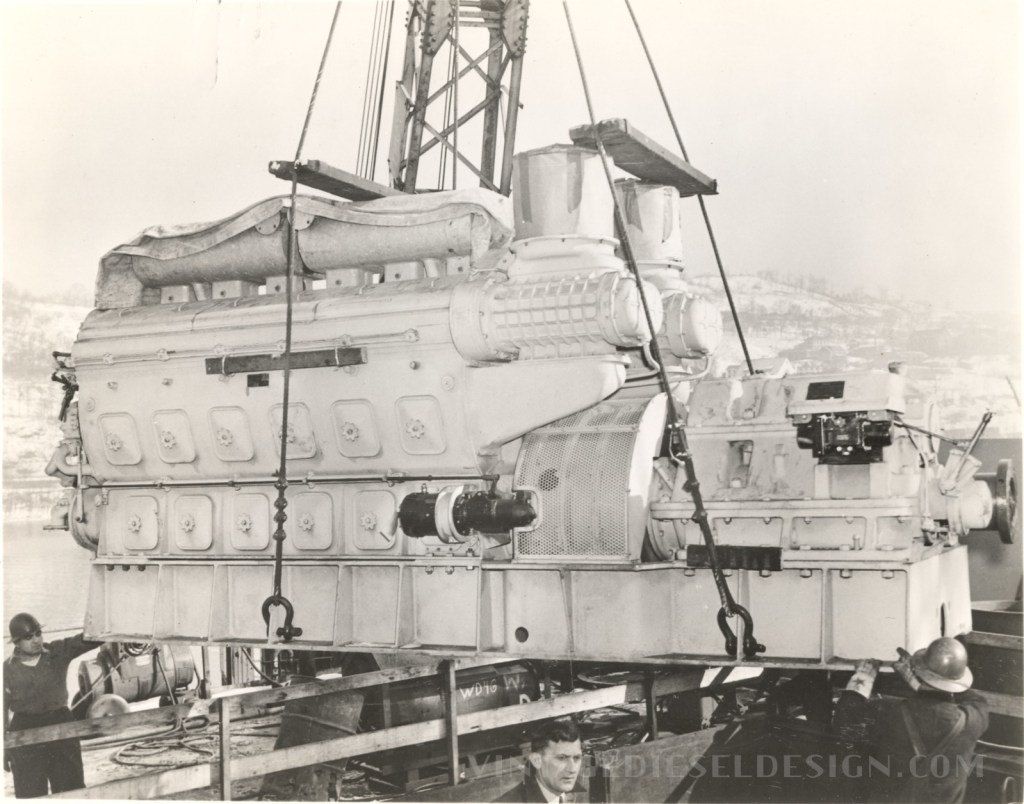
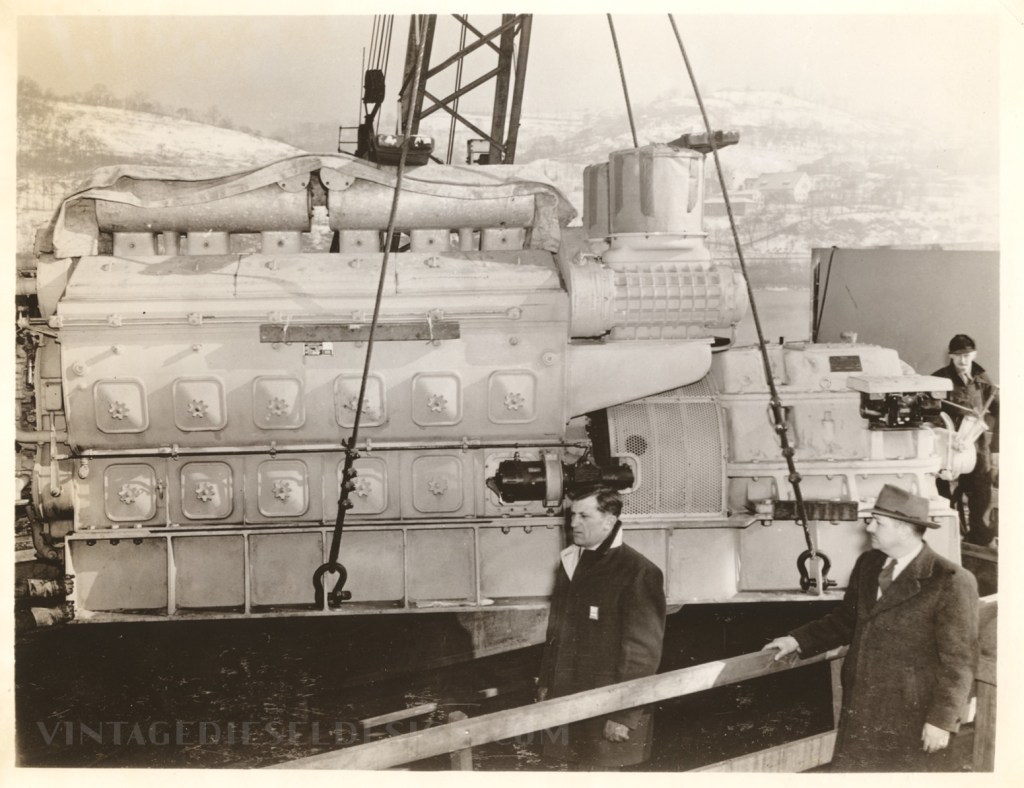
Down she goes. Unfortunately, I do not know what LST this is under construction. With as many LST engines were recycled, there’s a chance this one saw daylight once again.
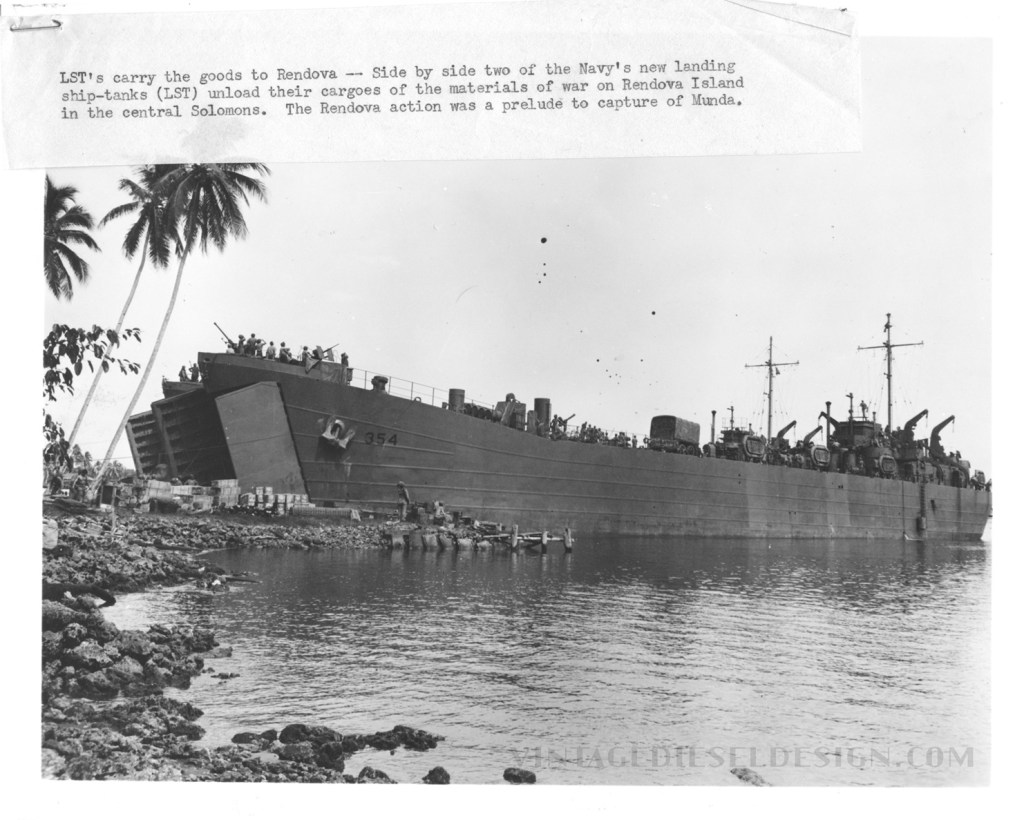
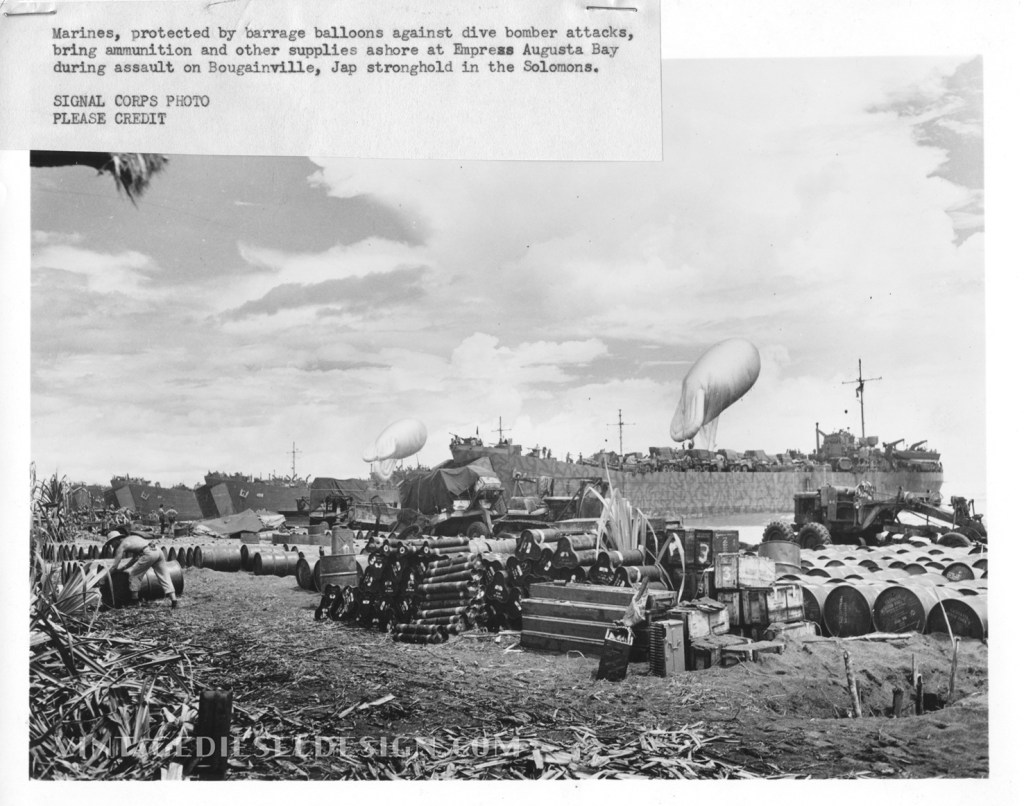
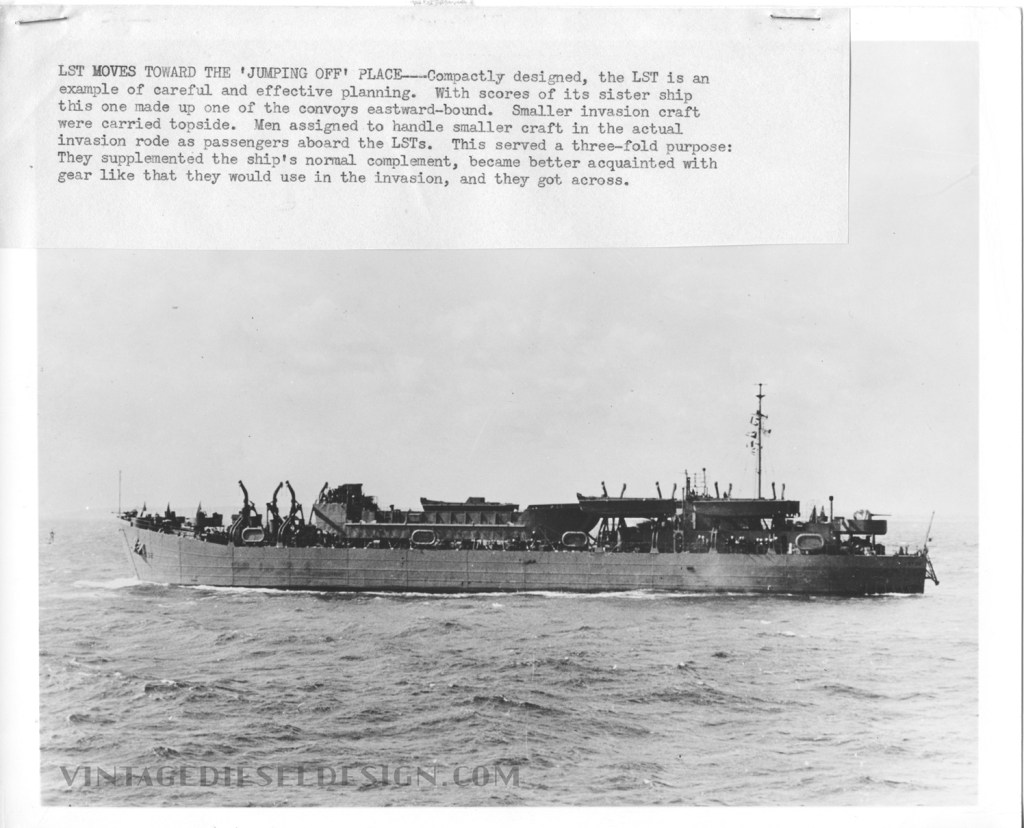
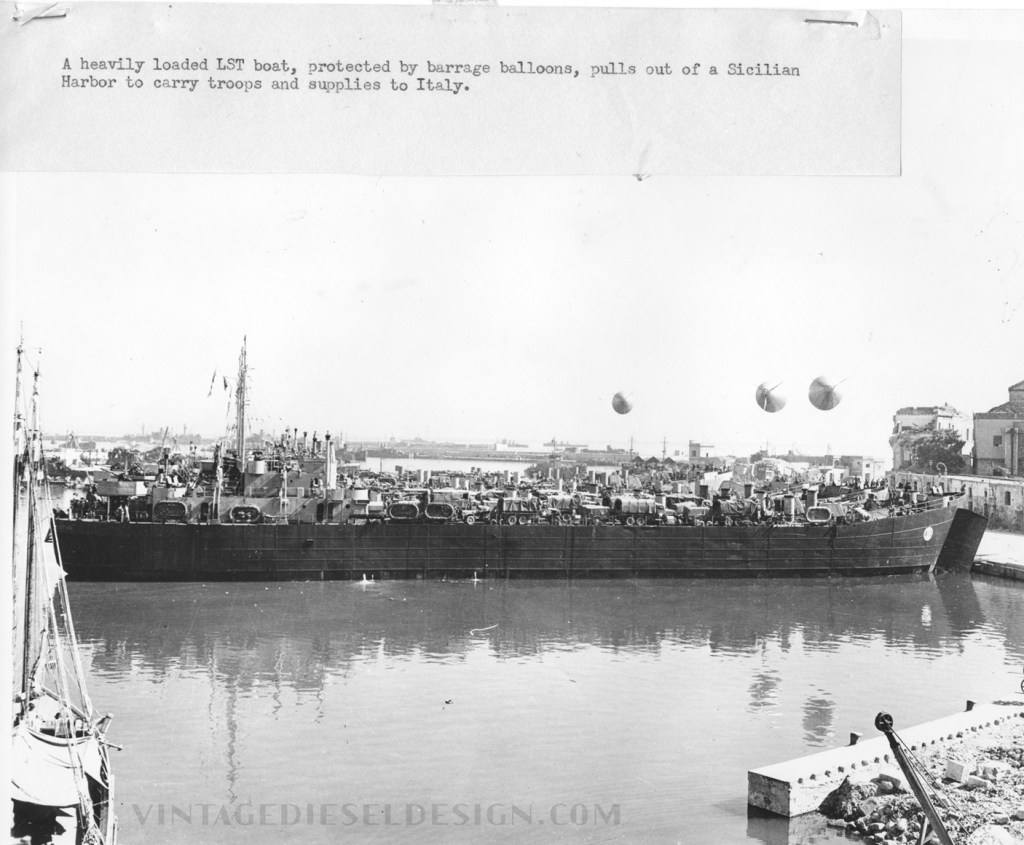
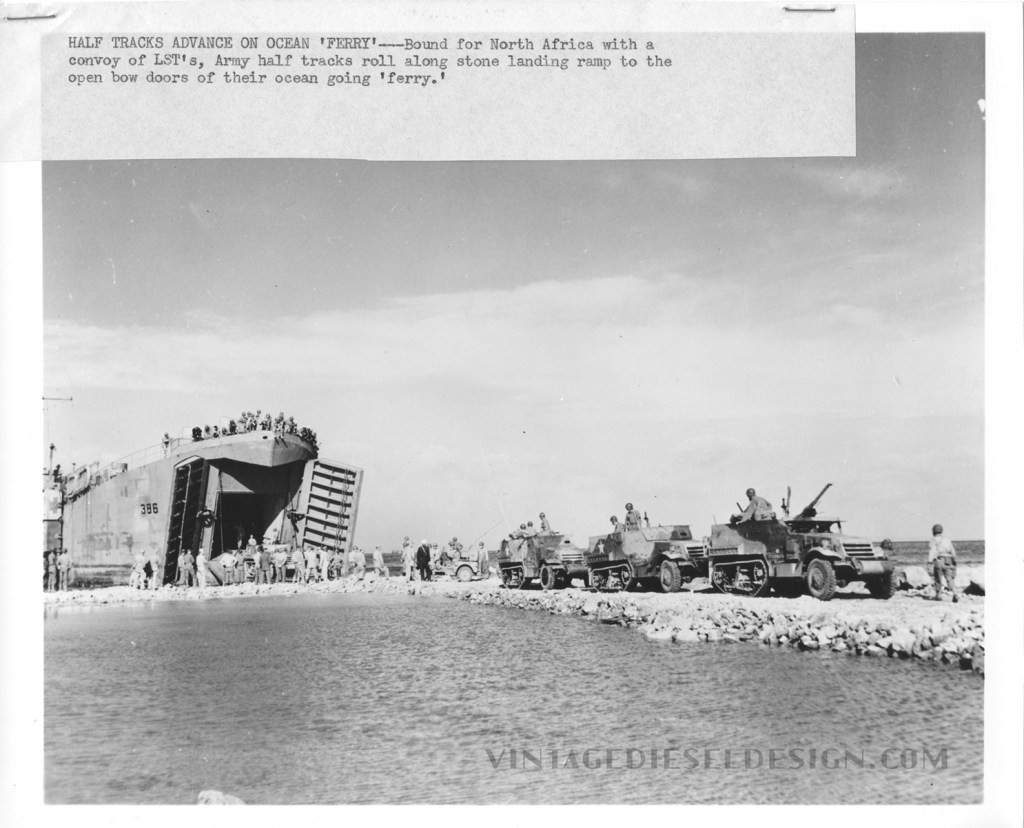
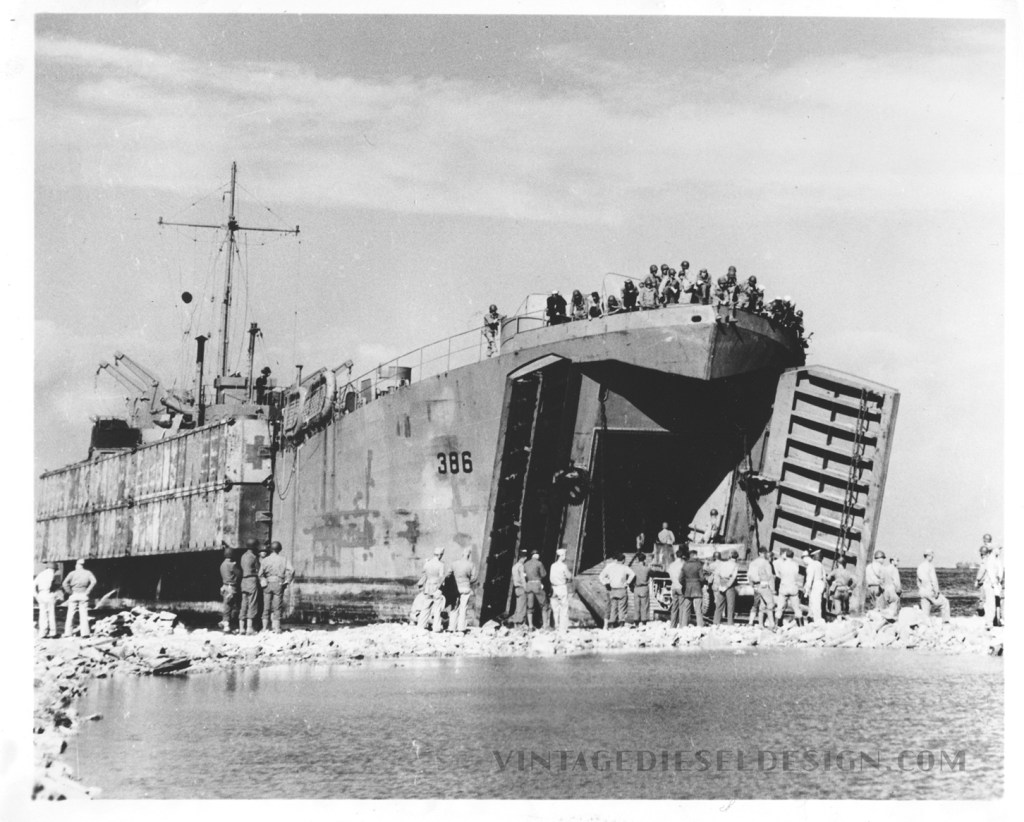
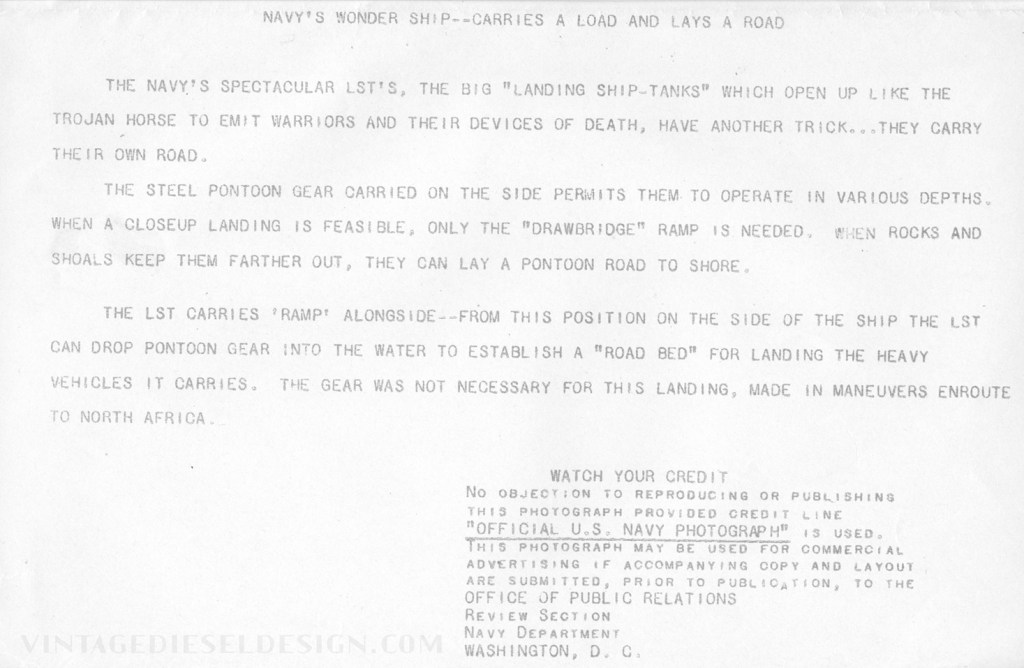
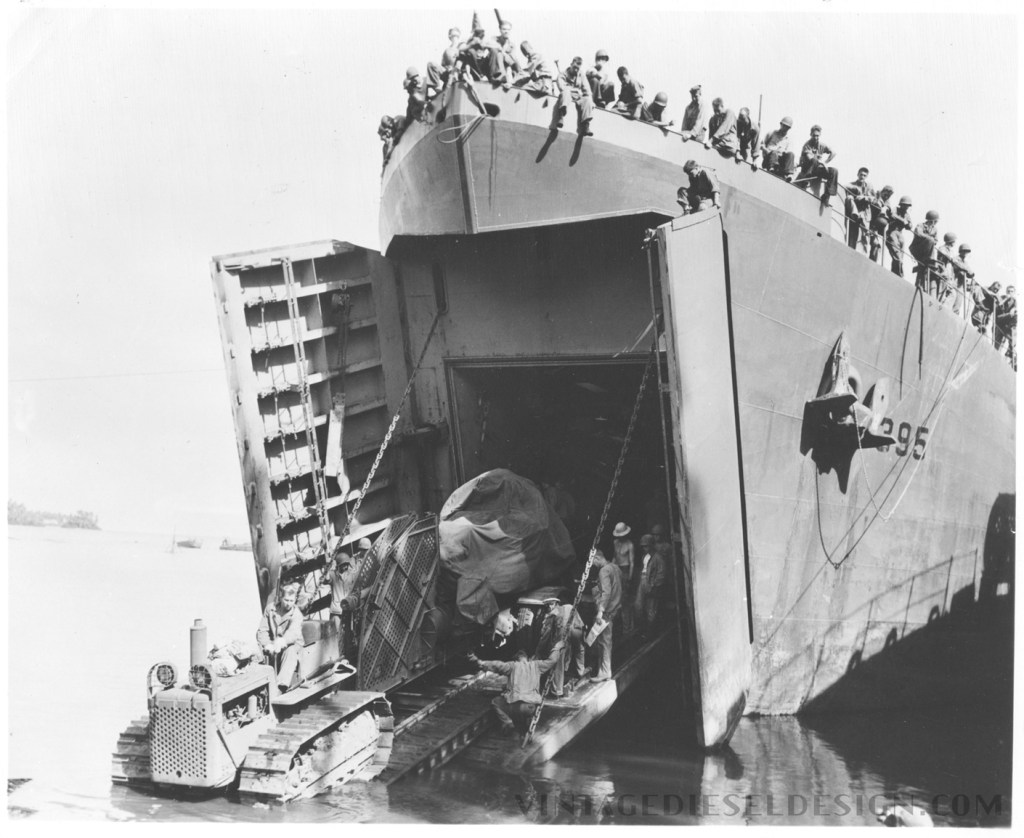
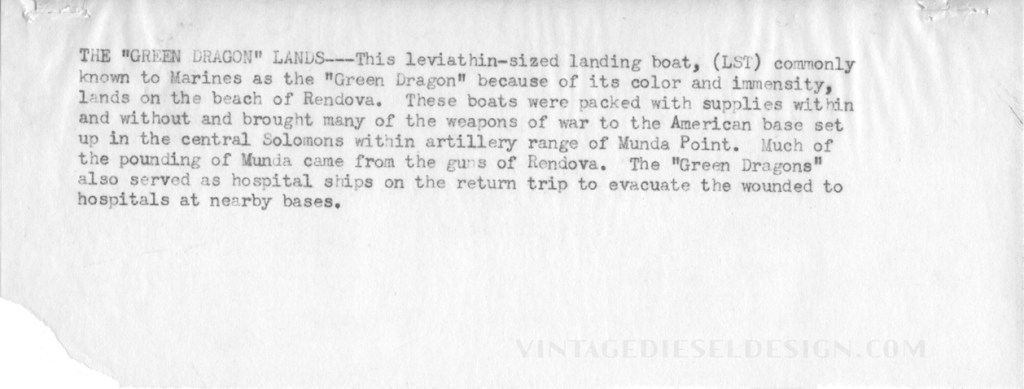
Along with the construction photos above, EMD kept a handful of photos of LST’s in use provided by the Signal Corps and the Navy Department. All of these have typed captions which can speak for themselves.
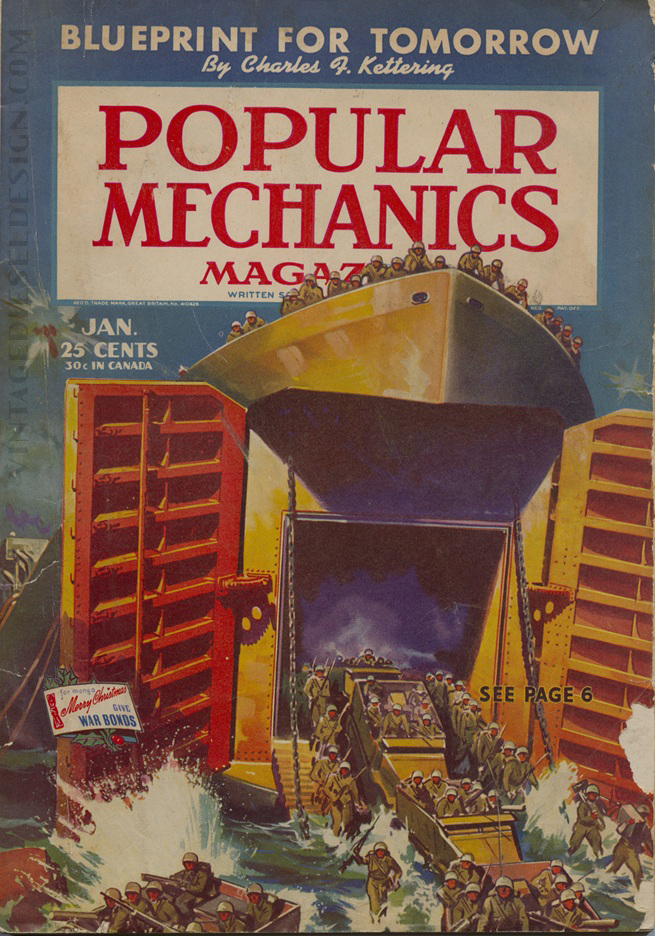
A few more things to add that I have come across, the January 1944 issue of Popular Mechanics had a nice painting of an LST on the cover..
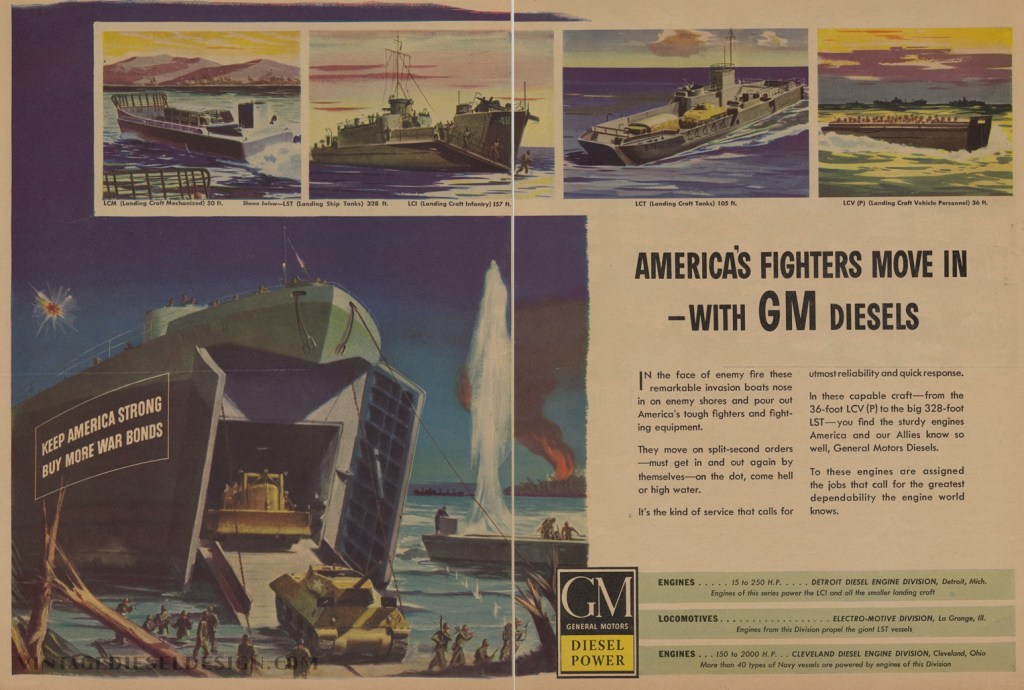
And finally, General Motors ran a two page advertisement showing 5 of the 6 types Landing Craft which were powered by GM: LCI, LCT, LCM and LCVP’s with Detroit Diesel 6-71’s and the LST with the EMD 567. Missing is the 278A powered LSM. There are some other versions of this advertisement, including a condensed one to fit on one page.
In 1968, the keel was laid for the the USS Nimitz, CVN-68, part of a new group of 1,092′ aircraft carriers. The ship was named for Chester W. Nimitz, former Fleet Admiral/Chief of Naval Operations. I am not writing a history of Nimitz, there’s plenty of that online already!
In 1965, the proof of concept for the Nuclear carrier was cemented in the success of the Enterprise (CVN-65). Two more traditional (oil fired – steam turbine) powered carriers were built after the Enterprise, the America (CV-66) and John F. Kennedy (CV-67) commissioned in 1965 and 1968 respectively.
Aircraft Carriers are no simple ships, it would be another 5 years before the Nimitz would be commissioned in the spring of 1975. The ships would pack a massive 260,000 horsepower power plant, producing steam from a pair of reactors, which in turn fed a quartet of steam turbines.
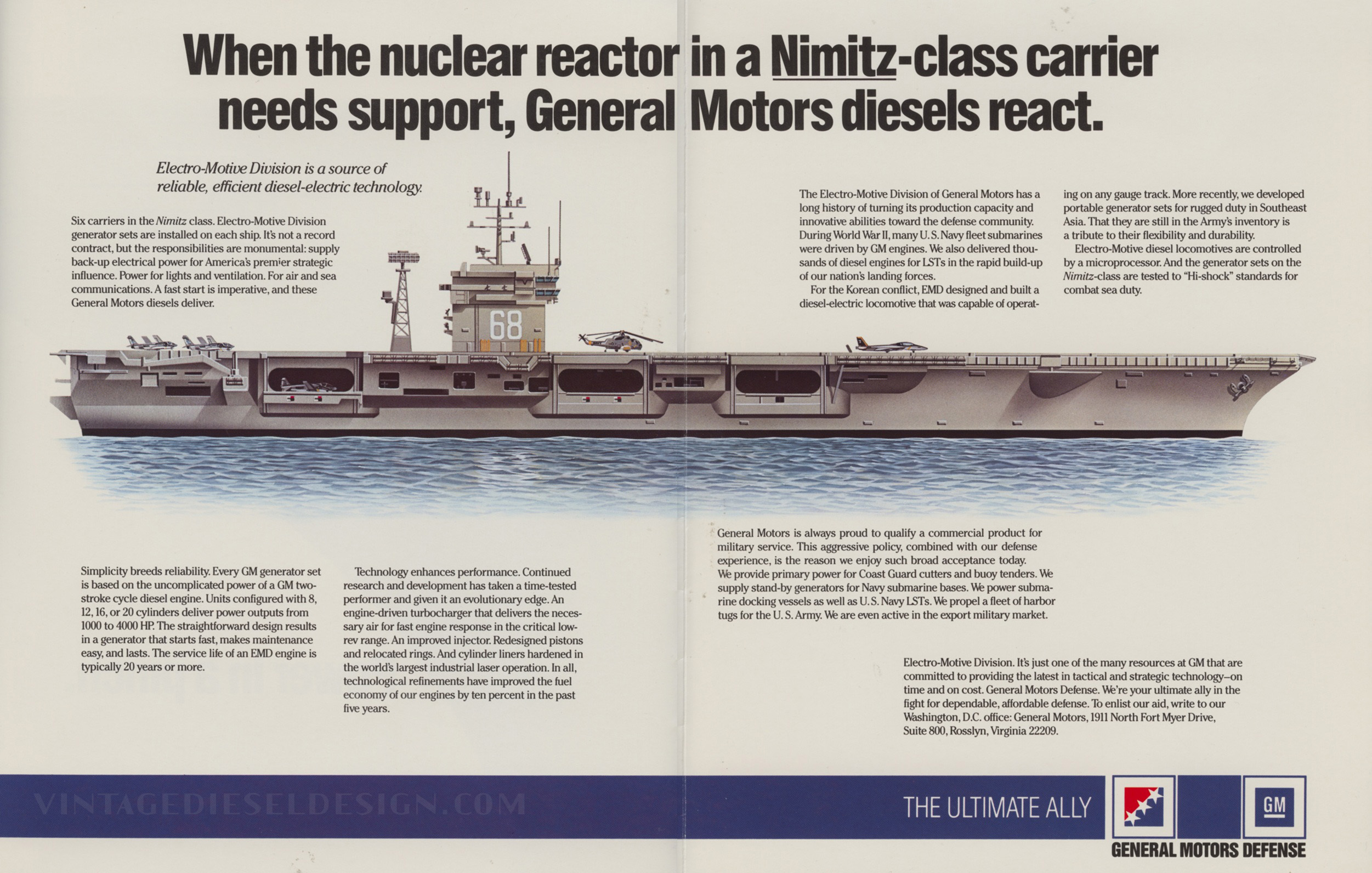
Even with all of that power at hand, ships need emergency power generation capabilities. This would be handled by the Electro-Motive Division.
EMD Brochure – Click for larger.
The fleet of carriers, grew from the original 3, to 10 in 3 different sub-classes. While we know for sure the 1st 6 had EMD-supplied emergency gen-sets, it is uncertain if the last 4 did as well, as my records do not go that late.
The generators chosen would be Turbocharged EMD 16-645E5N engines. These engines drove 4160 volt, 2000kW generators, and each ship had 4 of them! In order to be utilized in an Aircraft Carrier, the engines were required to go through some pretty scrutinous testing for the US Navy, something General Motors was well accustomed to at this point.
EMD photo, VDD Collection – Click for Larger
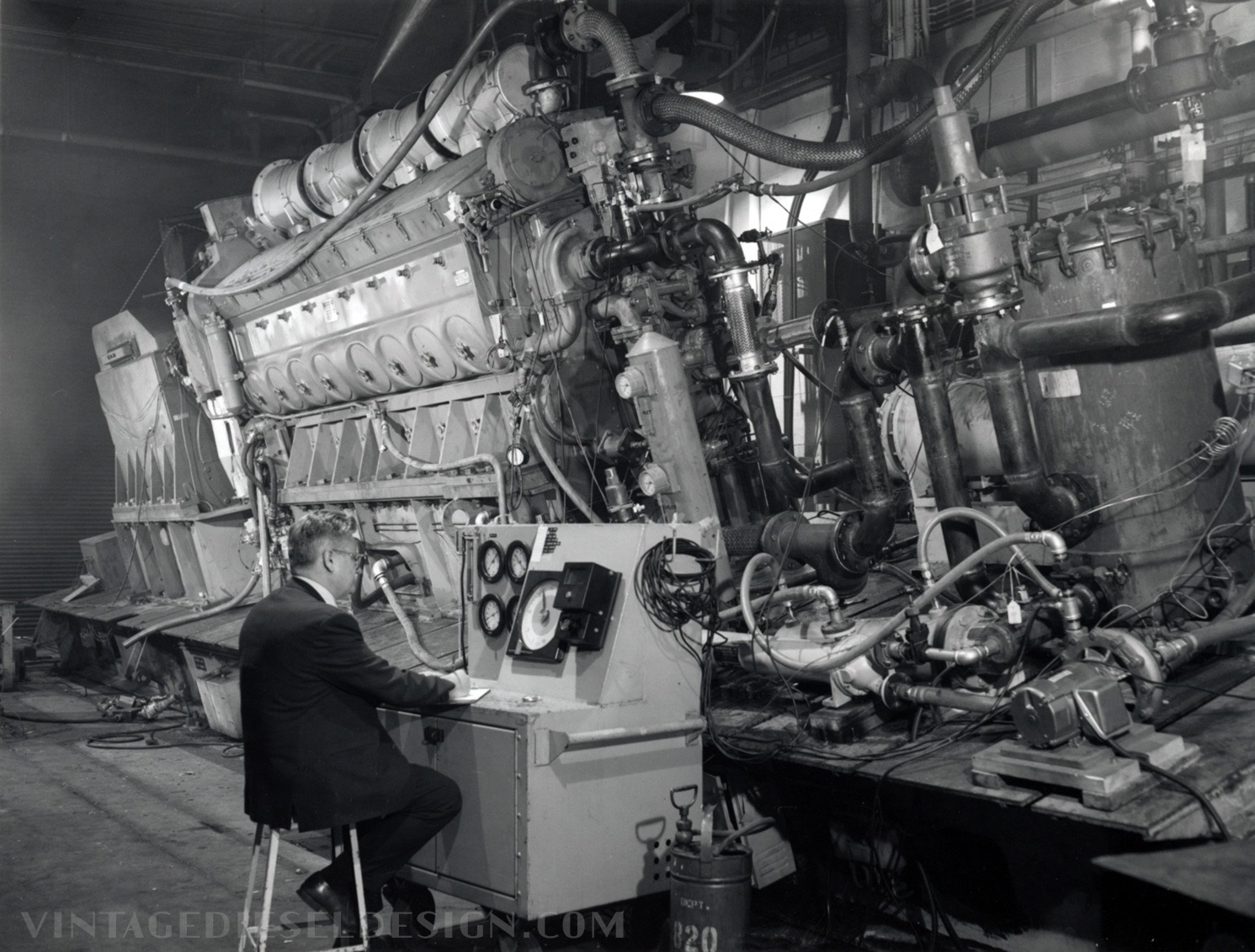
In order to do this, EMD made a gigantic, movable test stand! The engines needed to be tested in overload situations and at various angles to mimic conditions out in the ocean, as well as shock loading in case of battle conditions. In the photo above, an EMD engineer is as work testing one of these engines with it leaned over to the side.
EMD photo, VDD Collection – Click for Larger
All 10 of the Nimitz class carriers are still in service, however the Nimitz is currently out for her last deployment. The Nimitz is scheduled to begin the long decommissioning process in 2026.
It’s worth noting the previous three carriers, Enterprise (CVN-65), America (CV-66) and John F. Kennedy (CV-67) also had EMD generators. Each ship had 16-567C engines with 1000kW generators: Enterprise had 4, the others had 3 each. The engines in the Enterprise were ordered and shipped under Cleveland Diesel, one of their last large projects before being absorbed into EMD.
Additional Commentary by Jay Boggess
I worked at EMD from 1981 till 2004, starting off in the AC Design Group of the Electrical Rotating Department. I remember some of the Nimitz-class gen-sets being assembled in the EMD shop, probably around 1985.
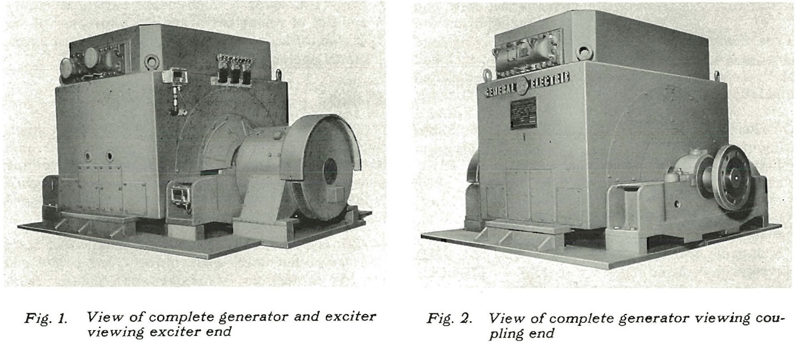
I can see in my mind’s eye 40 years ago, the General Electric AC generators sitting on the EMD hi-bay floor, awaiting installation. 2000 kW, 8-pole 4160 Volts, 60 Hz. Water to air cooler. No photos from that pre-iPhone era, but here’s a pic of a smaller GE generator installed in the carrier Forrestal:
GE figure from 1954 CDED 450 Volt 1000 kW instruction book – Jay Boggess Collection
I remember how the Nimitz GE generator was so physically larger than an EMD locomotive generator of the same kilowatt capacity (I learned later why that is – it has to do with the Navy’s requirements for the AC generator’s self-regulation – to meet the requirement, the generator has to get bigger and heavier).
The special skid for the 15-degree fore-and-aft list test kicked around the LaGrange back yard for some time. Fifteen degrees may not sound like much, but it translates to about 6 feet at the far end of the gen set.
While VDD’s records do not extend to the latest Nimitz-derivative nuclear carrier (John F Kennedy CVN-79 under construction), I suspect the EMD 16-645E5N engines are there. Navy Hi-Shock qualification tests are rigorous, and I can’t imagine any other diesel engine manufacturer attempting to get into that market for just a small quantity of engines.
Finally, Cleveland Diesel built 3 sets of 1000kW emergency generators for 3 Forrestal-class supercarriers in the 1950s – Forrestal (CVA-59), Saratoga (CVA-60) and Ranger (CVA-61). All three are now razor blades.
After the great rush of railroads converting to diesel power in the early 1950’s, the Electro-Motive marketing department had an epiphany. Now that the railroad market had pretty much hit saturation, locomotive sales were starting to slide. A new market had to be found. While the majority of marine and stationary engine markets were being held by sister company Cleveland Diesel, the Electro-Motive Division had their own department that handled the same sales. The PMI department, or Power, Marine & Industrial handled the non-railroad applications of EMD’s engines and equipment. The majority of what PMI was doing at the time was supplying Cleveland Diesel with engines, who in turn would convert them to the specific application. Somebody in PMI apparently had the thought of “Why don’t we start doing this ourselves?” Instead of acting as just a supplier, like what Cleveland Diesel did, EMD would actually build and market a complete product.
In 1954, Electro-Mobile Power was born. A catchy name that described a new concept: Mobile Power Generation. EMD would take one of their engines and generators, and package it in a mobile platform, be it a highway trailer or railcar. The heart of the Electro-Mobile Power trucks/cars would be the new 567C engine introduced the year before, combined with one of the new AC generators. EMD held a press event in the summer of 1954 showcasing the new models: The MH-8, which was the highway trailer version, as well as the M-16, which was the railcar version. We are going to focus on the MH-8 for this post.
The new logo used by Electro-Mobile Power (right) was a sort of caricature of a powerplant: An engine with stack, a generator with sinusoidal wave inside of it representing AC power, and the whole thing surrounded by a “box”.
A well known press photo of the time, EMD held an event in LaGrange showcasing the new Electro-Mobile Power line, including two M-16 rail mounted power cars, and an MH-8 highway trailer. All of the equipment was painted in EMD Demonstrator Blue, with a white lightening stripe. EMD Photo, VDD Collection. Click for larger.
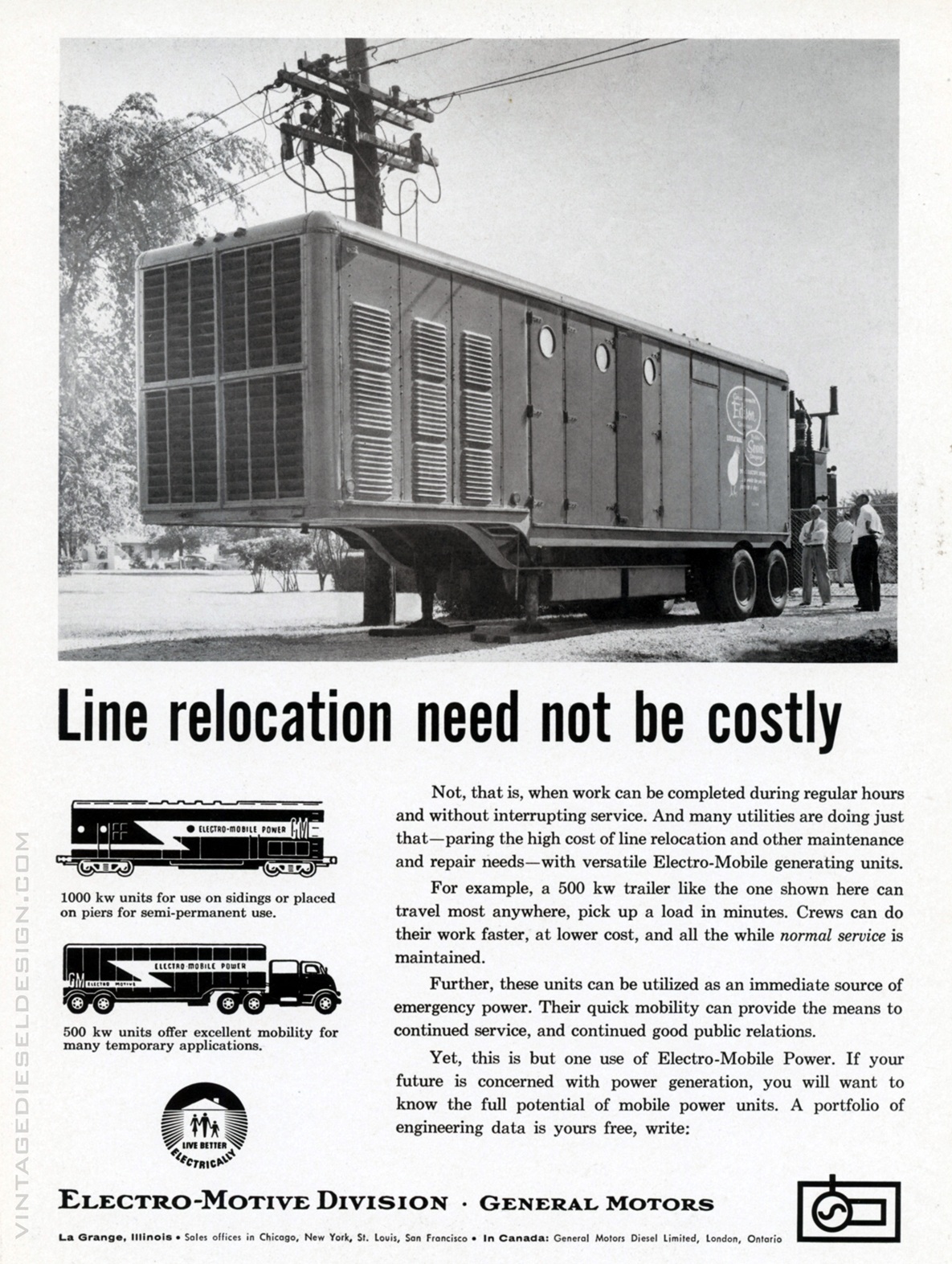
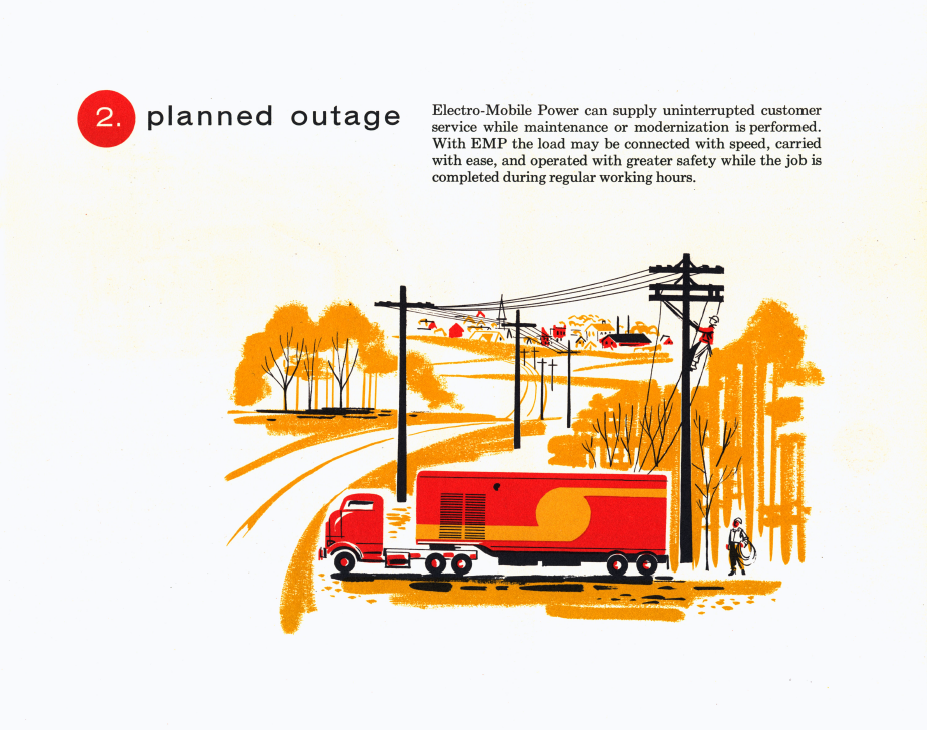
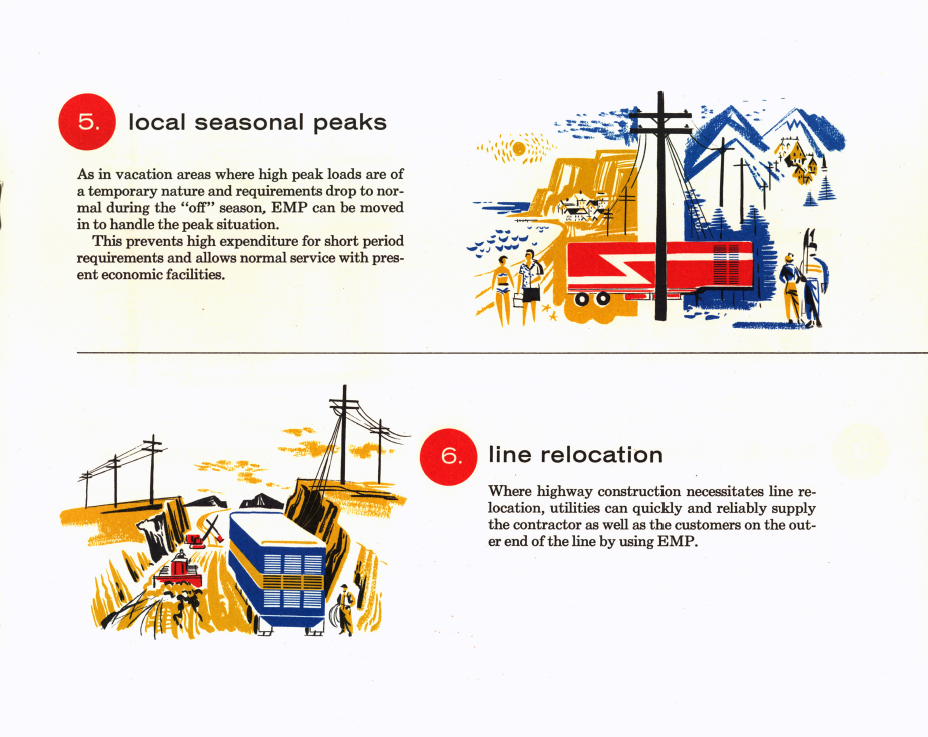
Marketing for the MH-8 was mainly geared towards public utilities. Rated at 500kW, the trailer would be a good “stand in” generator for electric companies doing planned outage type of work such as pole and line replacement. A second market was as an emergency generator. The US Navy would be the largest buyer of MH-8’s for use as backup generators in Navy hospitals. A third, rather unorthodox market popped up: generating power for electric mining shovels in various open pit mines.
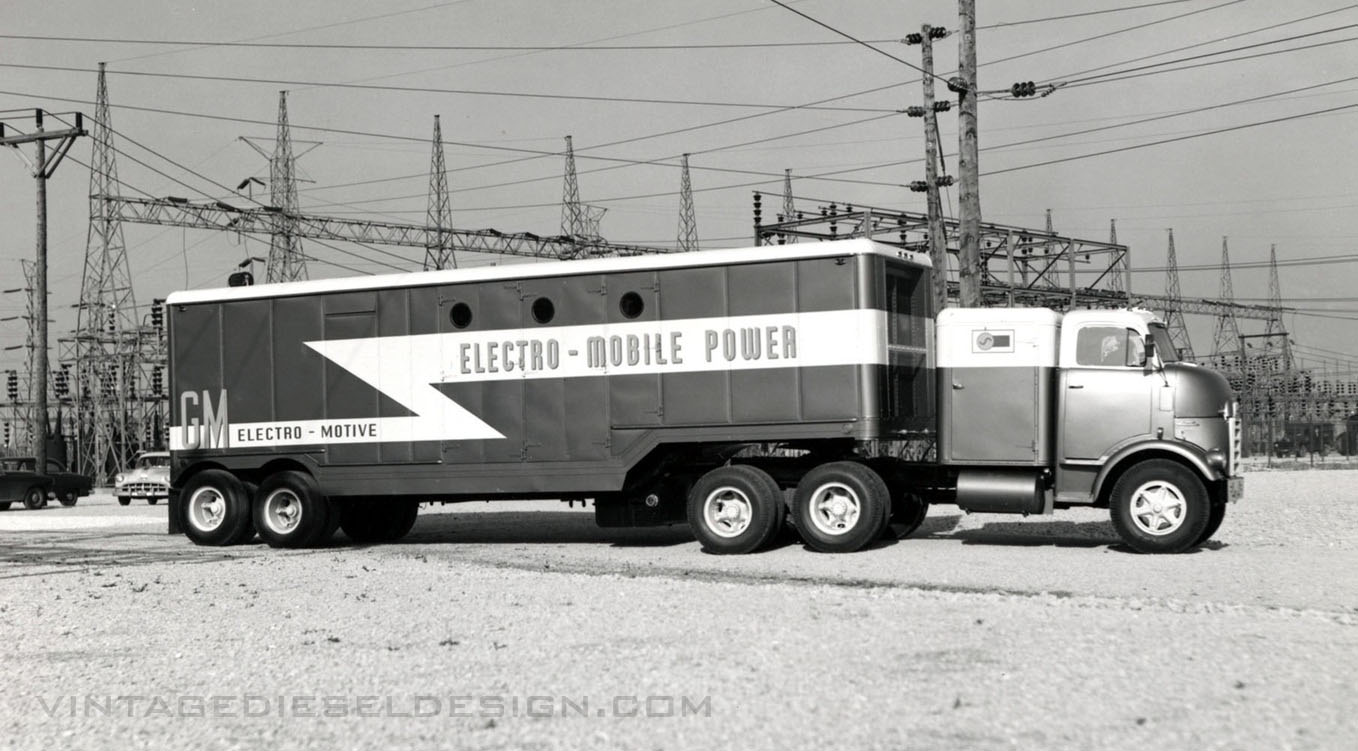
Not only did they build the trailer, through subsidiary General Motors Truck & Coach Company, a GMC Cannonball COE (Cab Over Engine) truck was supplied to pull the demonstrator trailer. Note how much larger the trailer is over the truck. EMD Photos, VDD Collection. Click for larger.
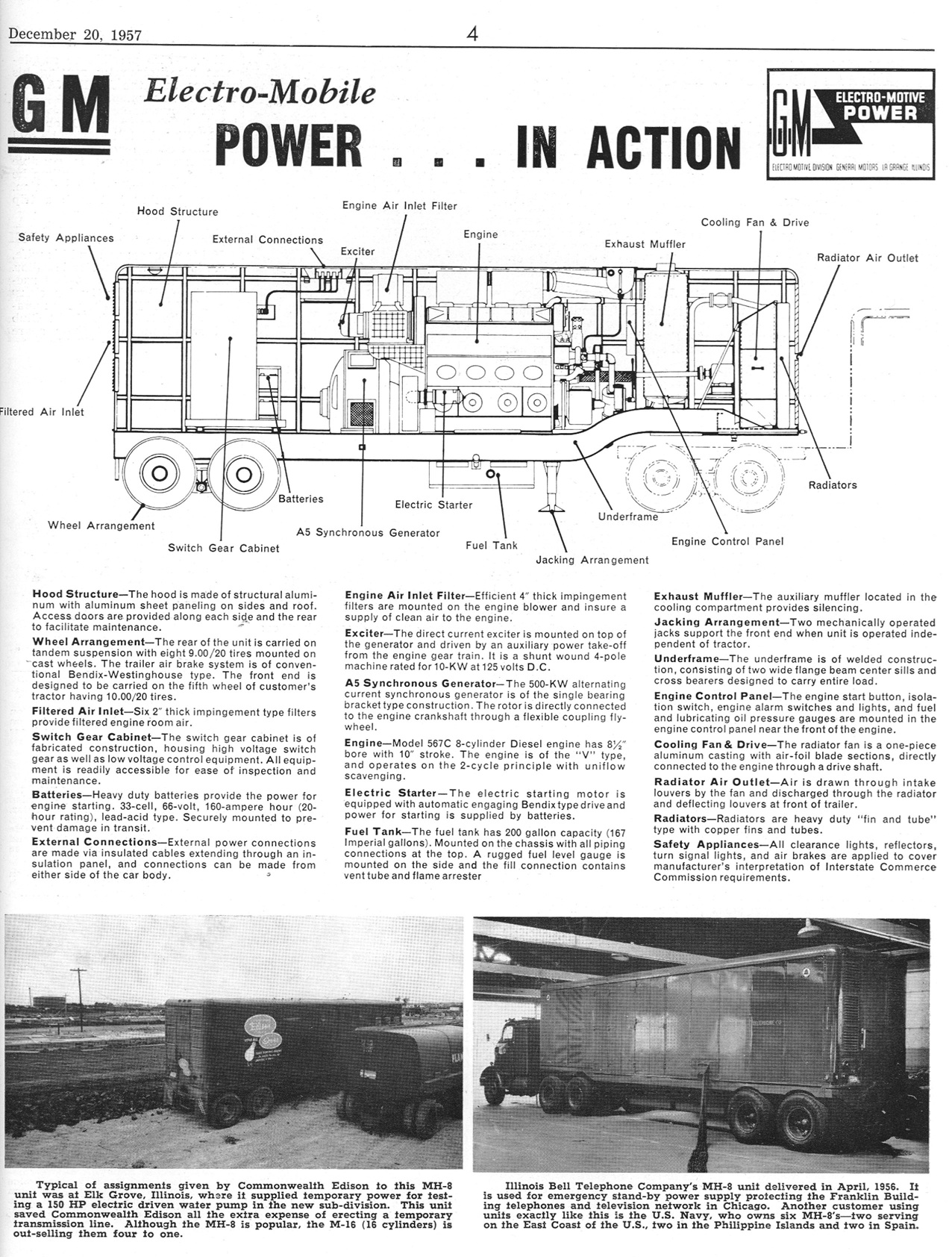
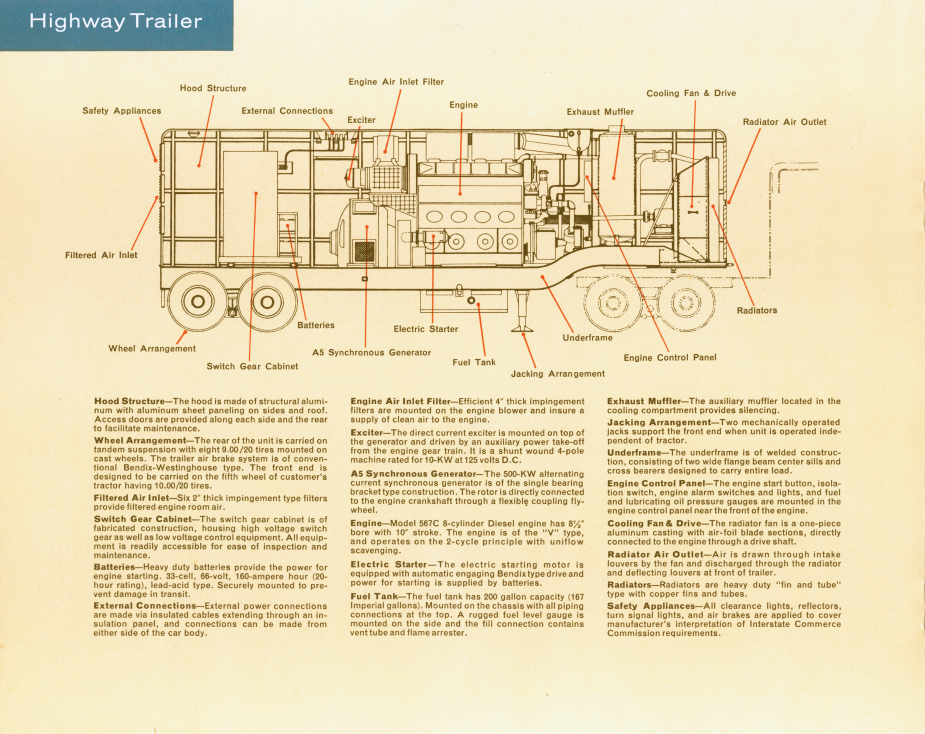
The MH-8 looks like an ordinary highway trailer, however there was no space for cargo inside! An 8-cylinder 567C sat inside the middle of the trailer, which in turn was connected to a 500kW model A5 alternating current generator. The rear of the trailer featured a basic set of switchgear (also built by EMD) with a 50,000kva oil type circuit breaker and dry transformers. The front of the trailer held a muffler (the muffler was on top on the demonstrator trailer), as well as the cooling system. An optional automatic starting system was offered, so the unit could be left on its own to start up when an outage is sensed. Start up to full load could be reached in under a minute.
The 32’11” trailer itself is a heavy-duty design, unfortunately it is unknown if it was built by EMD or subcontracted out. A basic metal box enclosed the trailer to keep it weather tight, with small, hinged doors on the top for the power connections on each side. The main entrance to the trailer was in the rear through a single door, with larger folding maintenance doors on each side. The original demonstrator trailer featured smooth sides, with the radiator intake screen on the top. Production trailers had the screens moved to the side, with either a large set of 4 open grills, or 9 smaller louvers like those used on a locomotive. A smaller 350kW trailer was planned (using a 6-cylinder engine) but was never produced. A truck could have been part of the package as well, using a GMC Cannonball COE – We know that Illinois Bell’s trailer included one of these trucks, however it is unknown if anyone else received the truck too.
A look inside the trailer shows the basic switchgear, A5 generator, 567C engine and the radiator compartment at front. Production trailers shifted the engine back slightly, and a larger muffler was installed in front of the engine. EMD Photo, VDD Collection. Click for larger.
Production of the MH-8 trailer ran from August of 1955- October of 1960. The MH-8 sales never really materialized in any number. Unfortunately, only 23 MH-8 trailers were built in this timespan. 500kW was really not a lot of power, with communities getting larger and larger, and the same amount of power being offered in smaller packages.
Production List
1 – US Navy Hospitals, 8/1955, S/N 120 2 – US Navy Hospitals, 8/1955, S/N 121 3 – Commonwealth Edison Co., Maywood, IL, 12/1955, S/N 150 4 – The Anaconda Company, 12/1955, S/N 154 5 – Wisconsin Power & Light Co., 12/1955, S/N 158 6 – Illinois Bell Telephone Co., 4/1956, S/N 168 – Used an Elliot generator in place of EMD A5 7 – US Navy Hospitals, 10/1956, S/N 196 8 – US Navy Hospitals, 10/1956, S/N 197 9 – US Navy Hospitals, 10/1956, S/N 198 10 – US Navy Hospitals, 10/1956, S/N 250 11 – Central Illinois Public Service Co. , 12/1956, S/N 199** 12 – The Anaconda Company, 1/1957, S/N 280** 13 – A.G. Schoonmaker Co., 2/1957, S/N 281** 14 – Isbell Construction Co., 2/1957, S/N 291** 15 – Homesake Mining Co. – New Mexico Partners, 5/1957, S/N 292** 16 – Missouri Power & Light Co., 9/1957, S/N 327** 17 – Homesake Mining Co. – Sapin Mining Co., 10/1957, S/N 388* 18 – Homesake Mining Co. – Sapin Mining Co., 10/1957, S/N 389* 19 – Compania Electrica Habana Del Este, Cuba, 3/1958, S/N 410** 20 – Compania Electrica Habana Del Este, Cuba, 4/1958, S/N 328 21 – Stearns-Roger Mfg. Co. (Rare Metals, Inc.), 5/1958, S/N 417* 22 – British Guiana Government, 11/1959, S/N 454 23 – Public Service Co. of Oklahoma, 10/1960, S/N unkw** Engines with a * used 8-567CDF dual fuel engines. Engines with a ** used 8-567CR engines
EMD Photo, VDD Collection. Click for larger.
1957 EMD Advertisement, VDD Collection. Click for larger.
1958 EMD Advertisement, VDD Collection. Click for larger. 1955 EMD Advertisement, VDD Collection. Click for larger.
1955 EMD Advertisement, VDD Collection. Click for larger.
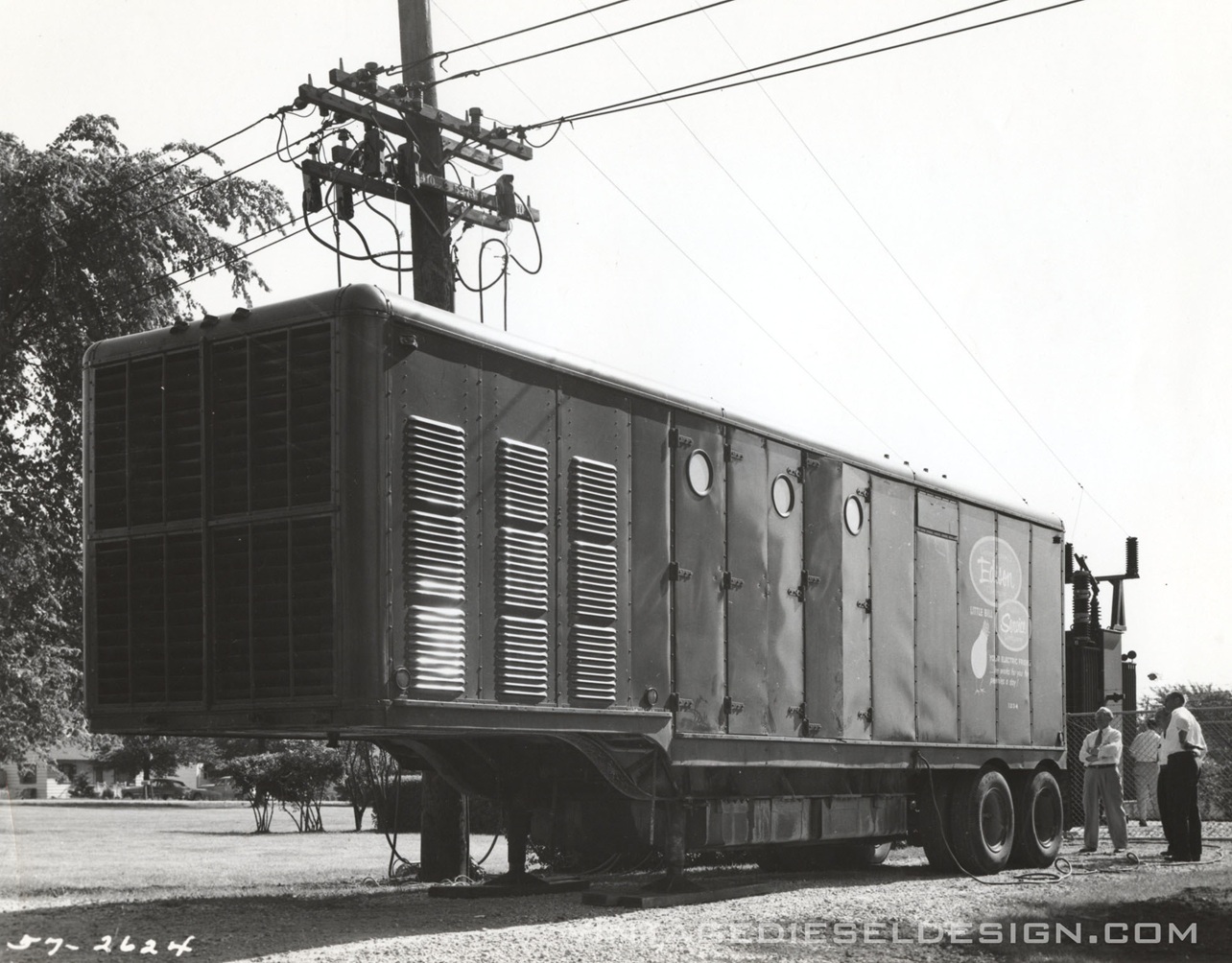
As seen in the advertisement above, Commonwealth Edison of Illinois purchased their MH-8 in 1955. The unit featured the louvered side air intakes. EMD Photo, VDD Collection. Click for larger.
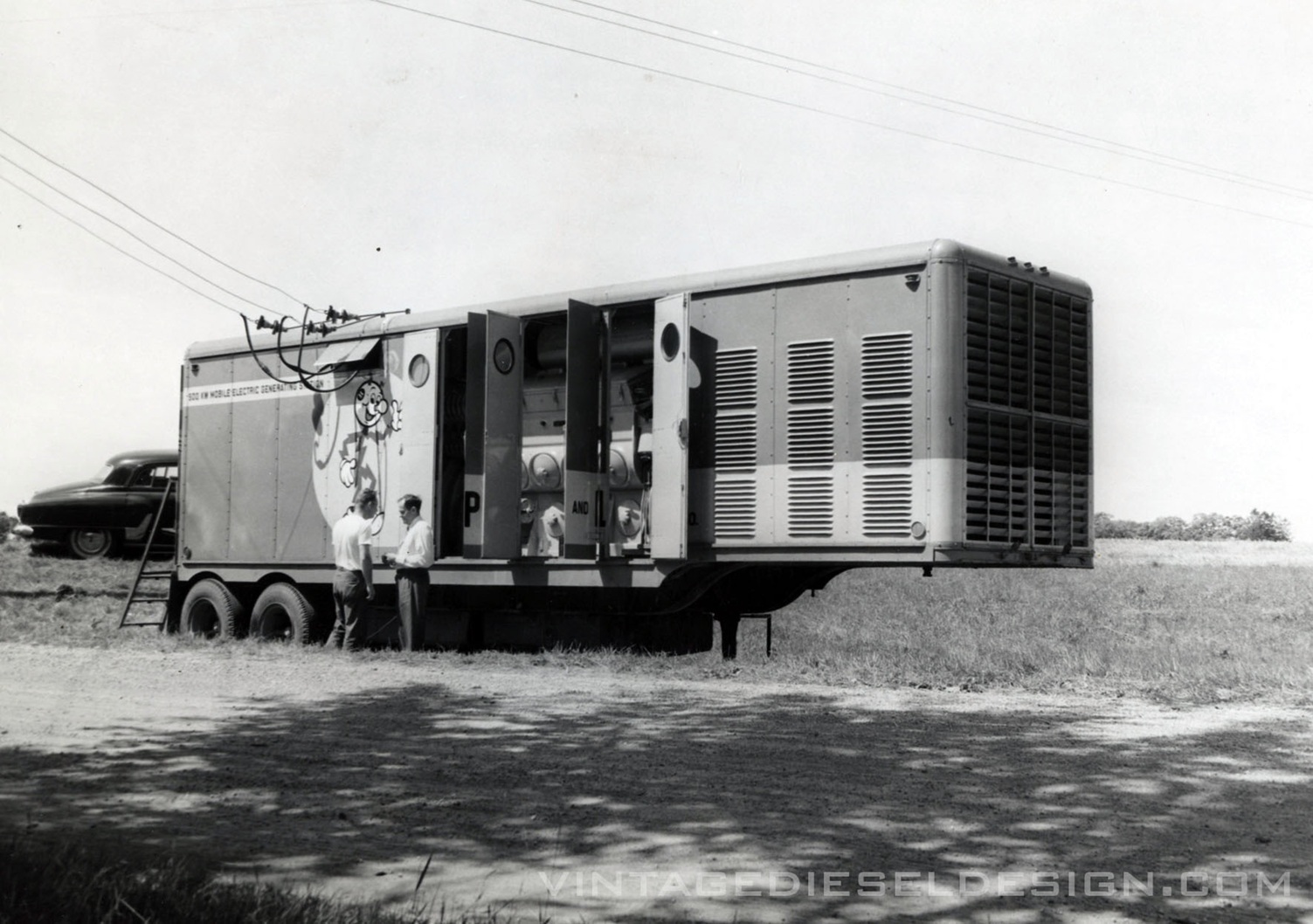
Wisconsin Power & Light Company purchased their MH-8 right after Commonwealth Edison in December, 1955. Note the cables entering into the small hatch on the side just above the gentleman standing. EMD Photo, VDD Collection. Click for larger.
The same trailer has been moved onto another location in rural Wisconsin. The selling point of the MH-8 was that they could be moved to any substation or line by truck, at any time. EMD Photo, VDD Collection. Click for larger.
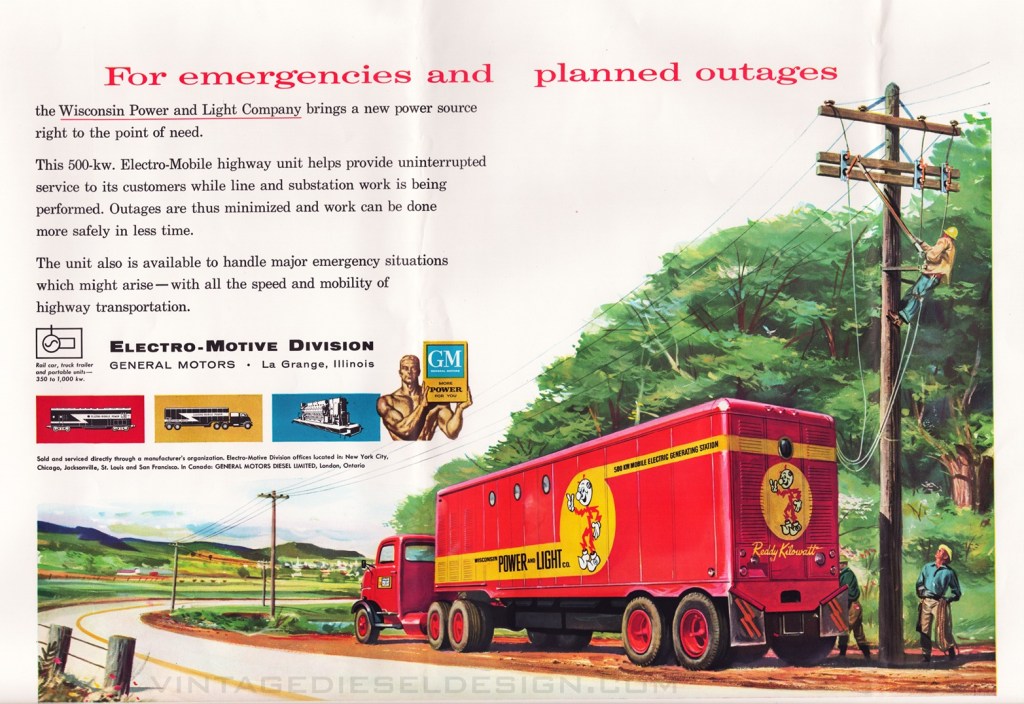
A fantastic 1956 two-page EMD advertisement shows us that the WP&L Co. MH-8 was painted in a splendid red and yellow scheme, with electrical mascot Reddy Kilowatt on the side. 1956 EMD Advertisement, VDD Collection. Click for larger.
EMD put out this basic brochure (below) on the MH-8, with a painting of the production version of the trailer (note the side grills) in demonstrator colors spread out across the front and back covers. Click for larger.
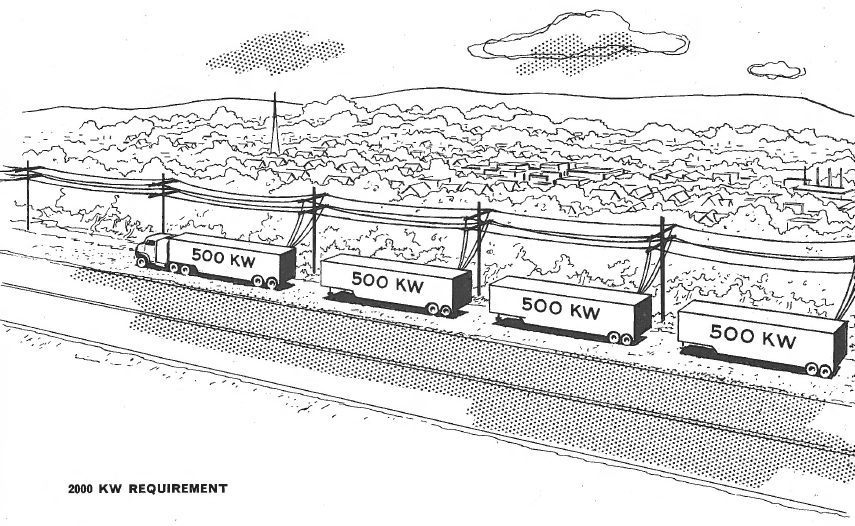
One of the benefits of the MH-8 highway trailer is that there was no limit to how many could be used. Need 500kW? One trailer. Need 1000kW? Two trailers, and so on. EMD Drawing, Jay Boggess Collection.
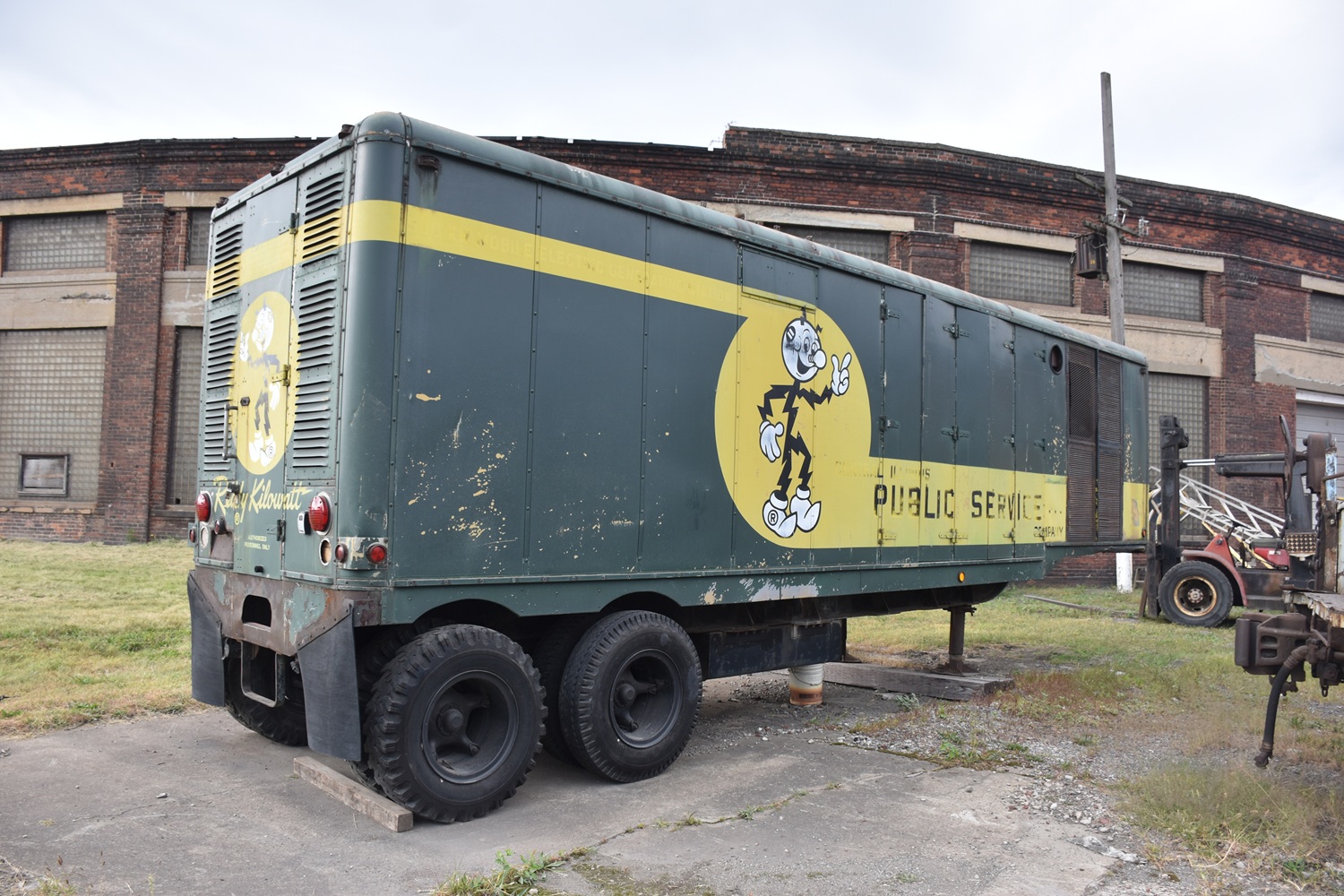
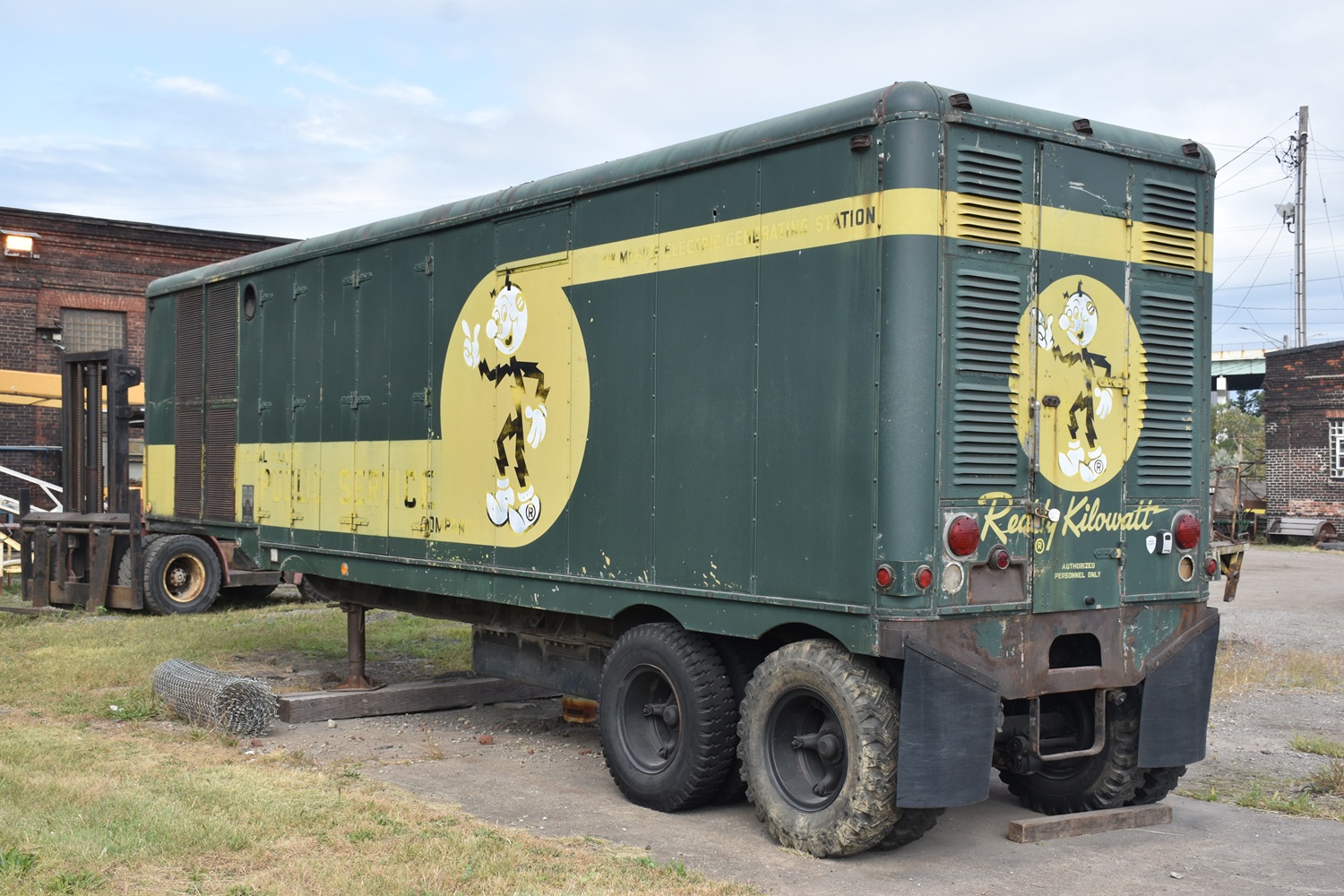
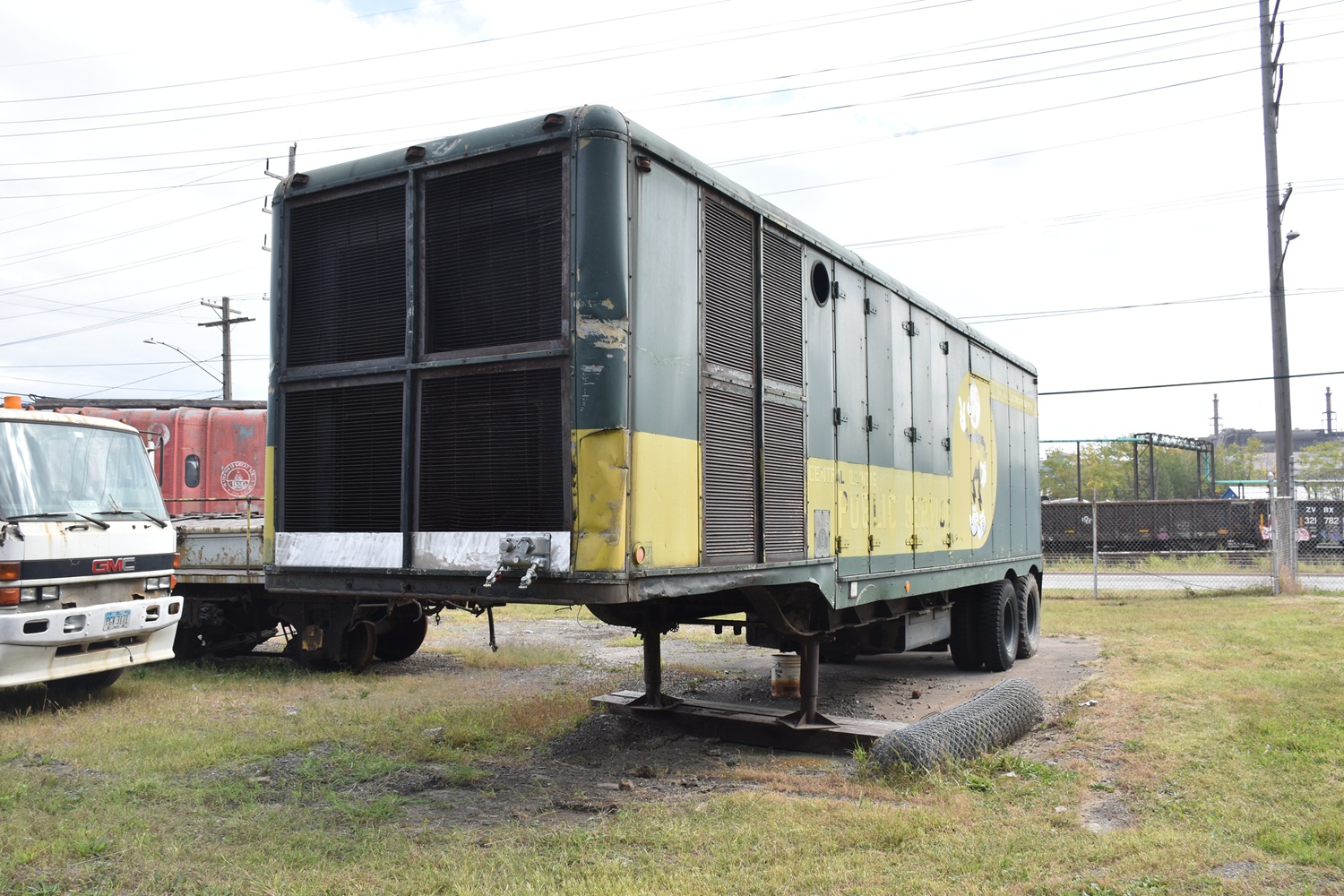
Amazingly enough – There is an MH-8 survivor! Jay Boggess was able to arrange a visit to its storage location to snap some photos. This trailer is S/N 199, built for the Central Illinois Public Service Company in 1956. All of the following photos were taken by Jay. The trailer has since moved into private ownership, and moved to a new location. As far as I know – this is the only known surviving EMD MH-8.
EMD used these large, stainless steel builders plates on the non-railroad items.
Access to the MH-8 is through a basic door in the rear of the trailer. Unfortunately, Jay was not able to obtain any interior photos.
The large radiator intake screens on the side of the trailer. Compare these to the louvers on the ones in the EMD photos above.
The MH-8 had two underslung fuel tanks under the frame, unfortunately one of them is missing on this MH-8.
The radiator discharge at the front of the trailer. Its great to see one of these trailers survive, a very rare piece of Electro-Motive history.
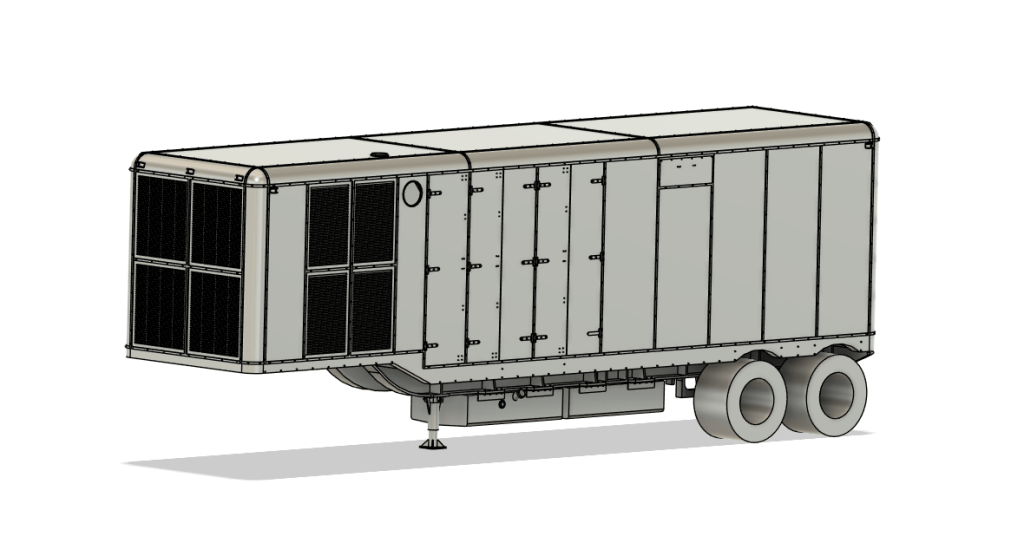
I have been slowly working on drawing the MH-8 in CAD to offer them as a 1/87th Scale kit.
A future installment will cover the M-16 Mobile Power Generating Car, as well as a deeper dive into EMD’s PMI department and such things as the MU Peaking Power Plant’s, Drill Rig’s and other Stationary uses. If anyone has anything to add (or knows of any more survivors) please let me know!


















 Vintage Diesel Design