This week, we have a 1941 classic, featuring the Carl Hussman Company, and a trio of Cleveland 16-567’s.
Click for a larger version
Unfortunately, I can not really say much about Carl Hussman outside of what is in the ad – I cant find anything! Other then they obviously made some spring isolation assembly’s.
What I can add though – is about those engines. The main trio featured, are Cleveland 16-567’s. Yes – They are Electro-Motive Corporation (at the time) designed, and even built in LaGrange – however these engines carried Cleveland Diesel plates. EMC (EMD), Cleveland Diesel and Detroit Diesel all fell under one banner after 1937 – the General Motors Diesel Power line. Locomotives fell under EMC/EMD, Marine and Stationary engines fell under Cleveland Diesel, and small engines up to 250HP under the Detroit line.
These 3 16-567’s were some of the earliest applications of these engines. These engines were shipped 11/1938, as 1000HP/600RPM gen-sets for the Alfred I. duPont building in Miami, Florida. Interestingly enough, 2 of the 3 were listed as being in emergency generator railcars, however as we can see – all 3 are inside the building. It is unknown if the order was changed in the process, of if the plant was reconfigured between 1938 and 1941 when this ad was made.
The 4th engine in the ad, the “225HP 8 Cylinder” is a Cleveland 8-233A engine. This was a small, 200HP/1200RPM engine. As with the early Winton designed engines, this was a 4 stroke, and one of the engines that ultimately would lead to the development of the Detroit 71 series. The 233A line was one of the engines used by Electro-Motive in the early railcars, as well as a yacht propulsion engine, and standby generator used in some early Aircraft Carriers.
The better question is – Are these engines still there?
In 1952, the Great Lakes Towing Company would purchase the former Milwaukee Fireboat “M.F.D. #15”. Great Lakes Towing, looking to build a large lake tug, for doing offshore over lake towing chores, would purchase the fireboat, and strip it to its bare hull. Over the next 2 years, the fireboat was rebuilt into a tug, including its conversion to Diesel Electric drive. Now named the “Laurence C. Turner”, after the president of the company, she would become Great Lakes Towing’s largest tug. The tug was no youngster, built in 1903 by the Ship Owners Shipbuilding Co., in Chicago, and came in at 118’ long, 24’ wide and a 13’6” draft.
1954 Cleveland Diesel ad featuring the “Laurence C. Turner” – Great Lakes Towing’s 25th Diesel Tug. She would go on to become Great Lakes Towing’s flagship for quite some time.
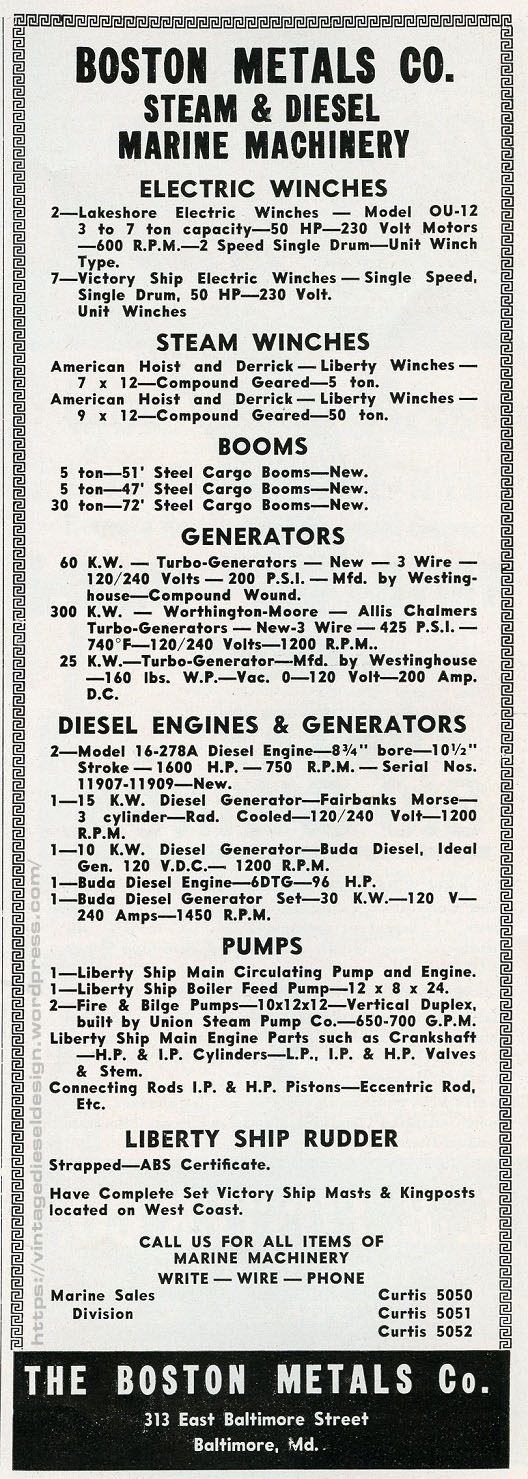
Coincidentally a few weeks ago I was browsing a 1949 issue of Marine News, and came across an ad for Boston Metals Company, advertising a slew of surplus WWII vintage equipment. Boston Metals was a rather prominent ship breaker and scrapped quite a bit of WWII era vessels such as Destroyer Escorts, Landing Crafts of all sizes, Liberty Ships and everything else you can think of.
Naturally, doing all of the Cleveland Diesel research lately – two engines caught my eye. While it was common to see these engines listed in the trade publications for sale, it was rare (as in, I have yet to see it anywhere other then this one ad) to see the actual engine serial numbers listed. So, off to the records…
Record for Cleveland engines 11907-11909 – Collection of my Cleveland Diesel research partner J. Boggess. Click for a larger view.
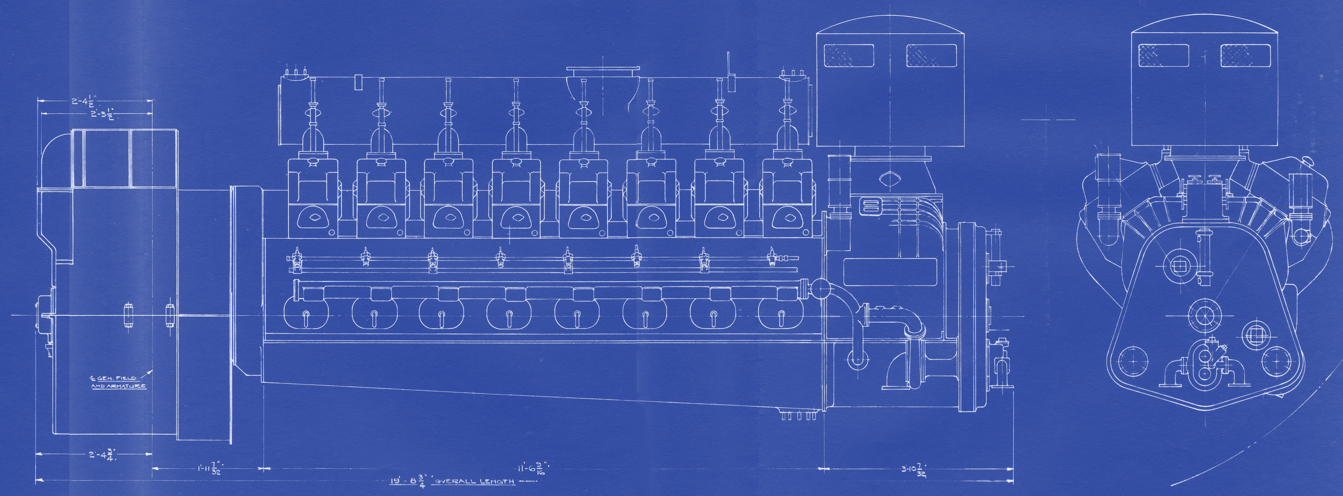
Engines 11907 and 11909 were originally part of Cleveland Diesel order #4752, which covered a vast portion of Destroyer Escorts. These specific engines (and two others) would go into 1943 built DE-278, to be named the “USS Tisdale”. DE-278 was never commissioned in the US and went to Britain as part of WWII Lend-Lease and would be commissioned by the Royal Navy as the “HMS Keats”. She would receive partial credit for sinking German U-Boat U-1172 as well as U-285. After the war, the Royal Navy returned the “HMS Keats” to the US, where she would be sold for scrap in 1946. The other pair of 16-278A’s from the “HMS Keats” would wind up in Norway, in the “MS Rogaland”.
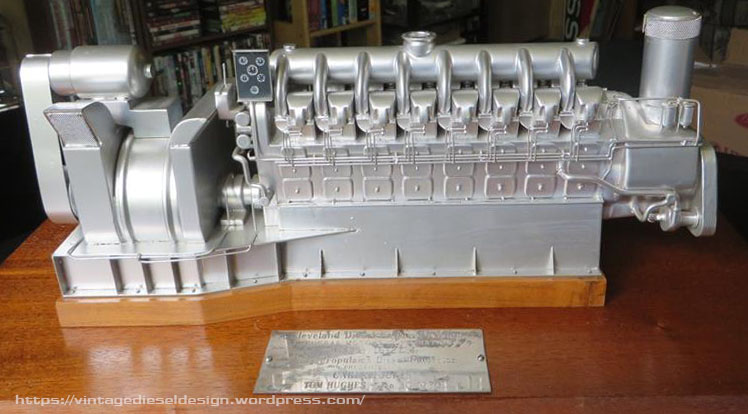
Cleveland 16-278A Propulsion Package model.
“HMS Keats” was powered by 4 “Navy Propulsion Diesel Generator” packages. These were a 1700HP Cleveland 16-278A engines, which drove an Allis-Chalmers 1200kW, 525V DC generator. In turn these provided power to 4 Westinghouse 1500HP DC motors, of which two in tandem drove each prop shaft. After the war, Cleveland Diesel would wind up purchasing back quite a number of engines, which in turn they rebuilt to new condition and resold. In some cases, new serial numbers were added, however some kept their original number. Cleveland would wind up with two engines from the “HMS Keats”. Each of these engines were put on a single base, with one of the Allis-Chalmers generators, as well as adding a belt driven 35kW generator mounted on top of the main generator. This power package (along with a single Westinghouse motor) would be a very common tug propulsion package, and we will dive into that more down the road in a future article.
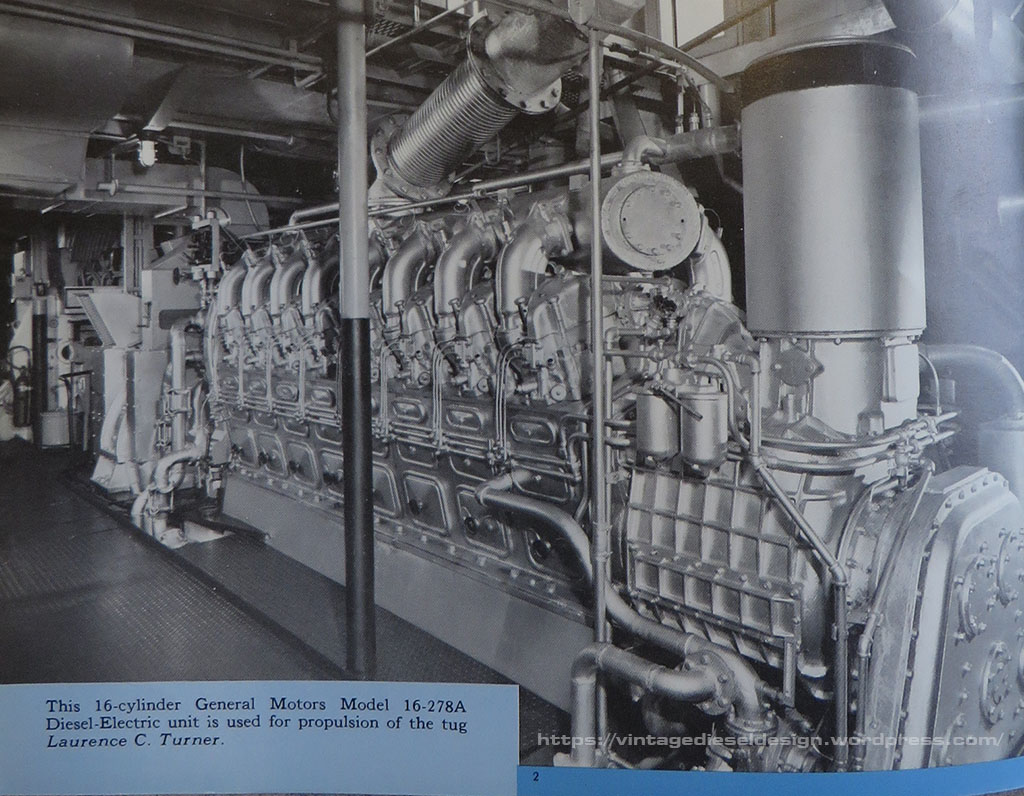
Engine room of the newly converted tug, from the 8/1954 issue of Diesel Times, which featured the “Laurence C. Turner”.
Engine 11907 was rebuilt and sold to Tracy Towing Line in NYC, and used in the tug “Helen L. Tracy”, and 11909 would go to Great Lakes Towing Co., for use in the “Laurence C. Turner”. By now the “Laurence C. Turner” was totally rebuilt, and now looked like a tugboat, and not a fireboat. The tug would have provisions for a crew of 13, a large central galley, 7 state rooms, 2 heads, and an 18 person lifeboat. One interesting feature was the Almon-Johnson electric towing machine on the back deck.
In 1972, the “Laurence C. Turner” was renamed as the “Ohio” to fit in more with the fleets state class naming. In 1977, she was re-powered. Out came the electric drive, and in went a brand new, 2000HP EMD 16-645E6 engine with a Falk reverse-reduction gear and air clutches. All of this drives a 102″x72″ 5 bladed wheel.
The new engine in the “Ohio” – a 2000HP EMD 645, taken in the same spot as the photo above. Ohio has one of the largest engine rooms of any single screw tug I have ever been on.
The “Ohio” would be Great Lakes Towing’s main lake tug until being laid up in late 2014. 111 years of service, 60 of which as a tug – Not bad! But her life did not end there. In 2018, the Towing Company donated the “Ohio” to the National Museum of the Great Lakes, in Toledo, Ohio. The “Ohio” was moved into place at the Museum in October of 2018 and has been under restoration since. “Ohio” has been fully water blasted, repainted, and cleaned up. The Wheelhouse has been fully restored, and work is well underway by volunteers on the rest of the boat. “Ohio” will be dedicated this coming week as a museum ship, and alongside her will be the new tug “Ohio” getting christened at the same time as Great Lakes Towing’s newest tug. The “Ohio” will be an excellent addition to the museum and will be open for tours later this year.
“Ohio” now at home at the National Museum of the Great Lakes, in Toledo. In rear, is the “Col. James M. Schoonmaker”, one of the most exquisite museum ships I have ever seen. This was in October of 2018, before the restoration started.
This week, we feature a prominent local shipyard – Jakobson Shipbuilding, in Oyster Bay, New York. Jakobson (originally Jakobson & Peterson, located in Brooklyn), moved out to Long Island in 1938, and would become very well known for their quality, and typically overbuilt vessels, especially tugboats.
Jakobson would overtime work very closely with TAMS Inc. Naval Architects, Merritt Demarest, Marine Design Inc. (Joe and Al Hack), Cleveland Diesel, EMD, Moran Towing and many others.
“Southern Kraft #9” was designed by Merritt Demarast, and used for moving pulpwood barges in South Carolina. She was covered in the April 1955 issue of Diesel Times, the Cleveland Diesel newsletter.
Jakobson (very often misspelled Jacobson) would keep busy right until the late 1980’s led by George Hossfeld. Jakobson Shipyard’s last new construction was the tug was the “Consort”, built for Express Marine in 1984.
“Julia C. Moran” (and sister “Eugene F. Moran”), designed by Joe Hack, then working at TAMS Inc., was one of the few new tugs that did not last long at Moran. She was sold to Venezuela by the mid 1950’s and renamed the “Puerto Ordaz”. Moran would replace the tug with the former Lehigh Valley tug “Wilkes Barre”, a nearly identical boat, which they also named “Julia C. Moran”. This has created much confusion for historians over the years. Note that Jakobson is misspelled on the ad.
Ultimately, the yard would be sold to Moran Towing, who used it as their personal shipyard, as well as doing other outside work using their marine railways, and a single small drydock. The yard closed in 1993, and the property sold to the town in 1997, where it is now a park. Very little remains of the original yard.