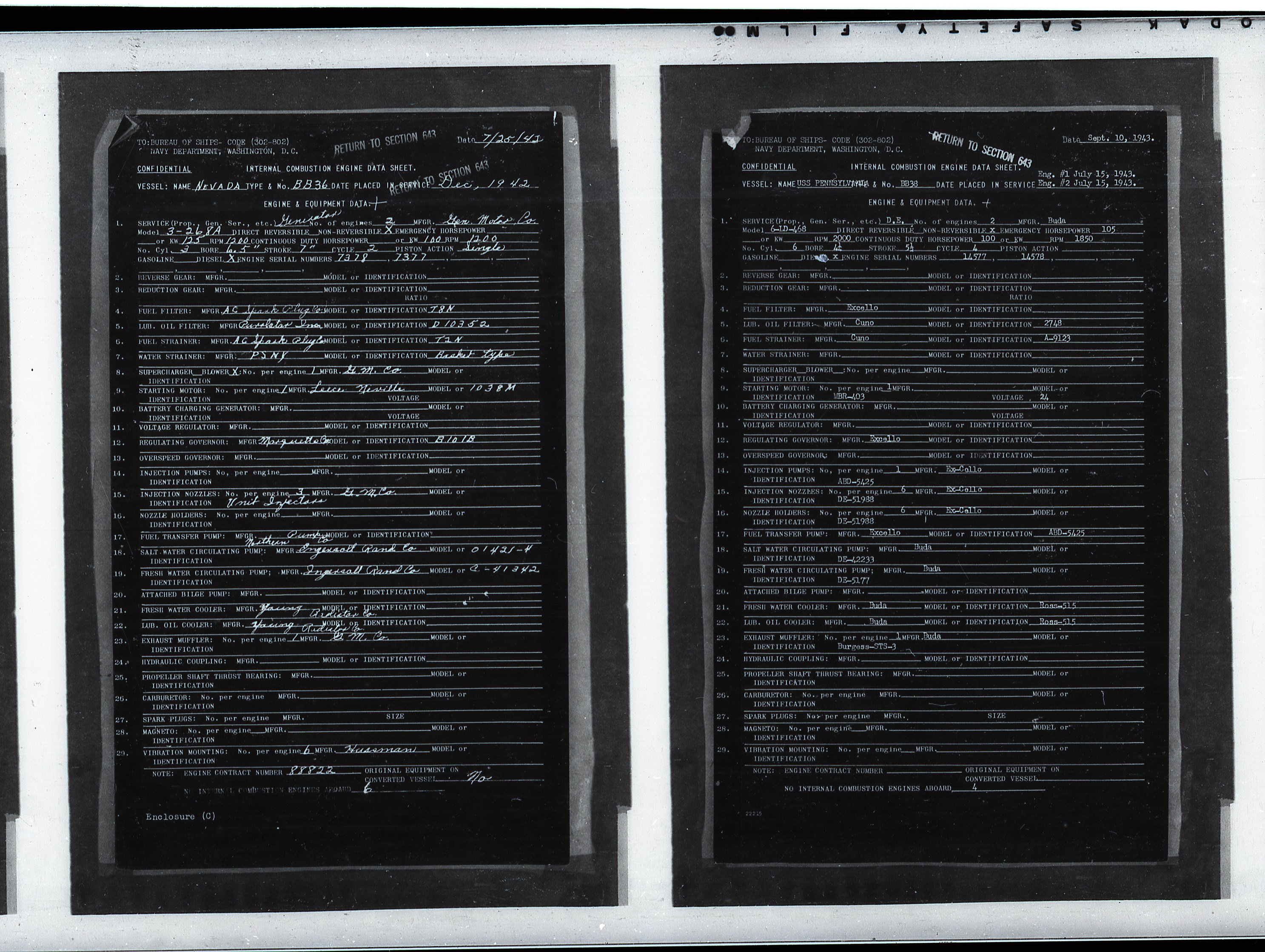
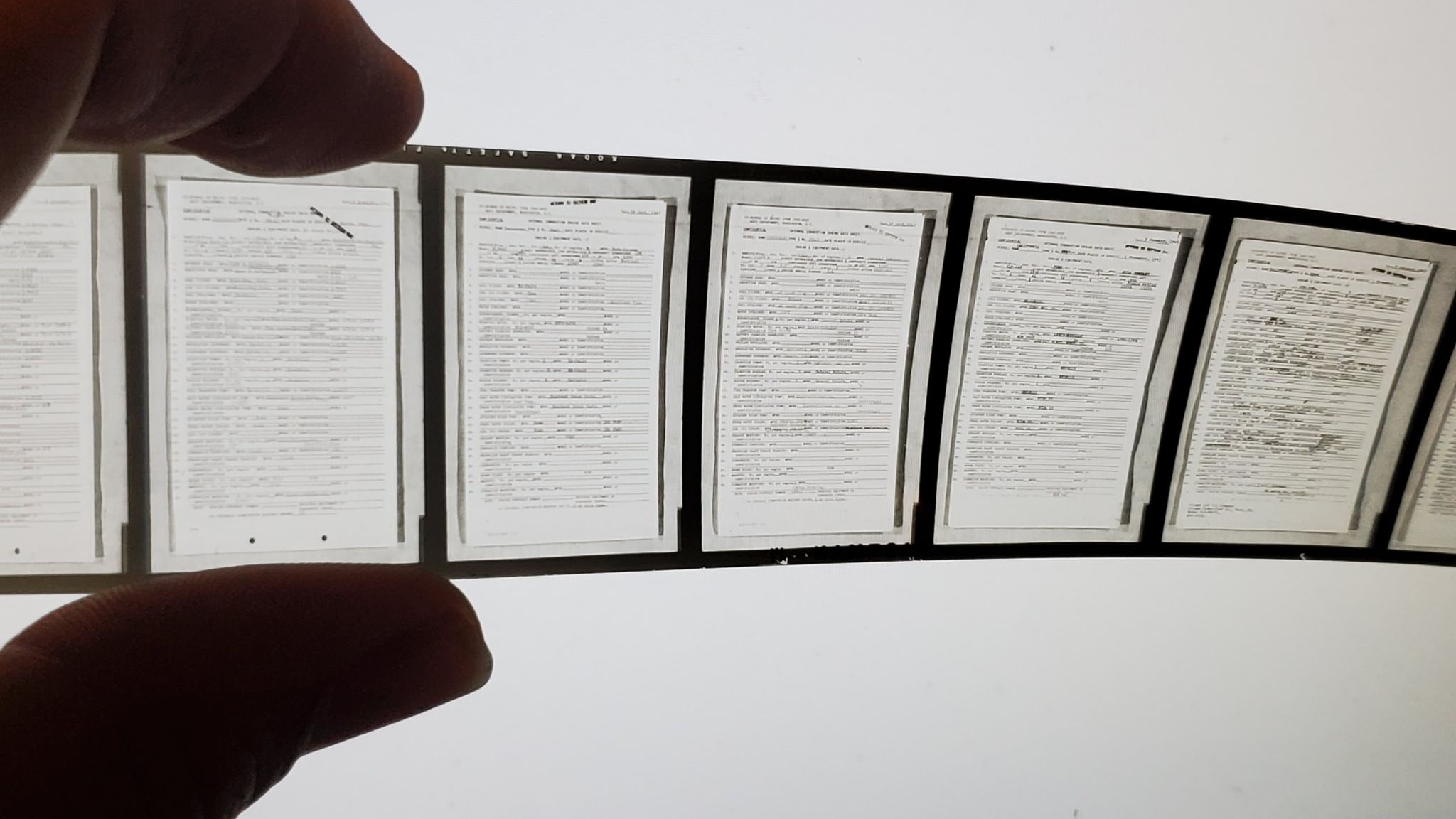
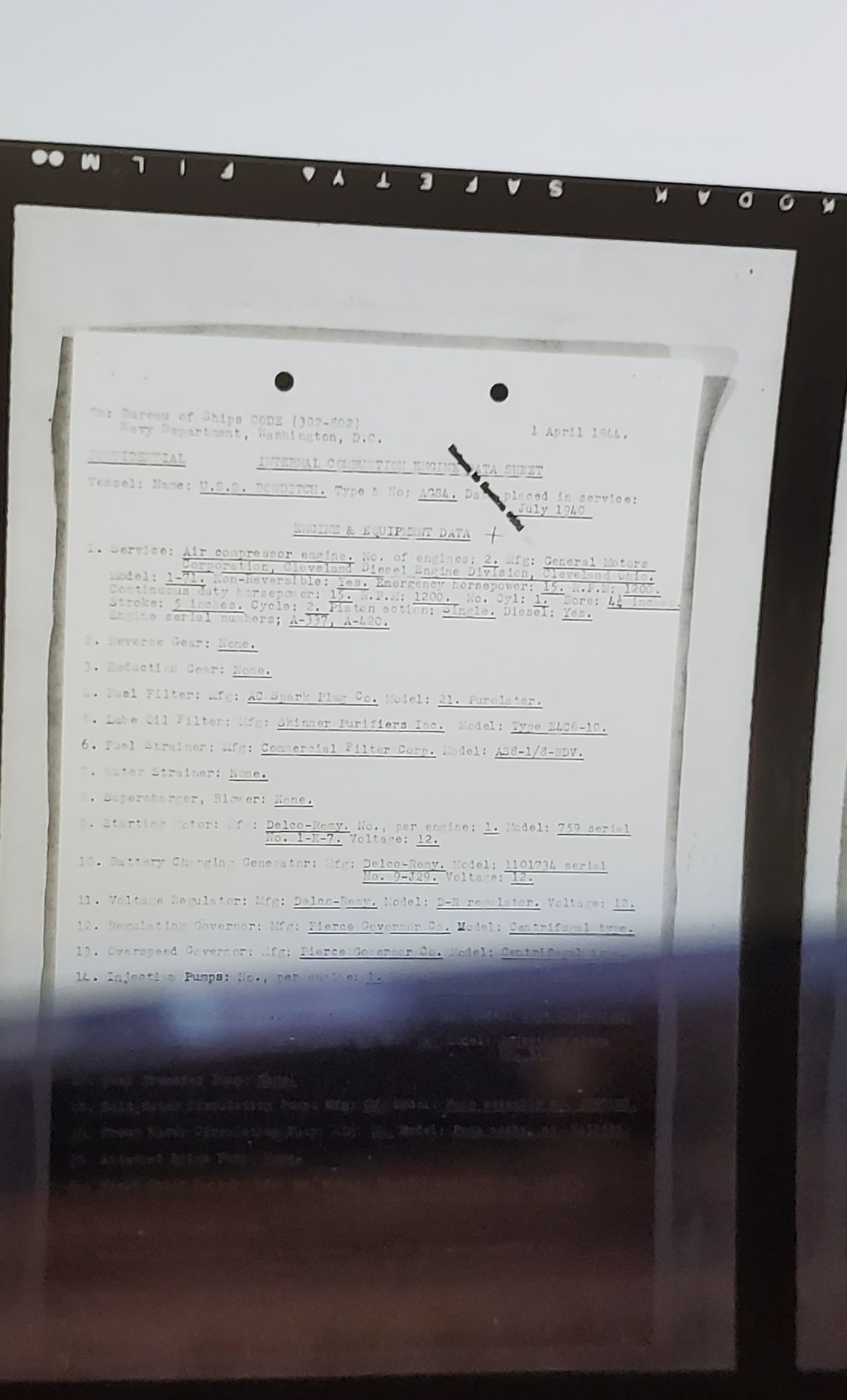
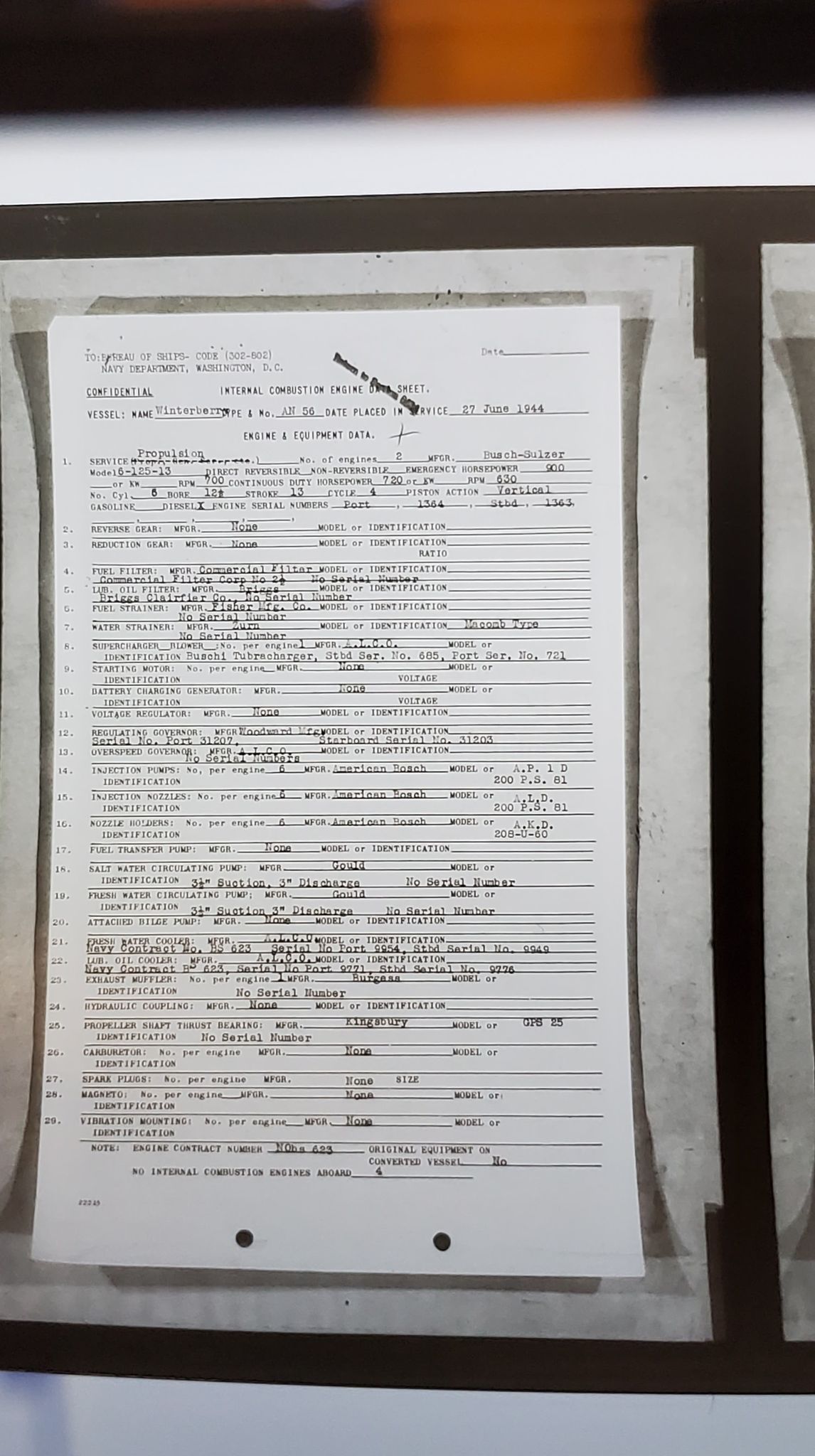
As I mentioned here a few times, I picked up a few rolls of microfilm a few years ago, including 3 rolls marked as “Diesel Data Sheets”. Unfortunately, there is no index on the rolls (that I can see..). Last night I went through them out of boredom, and was shocked to see sheets for a vast array of boats, including engine’s from a number of companies. I guess I need to find a microfilm scanner now. If my math is correct, each roll is 100 feet, 20 frames per foot, so about 2,000 images per roll. It is a lot of data! I have an idea to design and 3D print a holder so I can scan them on my flatbed, but that might take forever.
Click for larger
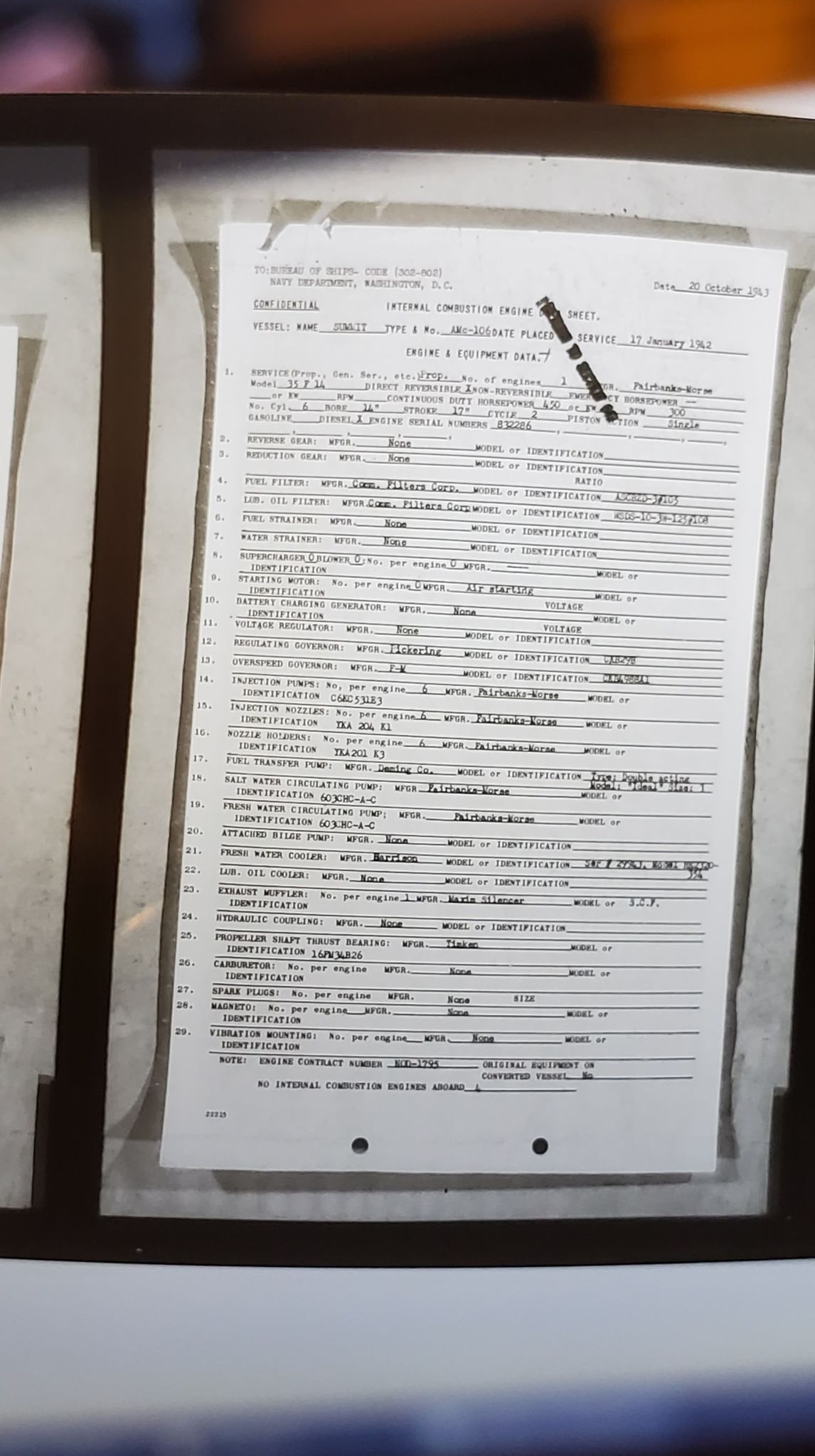
A few random examples (click for larger):
I saw data sheets for ships from the teens through WWII, with engine makes such as Busch-Sulzer, Enterprise, Cleveland, EMD, Detroit, National, Ruston-Hornsby, Stover, Fairbanks, Alco, Norfolk Navy Yard, Buda and others. Hopefully in time I will be able to digitize these, along with the other reels I have.
Remember, only a few weeks left to pre-order my book on Railroad Tugboats (which has lots of cool engine stuff in it also!)
Summer 2025 Update – The book has sold out! Thank you to everyone who supported this project! The book can still be found on ebay and other online sellers. Volume II will be coming down the road.
After several years, my comprehensive book on Diesel Railroad Tugboats is now available for preorder! This book will cover chapters on all the major designs on the East coast such as Tams Incorporated, Thomas Bowes, General Managers Association, and early oil-electric designs.
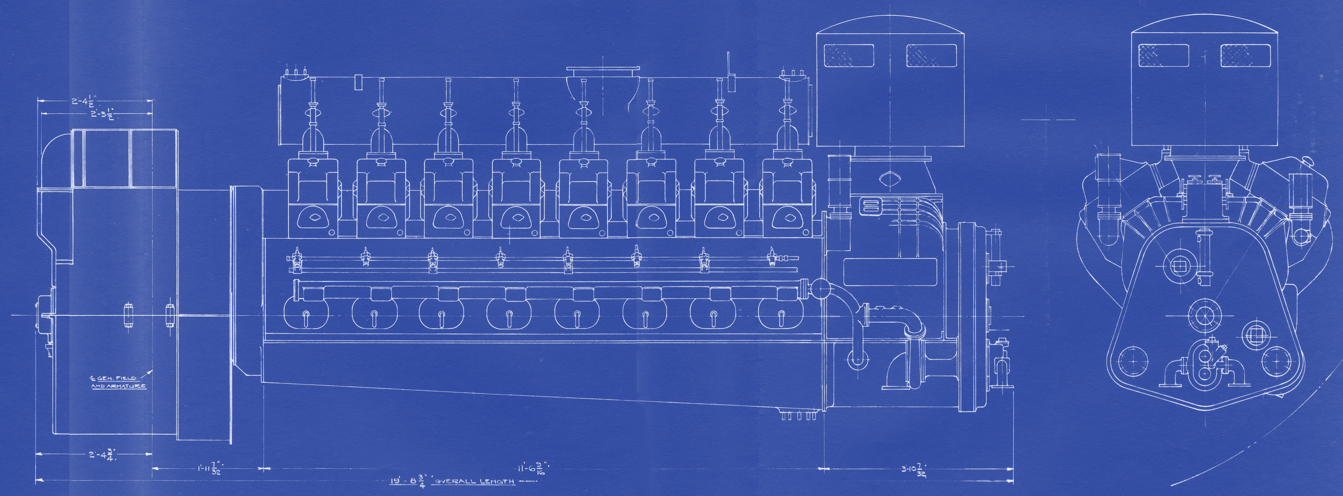
Over 75 tugs and their original owners are covered, as well as a vast section documenting what happened to these tugs, the last operations of railroad tugs, subsequent owners, and final dispositions. More then 250+ tugs will be pictured, along with numerous blueprints, drawings and technical data.
Operations and owners that will be covered include New York Harbor, Delaware River (Philadelphia and Wilmington), Norfolk (Hampton Roads, Sewell’s Point and Little Creek area operations) and Baltimore Harbor. Railroads featured include: Erie, PRR, BEDT, NYC, RDG, LIRR, LV, NH, B&O, CNJ, Dalzell, BTRR, NYD, DL&W, C&O/Chessie, VGN, SOU, V&M/ESHR and NYCH.
A little more insight as to just what is inside – Sections will cover: What’s inside a railroad tug: engines, propulsion systems, construction elements, how steering works, interior layouts, etc. Oil-Electrics: The original Diesel tugboats designed for railroads. Tams Inc. & the GM powered tugs. Tugs by Thomas Bowes & powered by Fairbanks -Morse. The railroads own design – General Managers Association tugs.Tugs for Norfolk, covering the C&O, Chessie, PRR/V&M, Virginian and Southern. The last stand, featuring the last original owners of railroad tugs on the Brooklyn waterfront. A huge photo gallery covering railroad tugs after railroad ownership. And finally, a large appendix with dispositions of every boat and a large amount of technical data and extras.
Railroad tugboat operations were unique, and the designs of these boats were specific to the needs of the railroads they served. This book appeals not only to railroad enthusiasts, but to maritime historians interested in this unexplored chapter of tugboat design and operation.
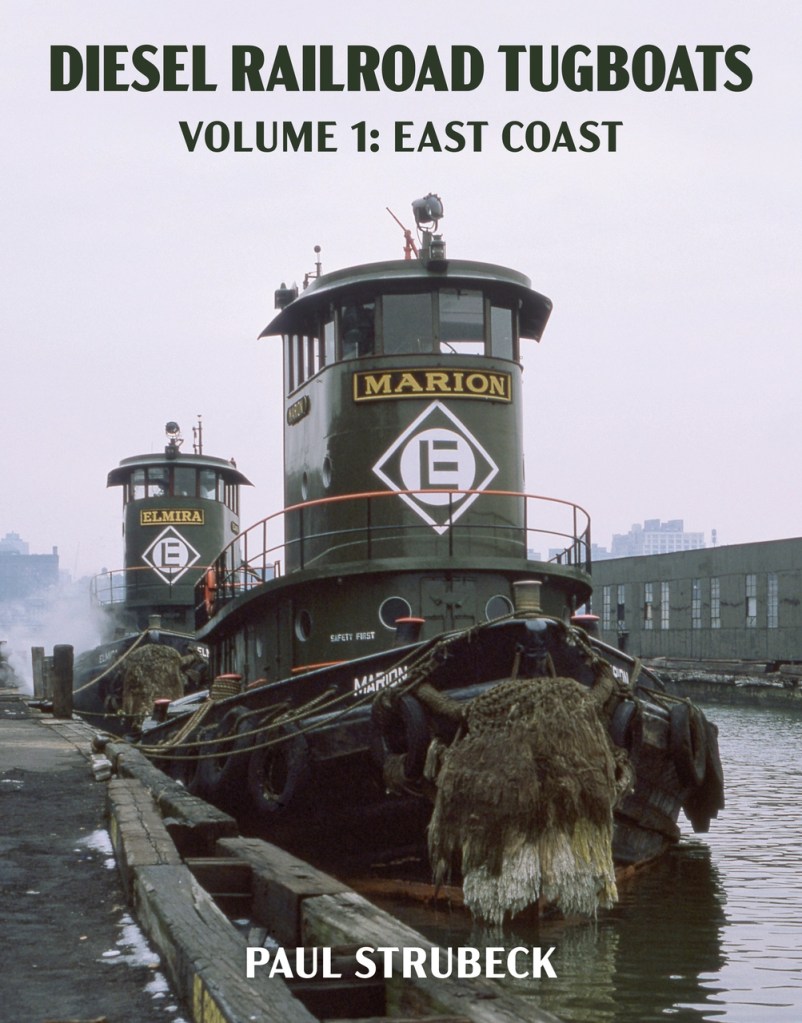
Pictured on the cover is the Erie Lackawanna tug Marion, photographed by Charlie Berkemeyer in 1975, in one of the most recognizable scenes in Hoboken, New Jersey. On the rear cover is a wonderful painting by noted maritime artist Dave Boone of the New York Dock Railway tug Brooklyn, Southbound on the North River. This is going to be a big book! Over 400 photos, numerous blueprints and drawings and a great deal of history of each of the designs. Be sure to get your preorder in!
Tugs featured in this book include (subject to change): Fred A. Cassidy, Olean, Long Island, Integrity, Intrepid, Rochester, Elizabeth, NYC #34, Elmira, PRR No. 18, PRR No. 15, PRR No. 16, Wicomico, Cleveland, Hornell, Marion, Akron, Elmira, Binghamton, Paterson, Lehigh, Bethlehem, Capmoore, Cornell, Wilkes Barre, Hazleton, Bumble Bee, Cordelia, Transfer 23, Transfer 24, Carol Moran, Altoona, Chicago, Roy B. White, Howard E. Simpson, William C. Baker, Walter L. Price, J.W. Phipps, Liberty, Communipaw, Sandy Hook, Sound Shore, Dalzell 1, Dalzell 2, Dalzell 3, Lacey 2, Lehigh, Delaware, Brandywine, Schuylkill, Tamaqua, Shamokin, Irving T. Bush, Brooklyn, Buffalo, Syracuse, Hoboken, Nazareth, Harrisburg, Pittsburgh, Cleveland, New York, Philadelphia, Chicago, Trenton, Indianapolis, Jersey City, Newark, Buffalo, W.R. Coe, R.B. Claytor, Accomack, M.I. Dunn, Walter J. Tuohy, J. Speed Grey, Howard E. Simpson, Brooklyn III (NYD), Brooklyn III (BEDT), Cross Harbor I, New Jersey, New York, Roy B. White (NYC), Williamsburgh, Petro Arrow, Petro Flame, James M. Witte, Cornell, Hercules, Pleon, Karen Tibbetts, Kyle Smith, Ned Ferry, Texas, Florida, G. Shelby Freidrichs, Margaret F. Cooper, Glenn Smith, James McAllister, Staten Island, Catherine McAllister, Yemetzis, Commander, Scandinavian, Fort Fisher, Bradenton, Tumbador I, Eric M. McAllister, Palmetto, Elizabeth, Thomas E. Moran, NYC No. 34, St Phillip, Timothy McAllister, Big Daddy, Edith Thornton, Carol Wales, David McAllister, Jeanne C., Elizabeth, Theresa S. Krause, Brandywine, Leo, Shamokin, Fall River, Mack Point, Blue B., Leonard J., Russel B. Murray, J. L. Krause, Narragansett, Cornell, Christopher B. Turecamo, Patrick R. McAllister, Virginia, Hawkins Point, Julia C. Moran, Marie Moran, Deborah Quinn, Neptune, Steven McAllister, Swan Point, Captain Bill, Blacksmith III, Nancy McAllister, Mobile Power, Fort Caswell.
And before anyone asks – Volume II down the road will cover Great Lakes, the West Coast and all other Diesel Railroad tugs. After release, a dedicated page will be on this website to maintain an errata as well as any extras.
Please visit https://store.garbelypublishing.com/tugboats1/ for ordering information. Preorders are due July 17th 2022, with a fall delivery. This is a limited run book, so be sure to preorder if you want a copy!
I have two c. 1944 advertisements in my collection – both featuring a Type 327 ST tug, built for the US Army, one from Enterprise, and the other from Busch-Sulzer.
You will note….both advertisements feature the same tug, ST-246! These 86′ Type (design) 327 tugs were built throughout WWII by numerous shipyards across the country and used 3 main types of propulsion, all of which were direct reversing engines:
Enterprise Engine & Foundry Co. – DMG-38: 8 cylinder, 12″ x 15″, 650HP Busch-Sulzer – 6DFMT-17: 6 cylinder, 13″ x 17″, 650HP Clark Brothers – MD-6: 6 cylinder, 12 /2″ x 16″, 650HP
It is likely that both of these companies used a stock photo provided by the Army, however it is indeed good for a laugh. A good portion of these tugs went on to postwar careers, many of which would get EMD 567ATL repowers. The Great Lakes region is home to a handful of these, as well as some with original Enterprise engines. The Enterprise seems to have been the better choice of the three. Other classes of ST tugs built during WWII featured a swath of other engine makes, including EMD, Atlas Imperial, Cat, Superior-National, Buda, Kahlenberg, Fairbanks-Morse and others.
Sarter Marine Towings Susan L (ST-709) is still powered by her original Enterprise DMG-38, and is likely one of the only direct reversing tugs still working commercially.



 Vintage Diesel Design