Tug Profiles II – Thomas E. and William J. Moran

3rd in our series of Historic Boat Profiles – Links to the others will be on the bottom of this posting.

New York City is home to one of the most recognizable towing companies in the world – Moran Towing & Transportation.  Moran was founded back in 1860 by Michael Moran.  The company would become one of the largest tugboat firms on the east coast.   But, this is not a history of Moran Towing – for that I defect to the company history on Tugboatinformation: https://tugboatinformation.com/company.cfm?id=59

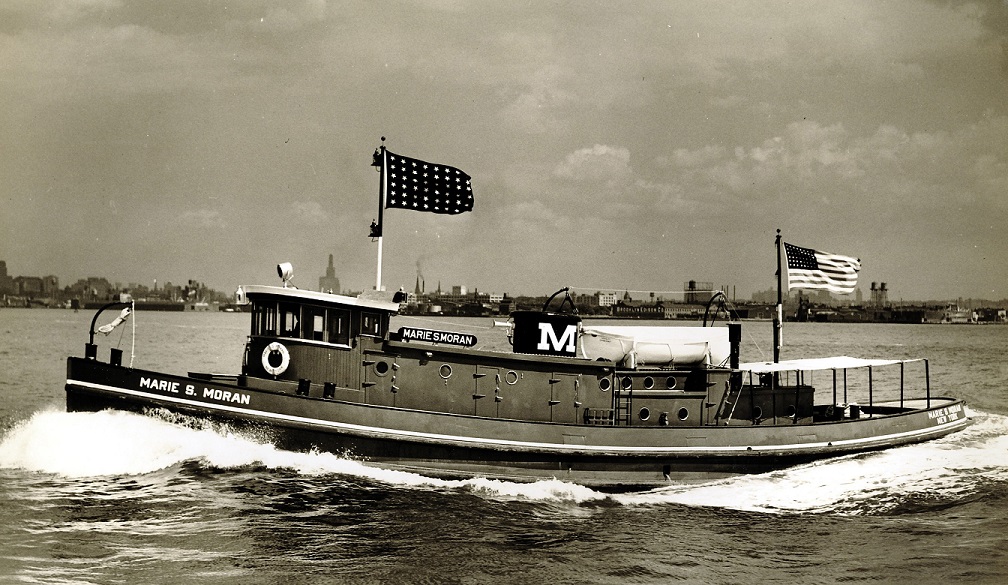
In 1936, Moran was operating a fleet of around 40 tugboats, from small Canal tugs, to larger ocean going and everything in-between.   A new era opened in the fall of 1936 – The Marie S. Moran was launched.  She would become Moran’s very first diesel powered tug. 
555
Winton publicity photo of the brand new Marie S. Moran. Courtesy of the Dave Boone Collection.

The Marie would be powered by a single direct reversing Winton 6-164 engine, a huge 15”x22” engine making a mere 550HP at 275RPM.  The 89’ tug was designed by Edmund J. Moran himself, and built at Pennsylvania Shipyards in Beaumont, Texas.  The low profile tug was designed for use in the New York State Barge canal, composed of the Erie, Champlain, Oswego, Cayuga & Seneca canals, all of which required the low profile due to numerous low bridges and whatnot.  When Marie S. Moran was constructed, Diesel engines were still being “figured out” so to speak, and companies would tend to try different engines and combinations.  Like many tugs of the era, the Marie would be retrofitted with a retractable wheelhouse later in her life (more on this later), and the original Winton would be replaced with a more reliable 12-567 engine.  The tug was sold foreign in 1961.  Two more similar tugs would be built in 1937, the Eugenia M. Moran and Elizabeth W. Moran, powered by Alco-Sulzer engines. Both of these would also be sold foreign in 1950’s as well.

 Skip ahead just a few more years to 1938.  Electro-Motive, under GM introduced the new 567 engines, and Moran was looking for some more canal tugs, so the two would become one with the introduction of Thomas E. and William J. Moran.  A new relationship would be born as well, Moran Towing working with Tam’s Inc. and General Motors. 

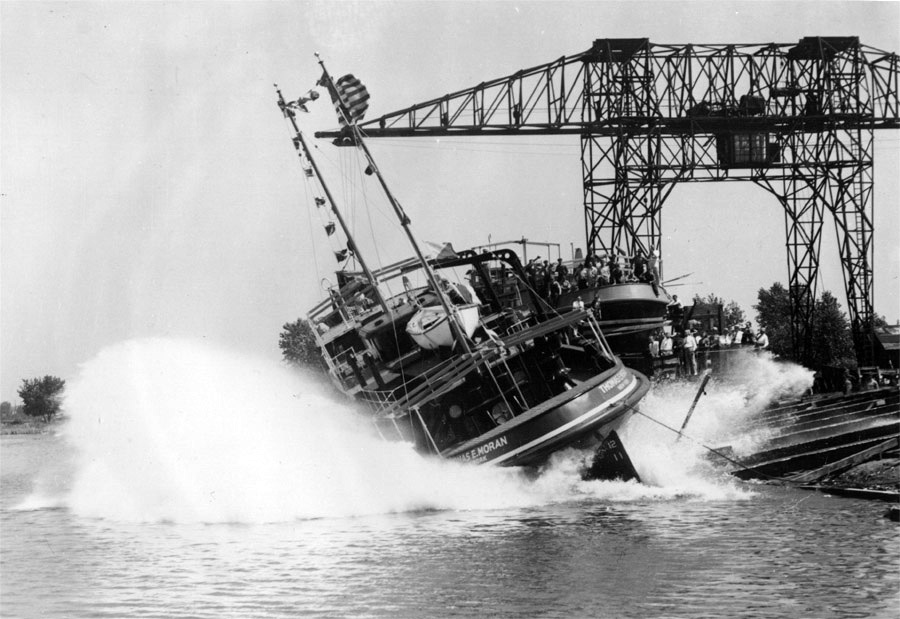
The Thomas E. Moran on is on the slipways in Bay City, Michigan. It looks like both tugs were launched the same day! Click for larger. Courtesy of the Dave Boone Collection

The tugs would mark another milestone – breaking Tam’s, Inc. into the world of tugboats. While I do not know if they were the very first ones, they would be the ones that really set the pace. Tam’s was well versed in yacht design, as well as being a broker and insurance company. Working with Winton on yacht design would start the relationship with GM as well, being that GM now owned Winton. Beginning in 1938, and lasting for only about a year, General Motors marketed all three engine divisions (Winton {soon to become Cleveland}, EMC and Detroit) under the single “General Motors Diesel Engine Division”, even though the three companies were still operating individually.

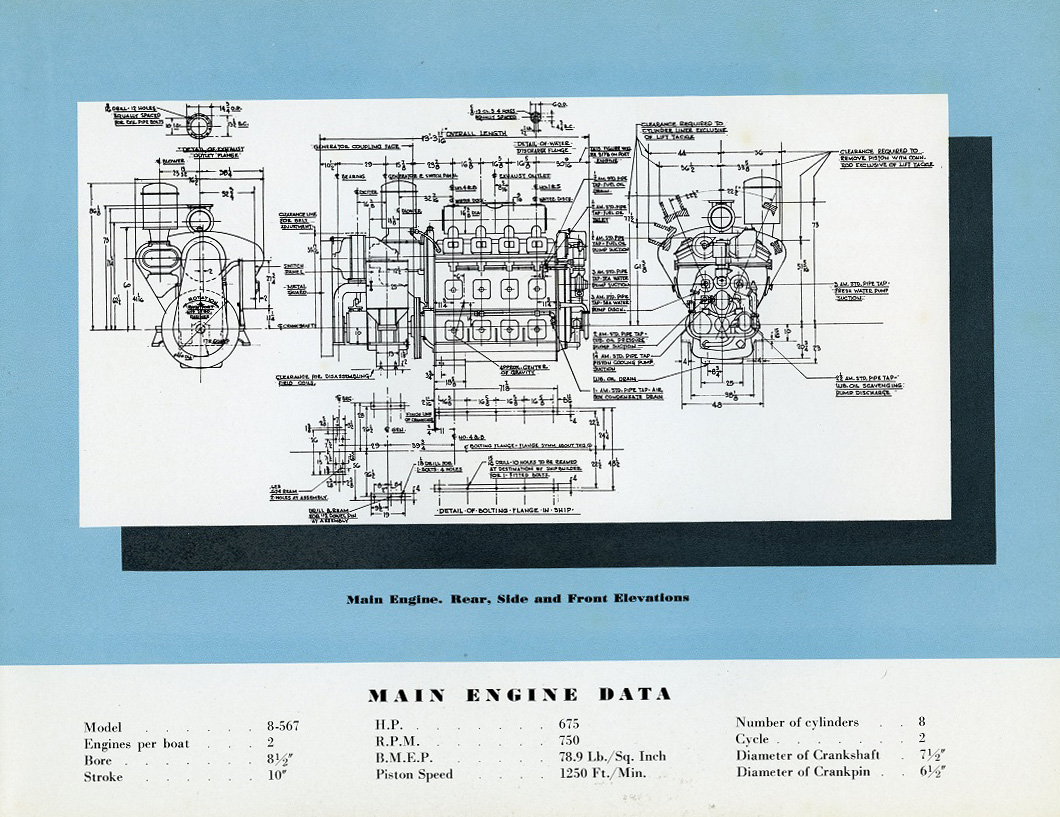
The Thomas & William were featured in the 1940’s booklet “Diesel-Electric Vessels Powered by Cleveland Diesel”. Click for larger.
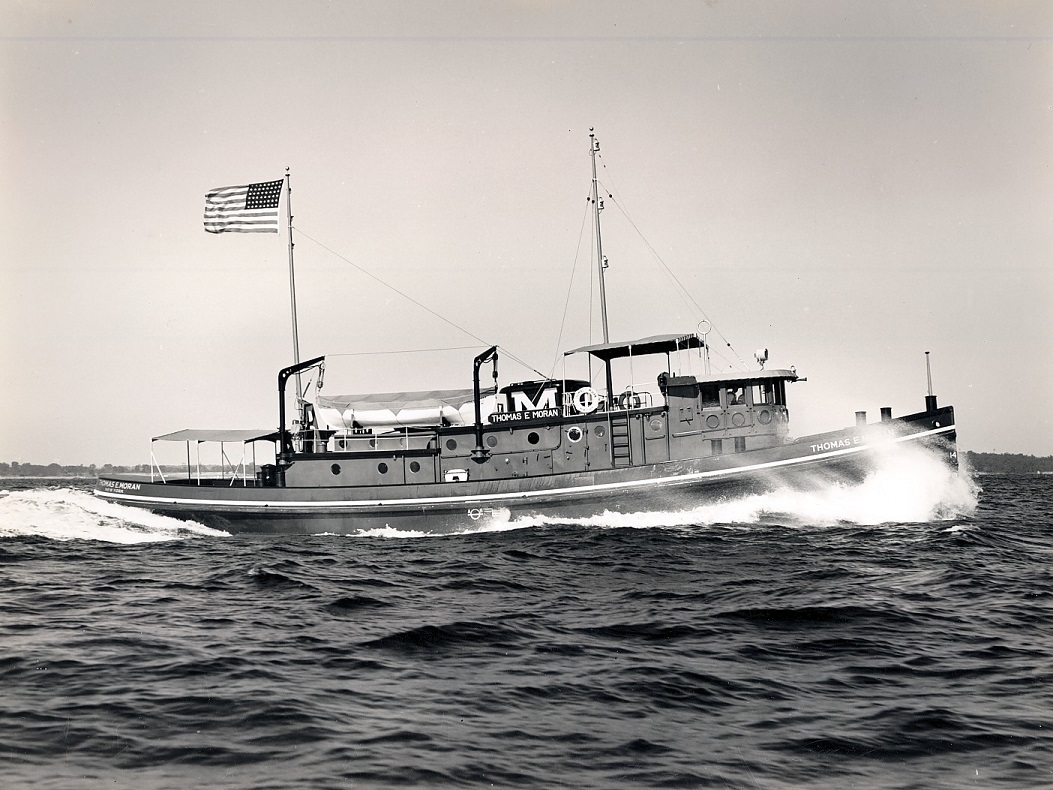
The brand new Thomas E. Moran on her sea trials, likely somewhere in Saginaw Bay. Click for larger. Courtesy of the Dave Boone Collection.

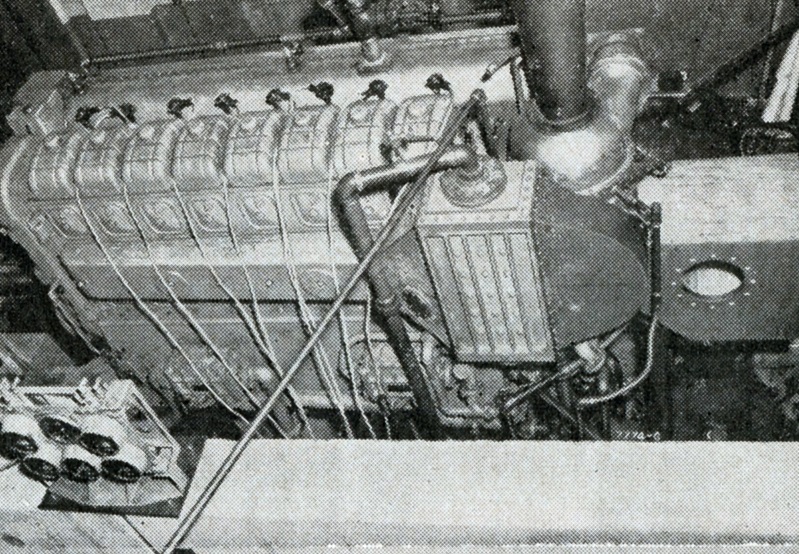
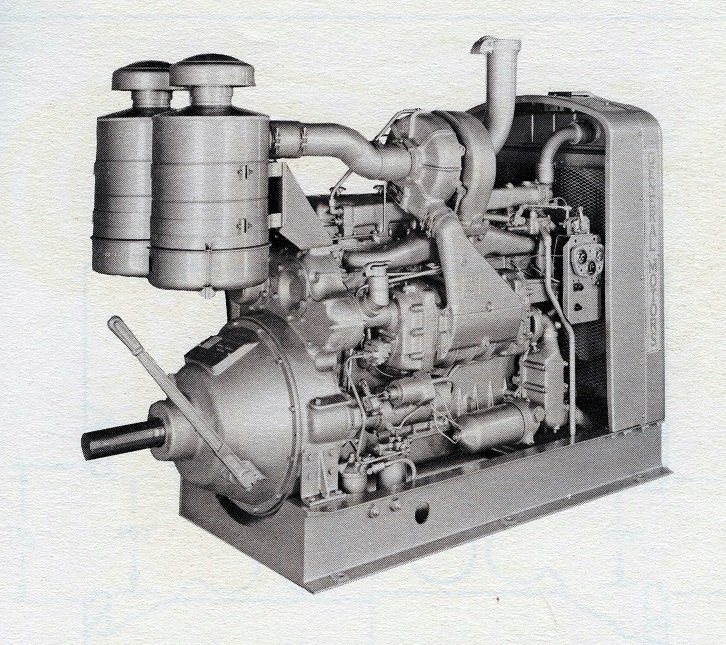
I was first introduced to the Thomas & William in detail when my partner in Cleveland research Jay Boggess showed me a scan of a GM booklet he had: “A New Conception of Diesel-Electric Drive”, which featured the two tugs in depth. Designed under Richard Cook at Tam’s, the tugs were 94′ 4 1/2″ long, with a 25′ beam. The all welded tugs were built in Bay City, Michigan at Defoe Boat & Motor Works. Diesel-Electric drive was not a new concept by any means, however using it with newer, medium speed engines was. Electro-Motive developed the new 567 engine in 1937 for railroad use, having learned from the lessons of the Winton 201A. However, interestingly enough, the first production 567 engines would be used in the Thomas and William, as quoted in EMD’s WWII era book “Diesel War Power”. The tugs used a pair of V8 567 engines, rated at 660HP at 750RPM each.

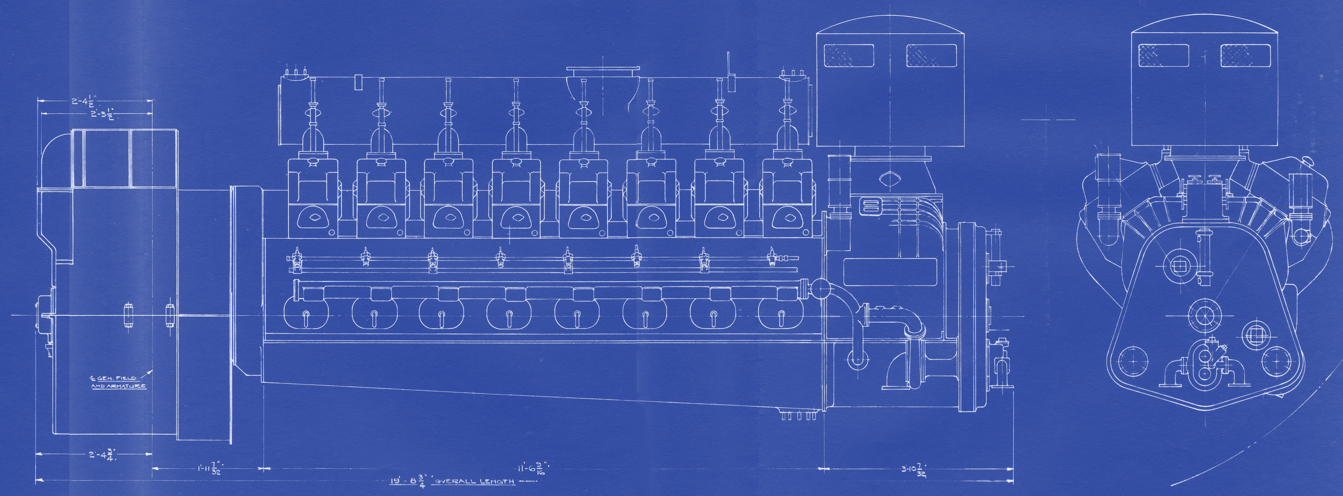
Photos of the engines from the “New Conception of Diesel-Electric Drive” booklet. Note how the engines do not look anything like the 567 we all know. While they did have a welded block, they did use more cast pieces in their construction, as well as individual covers for each power assembly. Click for larger.

Build sheet date for the engines. More on the name change shortly..

Thomas & William at home in the NYS Canal System. Click for larger. Courtesy of the Dave Boone Collection.

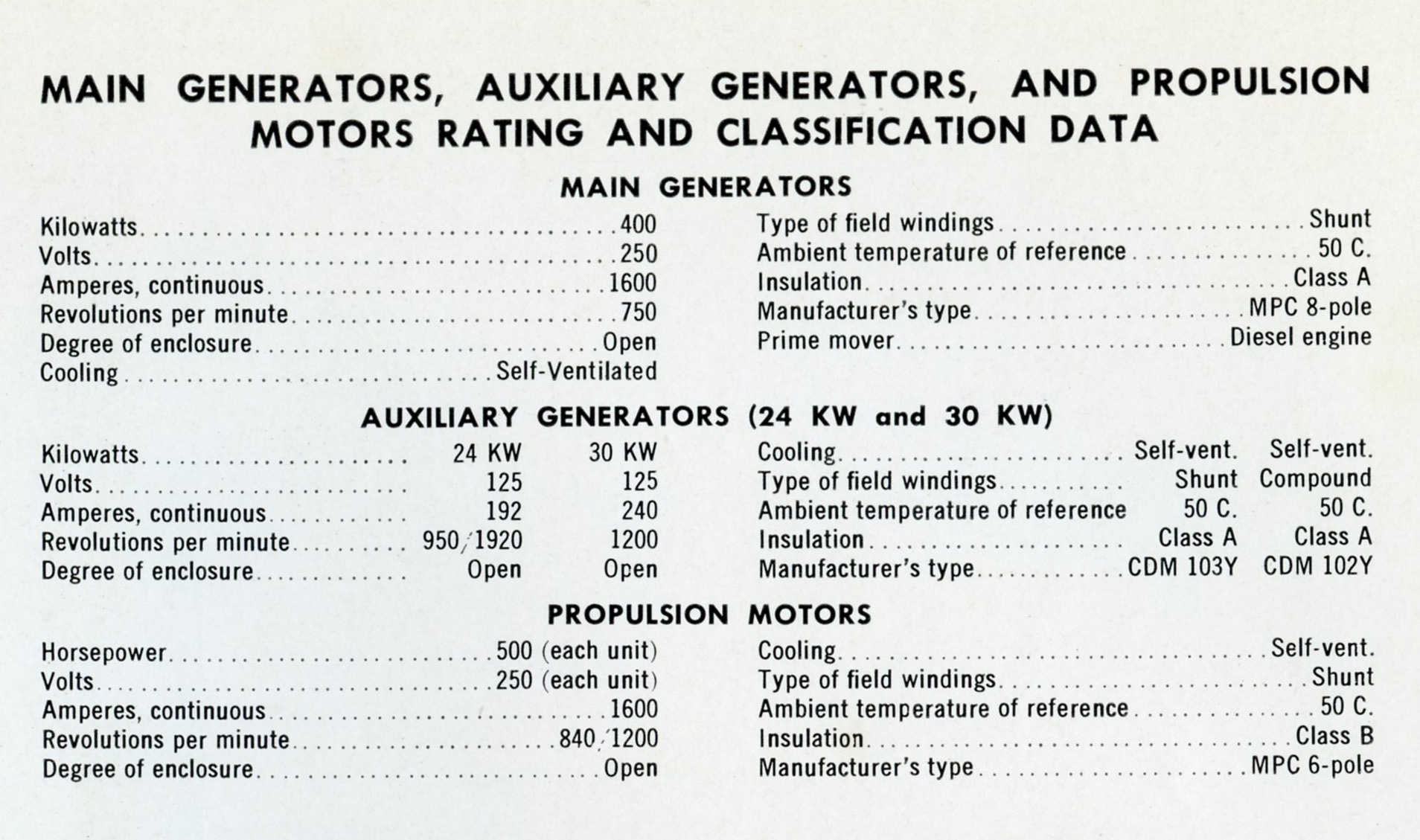
Electrically, the tugs used General Electric 400kW, 250 volt shunt wound main generators behind each of the 567’s, with belt driven 24kW exciter/shaft generators. General Electric also supplied the pair of 500HP propulsion motors. A common arrangement of the era was using two smaller motors, feeding into one reduction gear, supplied by Farrel-Birmingham. The arrangement was used on numerous fleet tugs throughout WWII. After the Thomas and William, Moran (along with James McWilliams Blue Line) would build several more tugs in 1939-1941 to virtually the same design, however they would be powered with single EMC 12-567 engines (Sagamore, Sheila Moran) and the last ones with Cleveland 12-278 engines (William J. Moran, Agnes A. Moran, Mary Moran, Sheila Moran), the later ones having a more normal, single level deckhouse (more on that later).
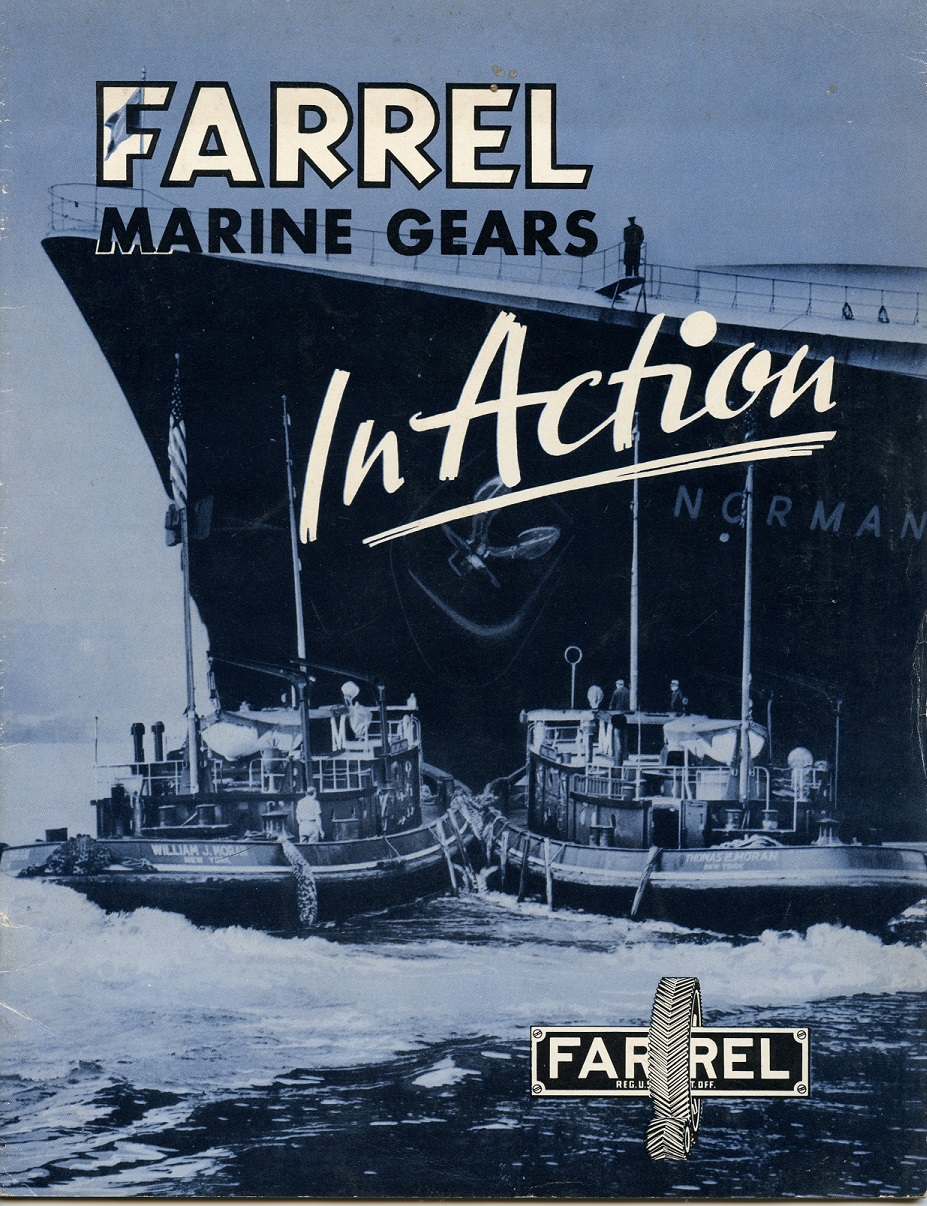
Farrel-Birmingham catalog pages showing the tugs. Click for larger.

Along with the 24kW shaft generators, the tugs each had a single Detroit 3-71, which drove a 30kW generator. The 71 was also a newly introduced engine in 1938. Click for larger.

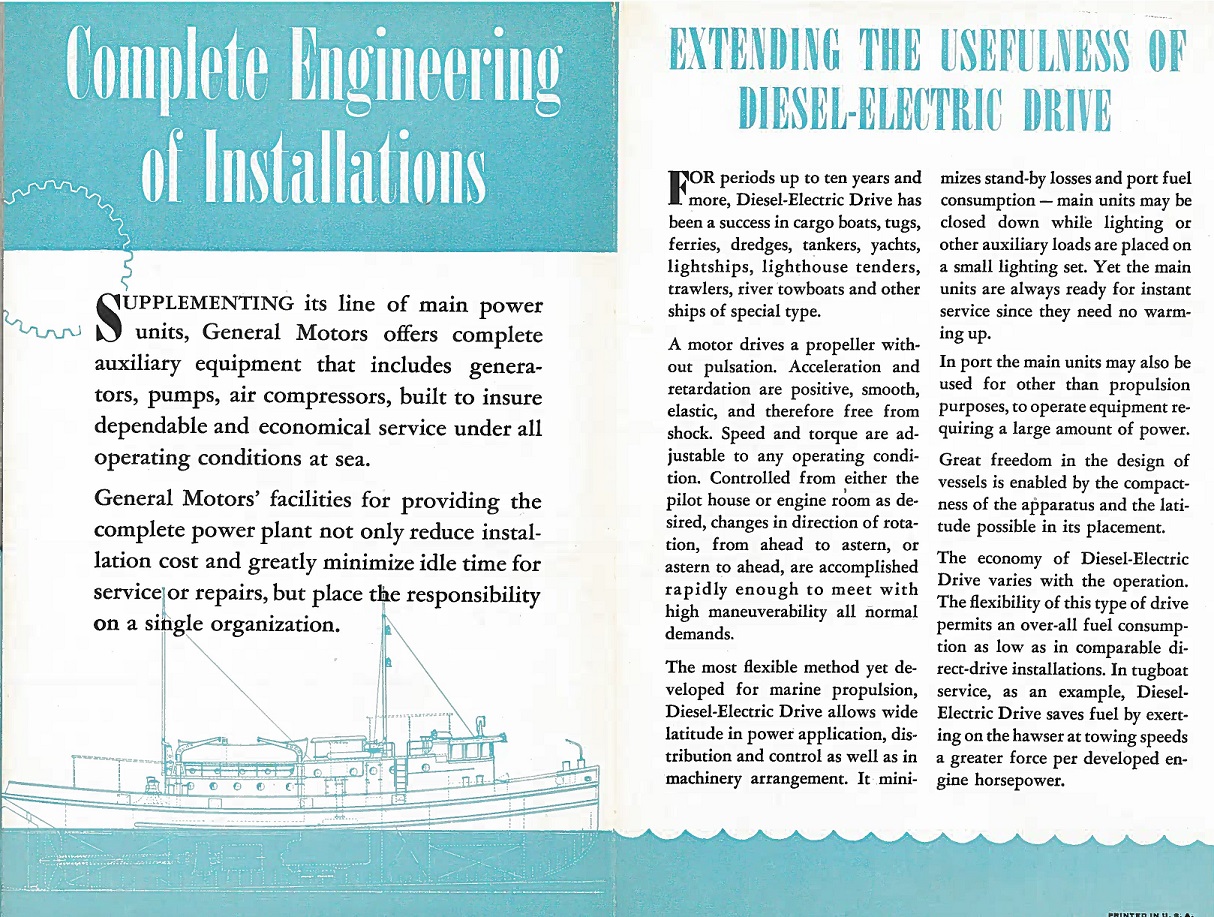
A small booklet produced by GM featuring the new 567 engine. Ironically only the Thomas had the 567! Click for larger.

With World War II looming in the distance, the US Navy would requisition these tugs in 1940. I have long since been told that the Thomas and William were the prototype design for the YTB series that would be built in mass throughout the war. Part of me wonders if the Navy financed these in some way, with an agreement that they would be used during the war. But these details are likely lost to history. The Thomas would become the Namontack, originally classed as a Yard Net Tender (YN-46), Net Yender (YNT-614) and finally Yard Tug, Big (YTB-738). The William received the same treatment, and was named Wapasa, and also did time as a Yard Net Tender (YN-45), Net Yender (YNT-613) and finally Yard Tug, Big (YTB-737). After the war, the tugs would be returned (resold? I am not sure how those requisitions worked, if anyone knows, please drop me a line!) to Moran, however would be renamed. Originally the Thomas E. Moran, her new name was now the Harriet Moran. The William J. Moran became the Anne Moran.

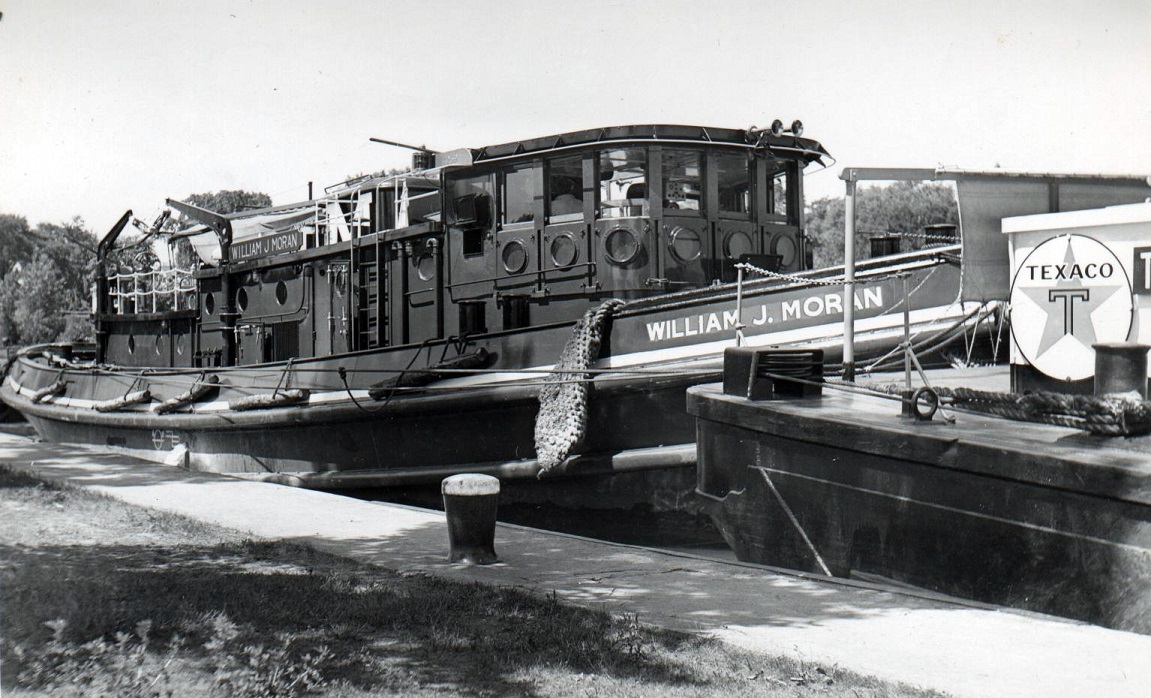
The Anne Moran at home in the canal, made up in push gear with a grain barge (which looks to be an old motorship). The tugs had 4 control stations, the wheelhouse, the upper deck, the aft deck, and the engine room. Note the “box” on top. This was the upper wheelhouse to gain a little more height to see over the barge. The primitive wooden box was installed in the fall/winter and would fold up in inclement weather. Click for larger. Courtesy of the Dave Boone Collection.

After the war, Cleveland Diesel went heavy on marketing, producing numerous booklets and brochures. These are from the late 1940’s book “Commercial Vessels Powered by Cleveland Diesel”. Note that they used older photos of the Thomas and William, and airbrushed the original names out in favor of the new, post war renaming’s. Not only that, but they incorrectly spelled the one! An interesting feature of these tugs is the sliding heavy weather portholes, that would slide up the cover the large glass windows. Click for larger.

In 1956, Moran embarked on a modernization program for the canal tugs. The Harriet and Anne would both be repowered with single war surplus (from PCE vessels, unfortunately the records do not note which) Cleveland 1000HP 12-278A engines and Allis-Chalmers 814kW main generators, however the original propulsion motors were kept. Along with the repowering, the tugs received a new retractable wheelhouse. Introduced in 1950 by Lake Tankers Corp. on their tug Canal Cities, the retractable wheelhouse was a revolutionary advancement for working in the canal.  A large air or hydraulic cylinder raised and lowered the wheelhouse to see over the barge, but to “duck” when a bridge or other obstruction was approached.  Virtually all “modern” diesel canal tugs would be retrofitted with these by the mid 1950’s, with all new tugs being built with them from then on out. 

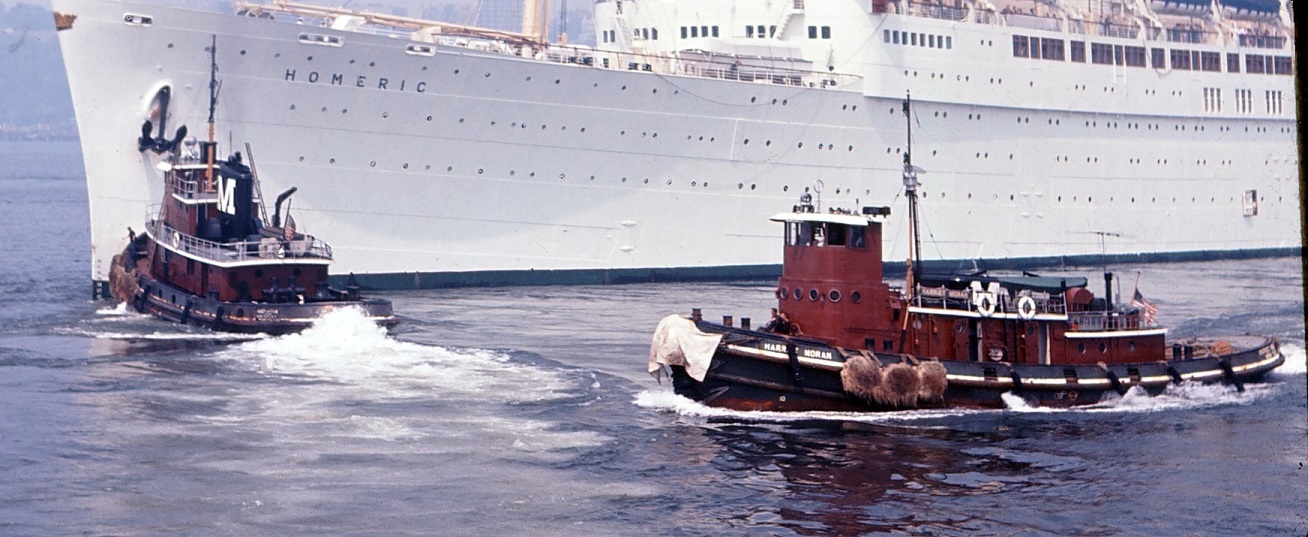
Now with her new retractable house, the Harriet Moran would still work the canal, but by the 1970’s was regulated to doing assist and barge work in the harbor. The Harriet and Anne would keep their stepped deckhouses, and sliding “portholes”, however the other Moran canal tugs mentioned above would get more modernized single level deckhouses, and square retractable wheelhouses. Note that the new wheelhouse fits inside the profile of the original one. Even the original Marie S. Moran of 1936 was retrofitted with one! Click for larger. Courtesy of the Dave Boone Collection.
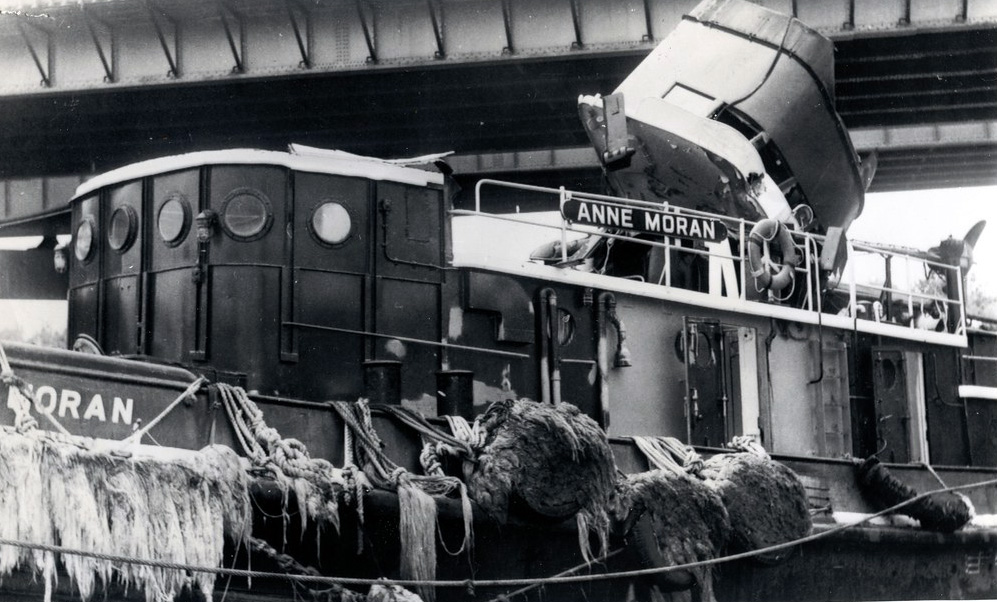
Unfortunately, working in the canal with a retractable wheelhouse had its downfalls. You need to pay attention! (To quote Buford T. Justice in Smokey and the Bandit: “Duck, or you’re gonna be talkin’ out yo ass!”) The wheelhouses essentially floated in a pocket, with some very basic guiderails. So when the captain forgets to drop the wheelhouse, the bridge is usually going to win, as what happened in 1965 to the Anne. Numerous canal tugs were decapitated over the years, but because they were so simple, the dents were pounded out, wires rerun, and back off to the races they went. I spent a few years working on a canal tug, and its an all hands on deck operation spotting for obstructions, especially high tension wires at night. Click for larger. VDD collection.

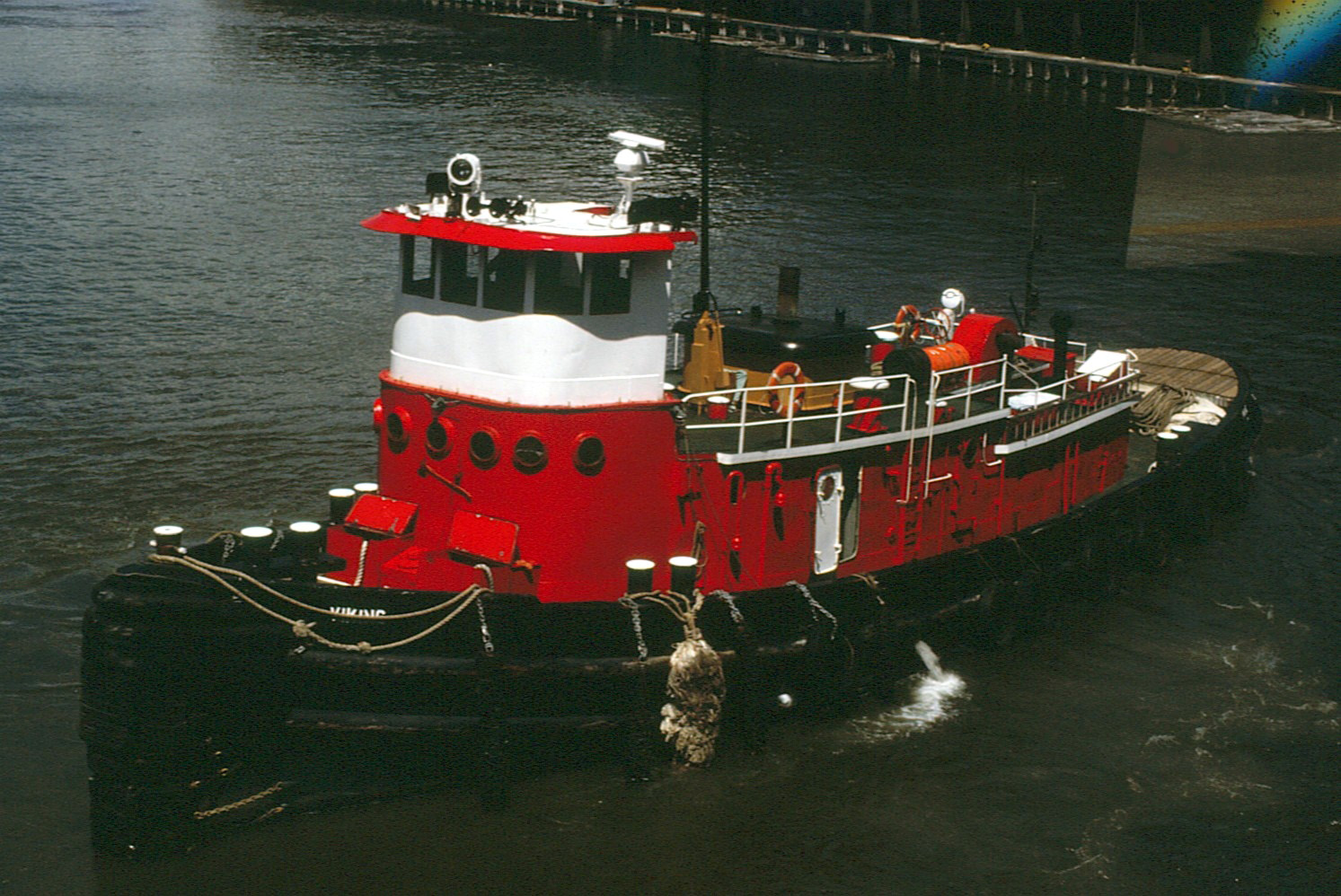
Typically a “last stop” for tugs working for Moran was to be put on the garbage barge run before being retired. The Anne is moving one of the DSNY scows in 1970. Click for larger. Courtesy of the Dave Boone Collection.

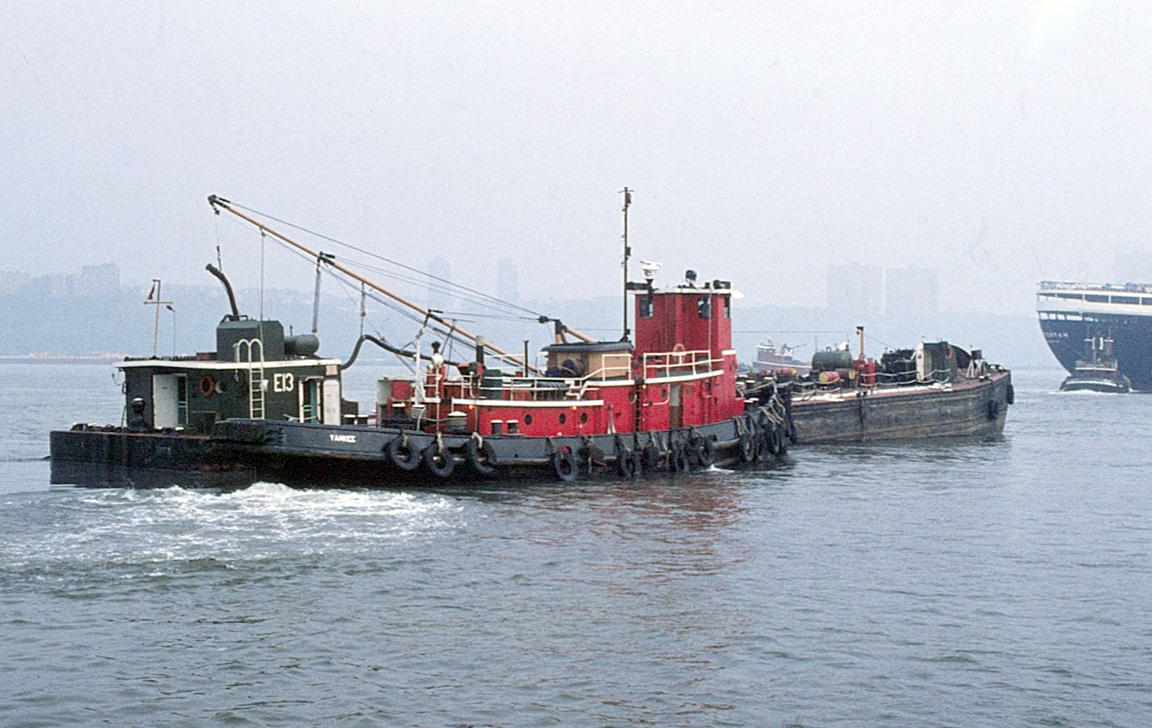
Moran would sell both of the tugs to Eklof Transportation in 1975/6 with the Harriet becoming the Viking, and the Anne the Yankee. Eklof would use the tugs for moving oil barges around the harbor for the next 15 or so years. Unfortunately, the road would end here for the Yankee (William J. Moran) and was scrapped in 1993. Our story does not end here though. Click for larger. Courtesy of the Dave Boone Collection.

Now the McAllisters Sharon Elizabeth in Georgetown, SC. Click for larger. Photo courtesy of Franz A. von Riedel.

A small towing company, Georgetown Towing, based in Georgetown, South Carolina purchased the Viking, and named her as the Georgetown, doing ship and barge work in the area. McAllister Towing would purchase the company in 1999, and renamed the tug as the Sharon Elizabeth. Zenith Tugboat of Duluth, MN purchased the tug in 2005, and brought it up to the Great Lakes via the Erie Canal – right at home, 67 years after being built.
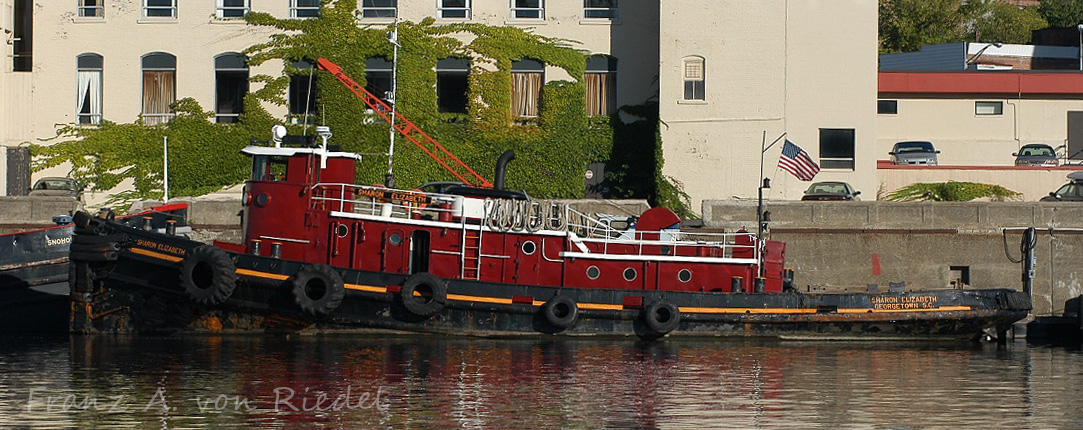
Now sporting Zenith’s stack colors, the Sharon Elizabeth is laying over in Troy, New York on her way to Duluth. Click for larger. Photo courtesy of Franz A. von Riedel.
Photo courtesy of Franz A. von Riedel.

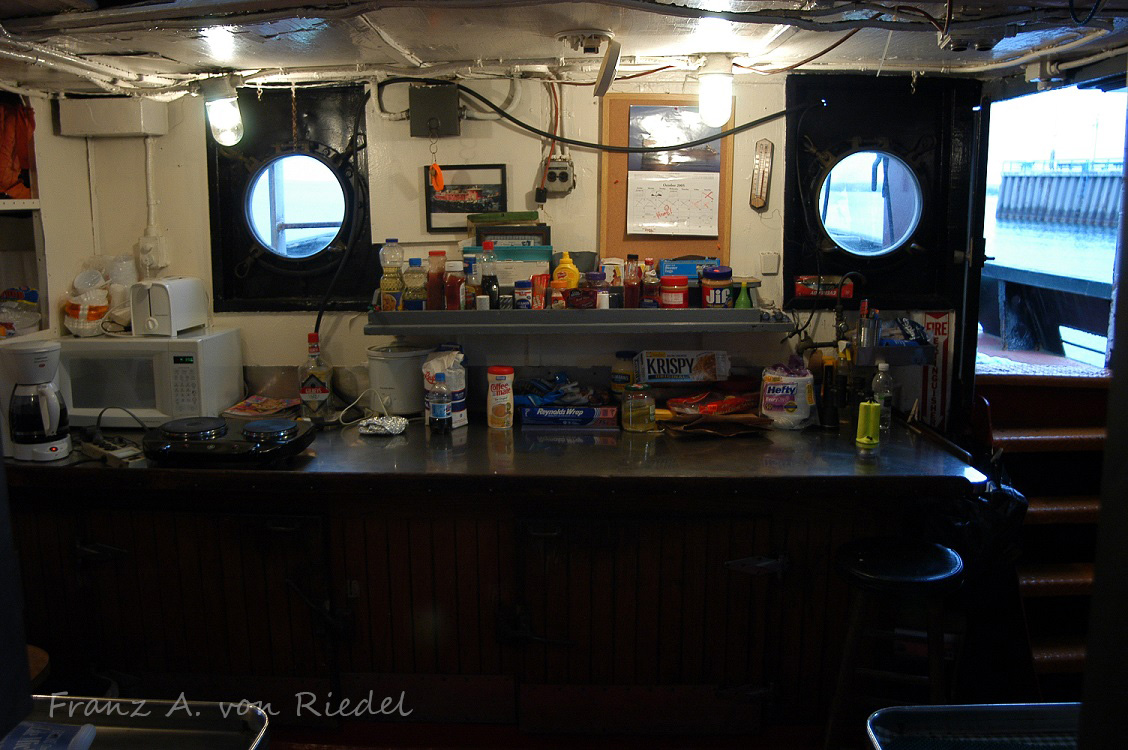
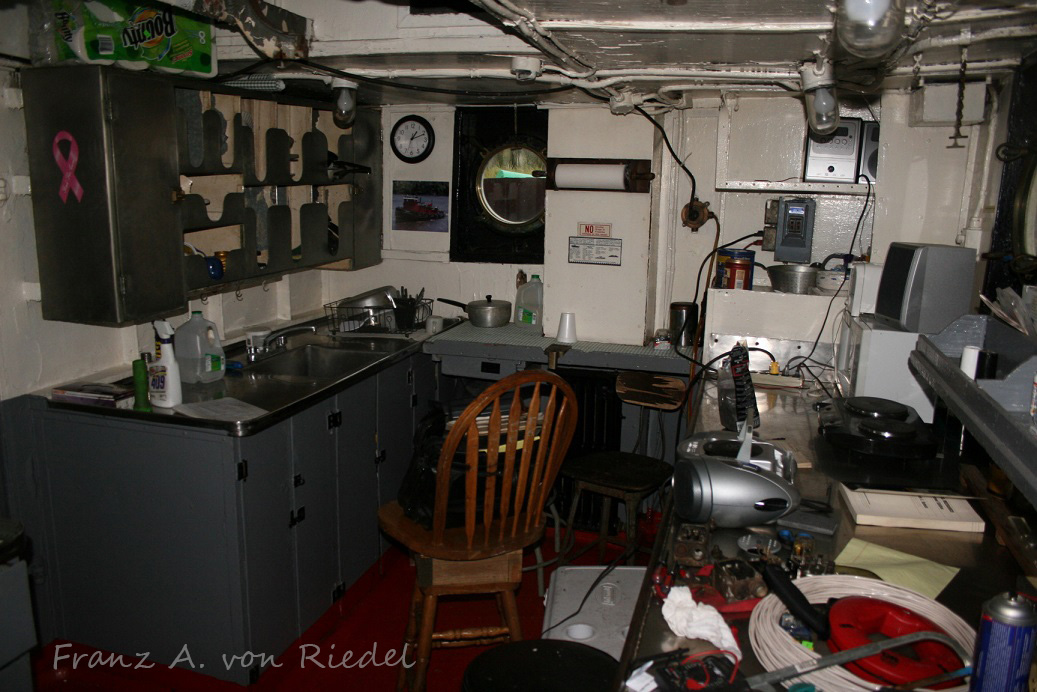
Lets take a quick walk through the Sharon Elizabeth, starting in the stern. I always wondered the reasoning behind the stepped deckhouse design. Entering in from the door, you head down a few steps into the galley, complete with giant cast iron Webb diesel stove that every tug and ship of the era had. Click for larger. Photos courtesy of Franz A. von Riedel.

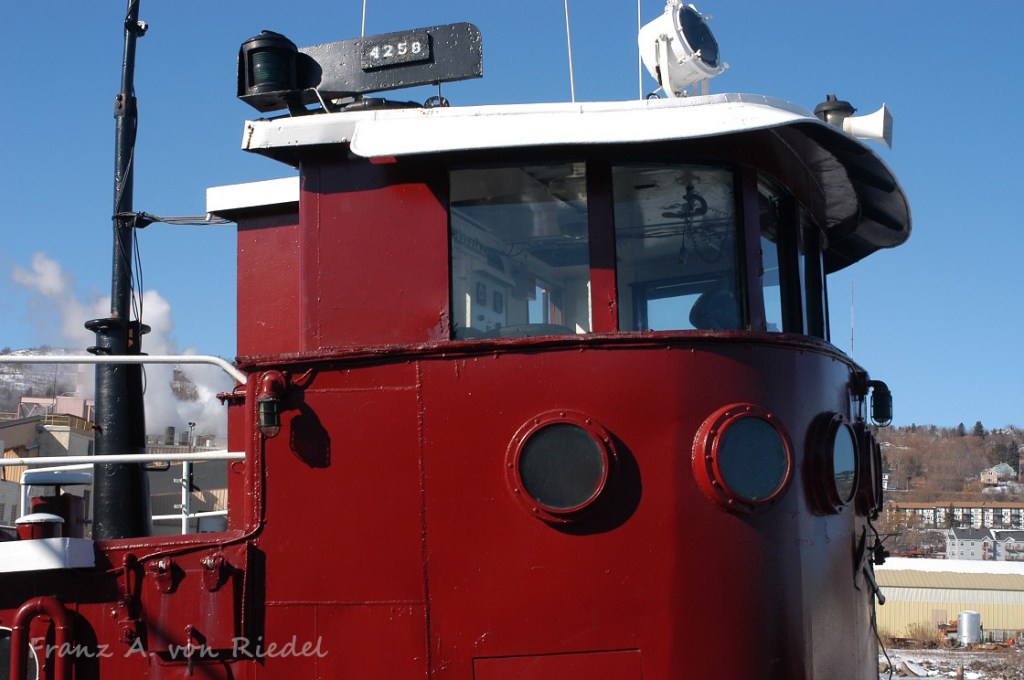
Canal tug wheelhouses are usually pretty spartan, simply because they lack any extra space. The Sharon’s wheelhouse had the typical Lakeshore Diesel-Electric control stands, and Benson electric steering, likely all installed during the 1950’s rebuild. Along the back wall is the running light panel, and the field amp/prop shaft RPM gauge and steering changeover switch. At some point in her life, Moran welded the sliding window portholes in a fixed position, and removed the tracks. It was not uncommon for canal tug wheelhouses to be kept in a semi-lowered position (especially when they get older and the system fails). The one on the Sharon is not all the way down here. Click for larger. Photos courtesy of Franz A. von Riedel.

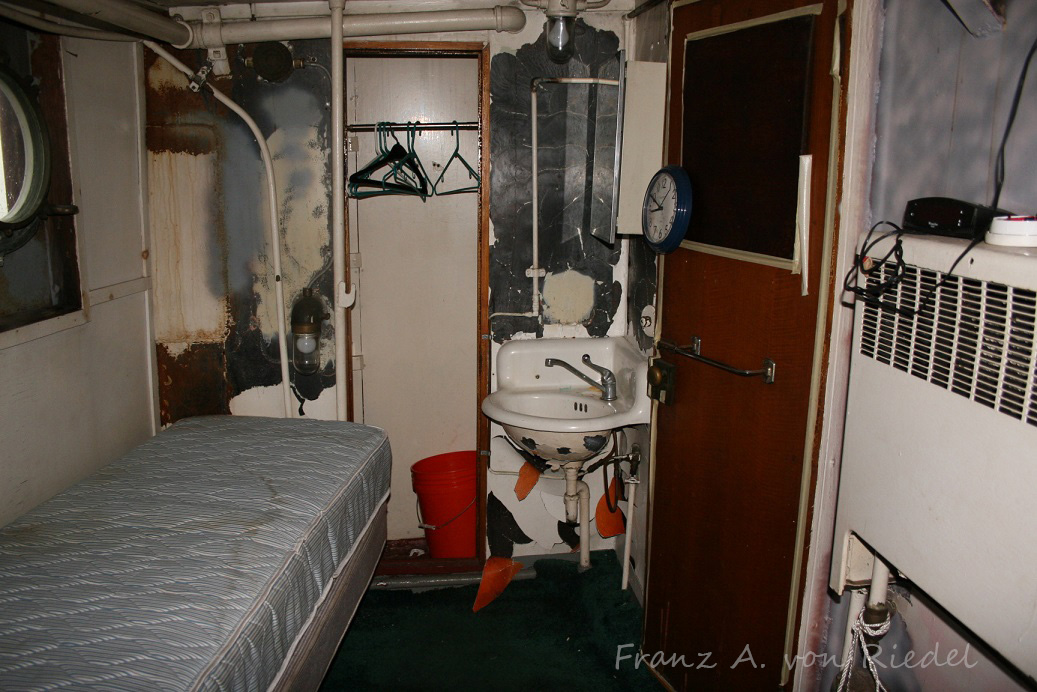
By the time smaller companies have these older boats, the staterooms are usually pretty tired – as often times the tugs are used as day boats, meaning no full time crews are living on the tug, which also means that maintenance starts to dwindle. For a canal tug however, these are some pretty big rooms! Click for larger. Photos courtesy of Franz A. von Riedel.

Photo courtesy of Franz A. von Riedel.

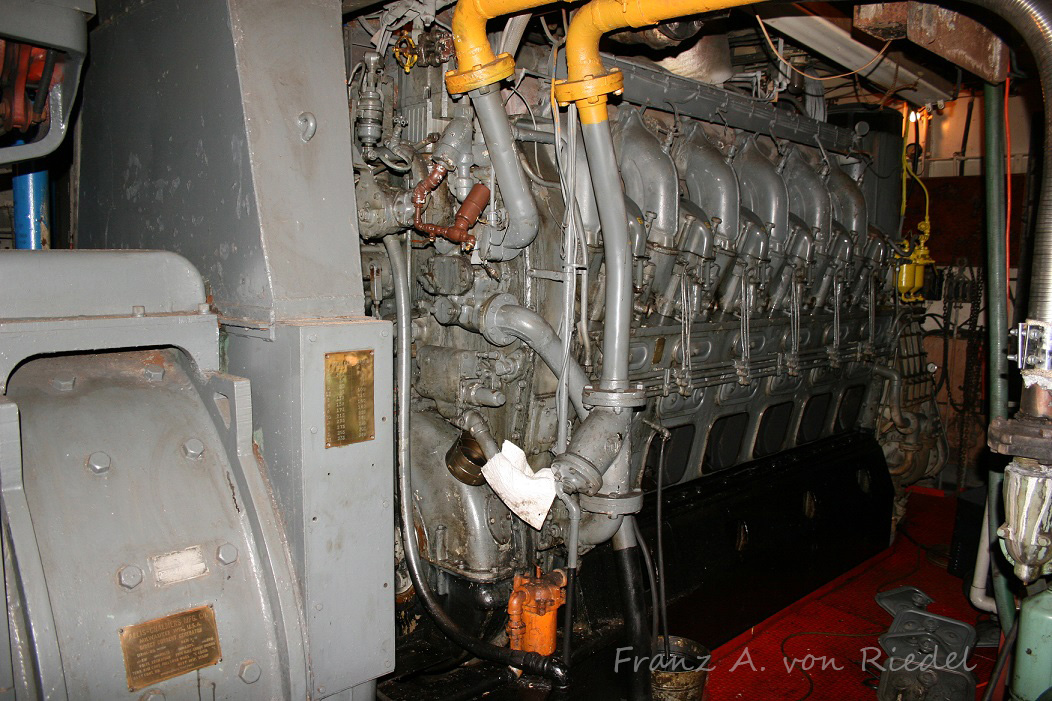
The Sharon had her twin 8-567 engines replaced in 1956 with a single Cleveland 12-278A removed from a Patrol Craft. An Allis-Chalmers main generator was utilized from a Destroyer-Escort, a common package used in Diesel-Electric tugs of the era. Click for larger. Photos courtesy of Franz A. von Riedel.

Electrically, the Sharon kept her original twin GE propulsion motors and Farrel-Birmingham reduction gear. A lakeshore propulsion panel connected the motors and generators. A Detroit 3-71 is seen in the forward end. Click for larger. Photos courtesy of Franz A. von Riedel.
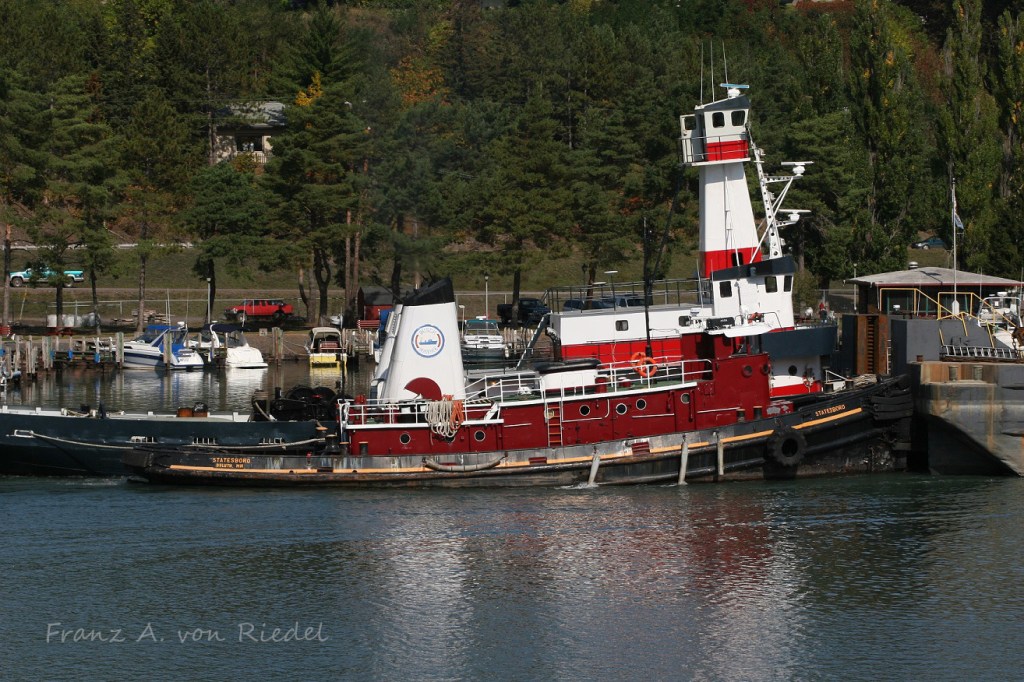
Zenith renamed the Sharon Elizabeth as the Statesboro in Spring of 2006. For an almost 70 year old tug at the time, she still looked sharp. Photo courtesy of Franz A. von Riedel.
The tug was sold in the fall of 2006 to Busch Marine of in Carrollton, MI. The tug is being towed by their own tug, the Gregory J. Busch. Photo courtesy of Franz A. von Riedel.

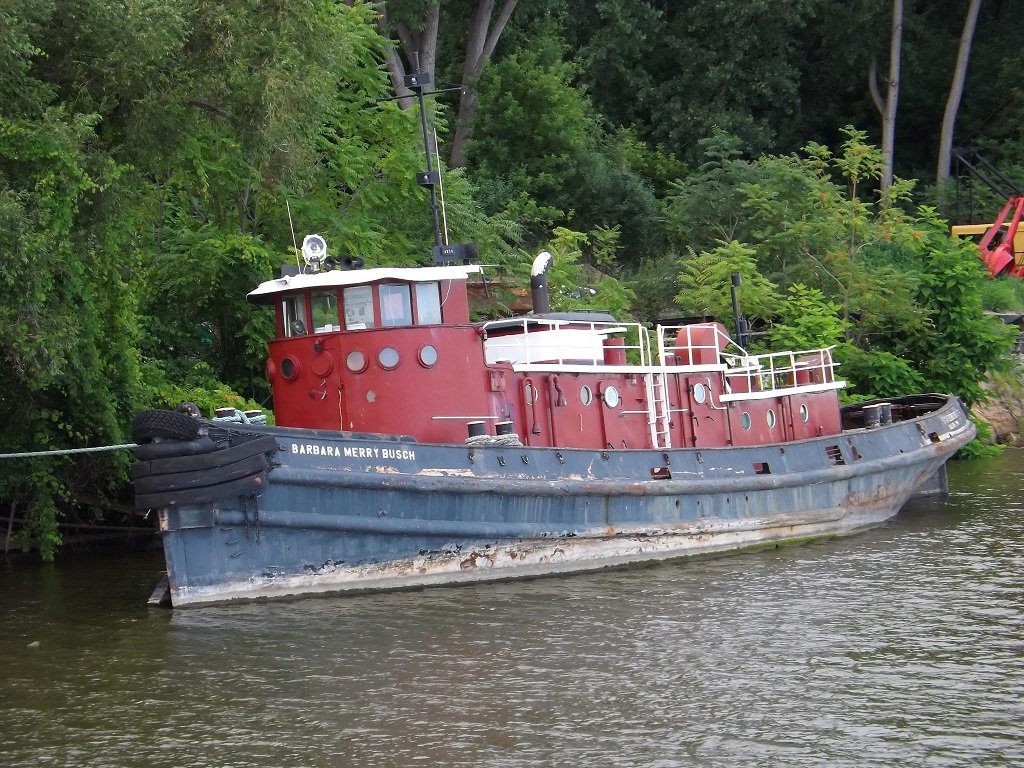
Busch Marine renamed the tug as the Barbara Merry Busch. The tug was tied up at their dock in the Saginaw River, only a few miles up from where she began her life in 1938. Unfortunately, the tug was never used by Busch, and she sits tied up listing heavily, waiting for what is likely an inevitable date with a scrapper one day. Even Busch’s large tug – Gregory J. Busch is laid up. This is another tug I would love to see inside, as she is powered by Alco 12-244 main engines.
Click for larger. Photos courtesy Todd Shorkey

Thomas E. Moran was featured in numerous GM advertisement’s.

While just a footnote in history now, the Thomas E. Moran will go down in history as being the first use of the EMD 567 engine, the engine that went on to become one of the most successful diesel designs even built, and used in countless tugs, locomotive’s and stationary applications. Moran would wind up working almost exclusively with Tams (and successor GM Design and Marine Design Inc.) over the next 30+ years, building some of the most recognizable tugs on the east coast – all powered with General Motors Diesel-Electric Drive. Following the Thomas and William, several 567 stationary gensets would be built, as well as a bunch of 12-cylinder models used in Navy and USCG tugs in 1939.

Be sure to visit our other pages highlighting historic vessels – https://vintagedieseldesign.com/historic-vessels/


Many thanks to Franz A. von Riedel for sharing his photos of the Sharon/Statesboro. Thanks to Dave Boone for sharing numerous photos with me over the years, Todd Shorkey, Isaac Pennock & Jay Boggess as always for scanning and sharing more then I can recount.

More reading –
https://tugboatinformation.com/tug.cfm?id=798
https://tugboatinformation.com/tug.cfm?id=802
https://gltugs.wordpress.com/barbara-merry-busch/
http://www.navsource.org/archives/14/22046.htm
http://www.navsource.org/archives/14/22045.htm

A Turbocharged Failure – The Story of the Cleveland 498, Part II

In this second part of A Turbocharged Failure, we will go through some design features of the engine.  What better way to do this then to simply go through the engine manual and show a few key areas of the engine design.  Numerous additional photos of the 498 will appear in Part IV. 

Be sure to view the other parts of this series:
A Turbocharged Failure, Part I – Engine History
A Turbocharged Failure, Part III – Uses and Installations

The initial “catalog photo” of a production 12-498, with a Falk MB series reverse-reduction gearbox.

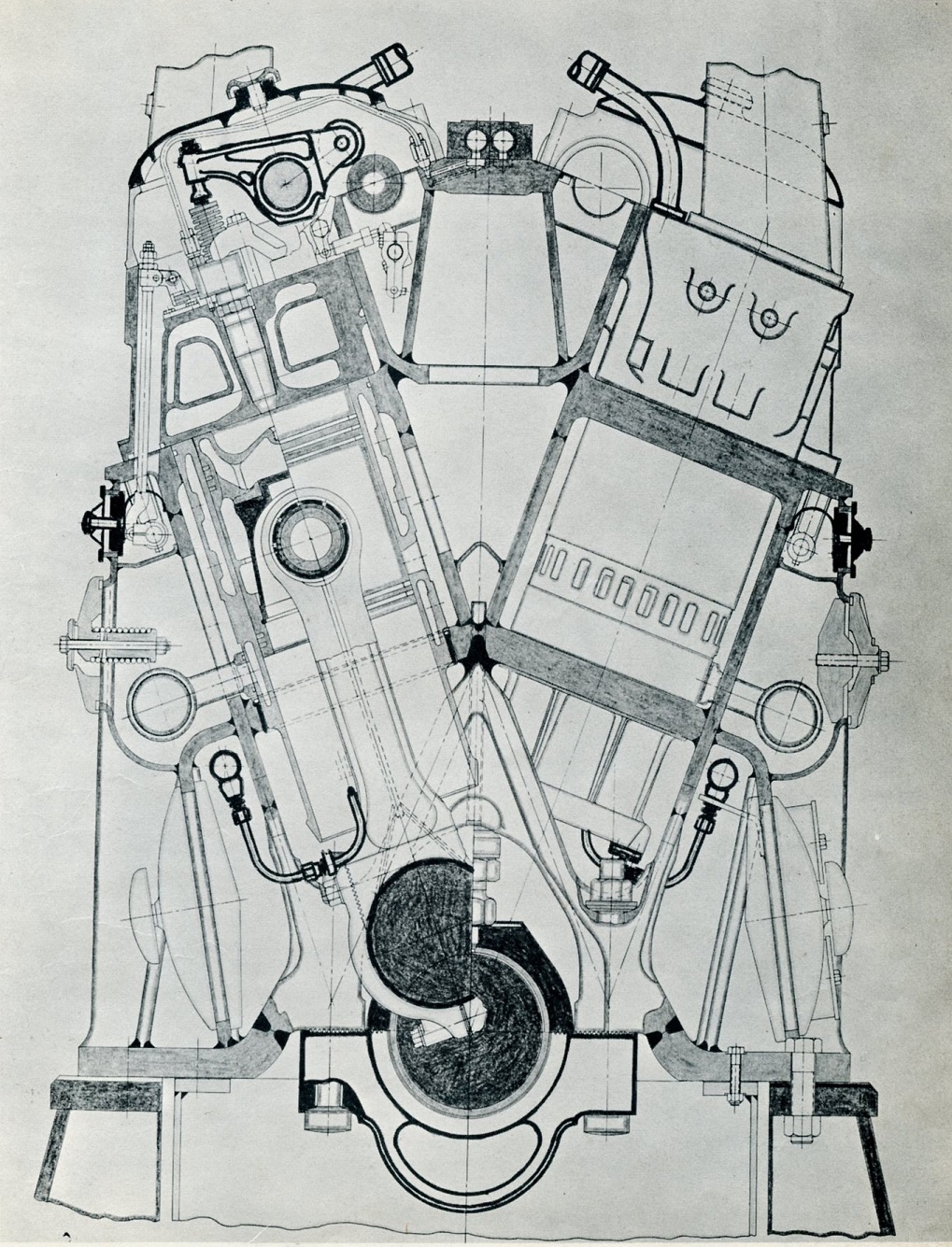
I have two versions of the 498 manual – both of which are titled as “preliminary” manuals.   The older version, which is undated and likely from around 1957, and lists 4 models of the 498; a 6-, an 8-, a 12- and 16-cylinder.   Like all manuals, an end view diagram is included, however this is a rather primitive, hand- drawn sketch. 

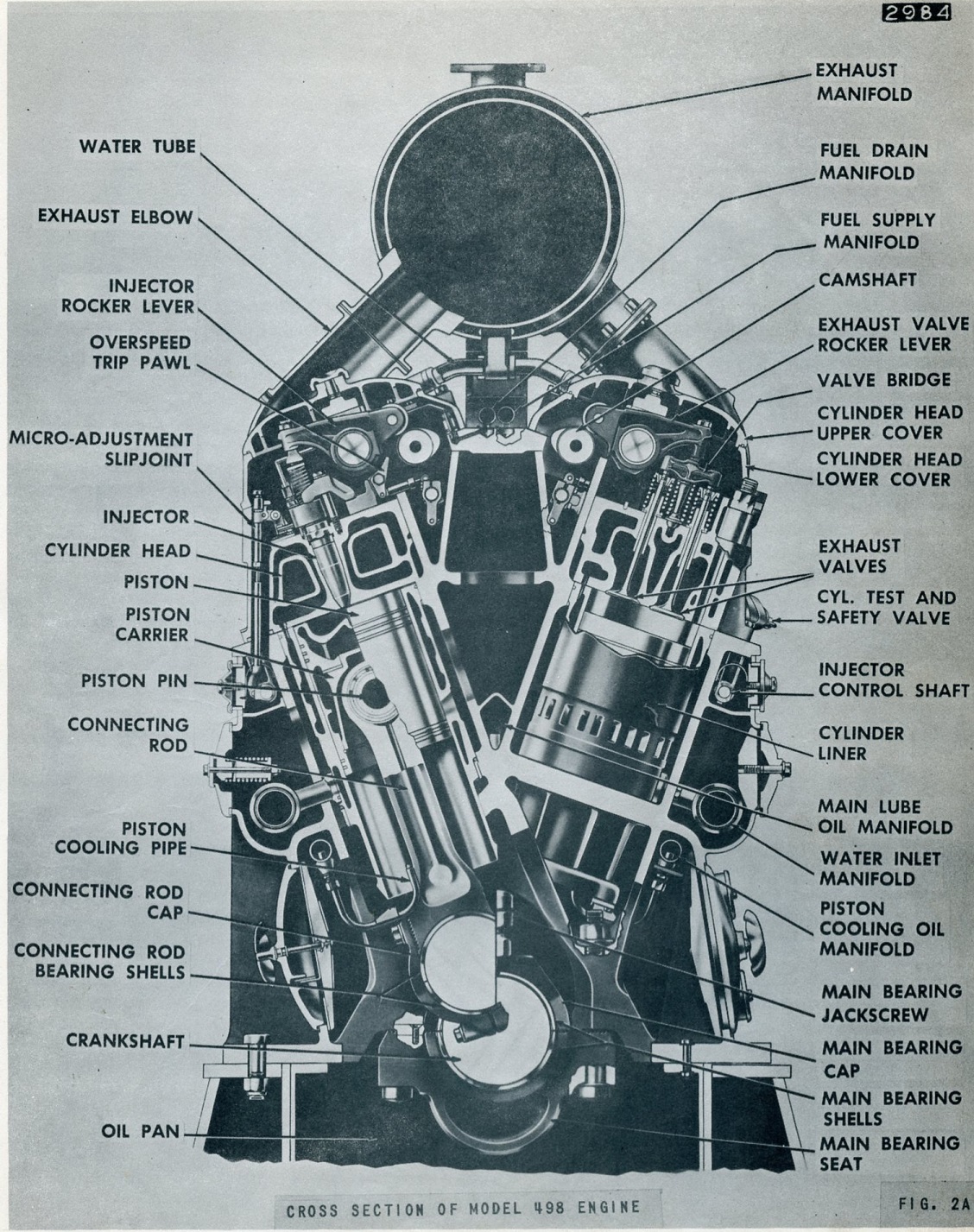
Engine cross section drawings. A colorized version would never be done. Click for larger

By the time the second edition was printed, dated for July of 1960, an all-new diagram was made including outlining various parts of the engine.   Along with this, several additional diagrams appear in the manual, as well as some more photos of various engine parts and repair techniques. At some point the 6-cylinder version was dropped from documentation, and would ultimately never be built.

Engine data and ratings – Click for larger

Engine Operation
Like all Cleveland engines, a simple lever is attached to the injector linkage.  A small thumb latch allows the lever to control the engine with no governor input.  When unlatched, the governor takes over all control of engine operation, used in conjunction with whatever remote propulsion control system is used.   On the 498 (and some Cleveland 567’s) equipped with reverse reduction gears, a second lever was added to control the air clutch, so that propulsion speed and direction could be controlled right at the engine.  498 engines were air-started- using an air motor, unlike the 278A engines which had direct air start into the cylinders.  

Engine operating levers on the 498. Click for larger

Crankcase
Like the previous Cleveland models, the 498 used an all-welded crankcase of various forged parts and steel plate.  A balanced, alloy steel crankshaft is used, interestingly enough the 12-cylinder crankshaft did not have any counterweights.  The crankshaft is drilled for oiling the connecting rod main bearings and wrist pins.  A vibration damper and balancer are mounted on the front end of the engine. 

Pistons, Connecting Rods & Liners
One of the biggest sets of improvements to the 498 engines from the previous 278A – are actually a few concepts borrowed from sister division EMD and the 567C engine. 

While the 278A and all previous models used a semi-water deck style liner (like the EMD 567 though the “B” block) – the 498 used a sealed liner which was attached to a water manifold in the airbox by a jumper (much like the 567C). 

A look in through the crankcase inspection cover at the connecting rods, showing the “pee pipe” attached to the lower end of the liner for piston cooling.

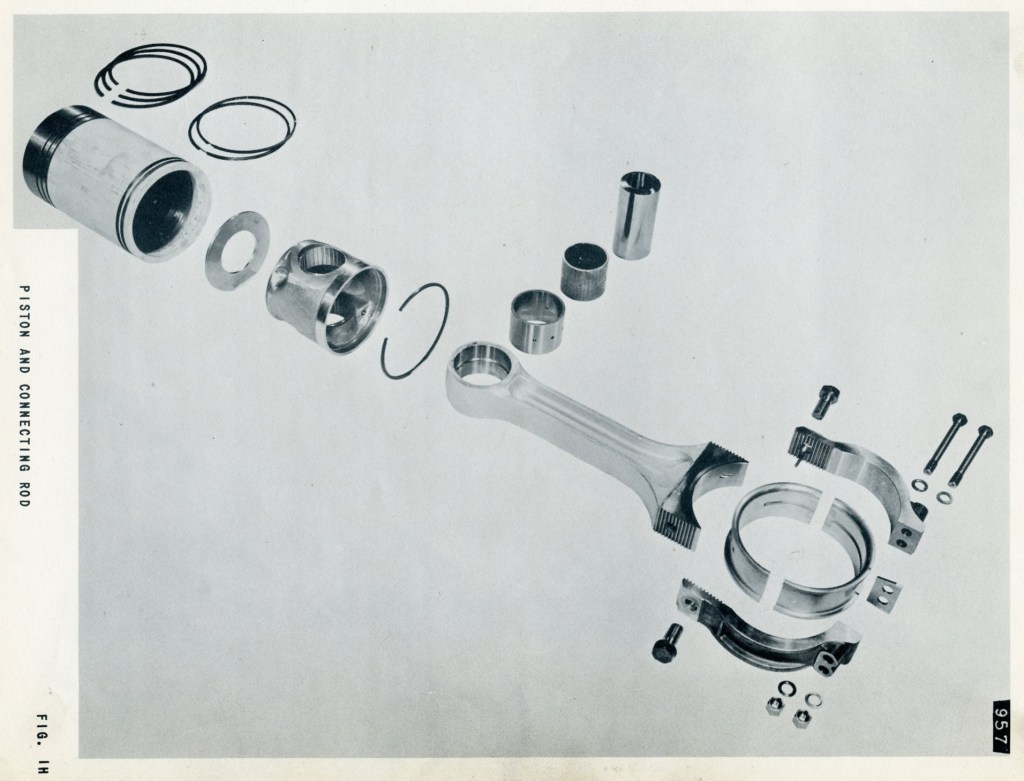
Again, borrowing from EMD, the pistons are a two-piece, trunk style floating piston (introduced on the LST 12-567 in WWII), whereas the 278A used a more traditional one-piece piston and a wrist pin.  On the floating piston, the piston itself sits on a thrust washer, which in turn sits on the piston carrier attached to the connecting rod.  Again, departing from the 278, Cleveland adopted the “pee pipe” piston cooling scheme EMD used since the first 567 of 1938, as opposed to the drilled connecting rod of the 278 & 268, which directed cooling oil from the crankshaft to the bottom of the piston. In the 498, the drilled connecting rod is only used for oiling the bearings and wrist pin.

Piston cooling on the 498 (top) used a drilled connecting rod to lubricate the bearings and wrist pin, however used a jet of oil which sprayed into an orifice directing oil into the cavity below the piston crown. The 278 (bottom) simply used the drilled connecting rod to lubricate everything, and used a spring check plate to retain oil in the crown.

The connecting rod of the 498 used a strap style of “cap” to contain the bearing and connect to the crankpin.  Like all Cleveland’s, each connecting rod used its own bearing on the crankpin, unlike the EMD engines which use a shared crankpin and bearing set by use of the fork and blade connecting rods. This allowed the EMD to be a slightly shorter length overall, as the cylinders were directly opposite each other, versus slightly offset on the Cleveland.

Cylinder Heads & Exhaust
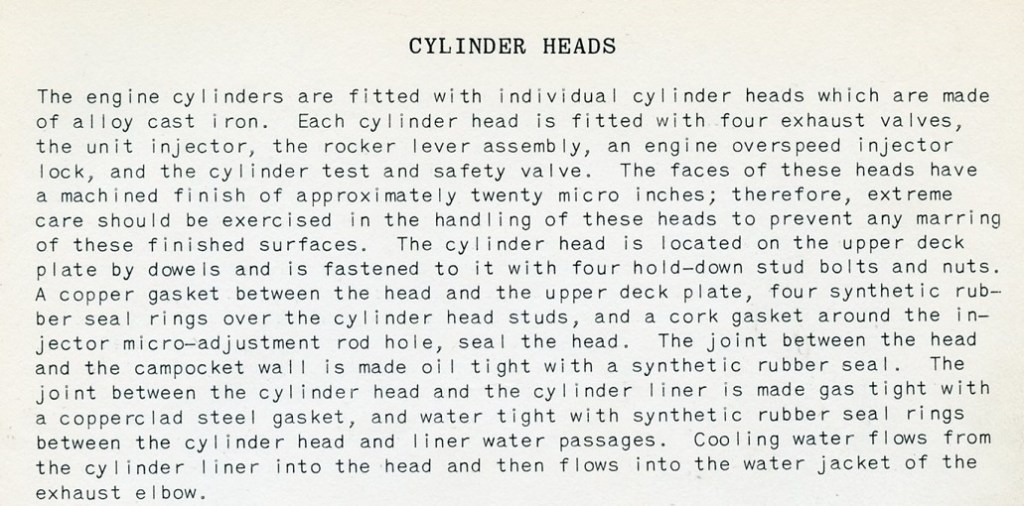
Again, sharing with previous Cleveland models, the 498 used individual external heads, however these had some upgrades.  One of the big downfalls with the 278A style head, is there is a half-circle seal against the back of the head, which seals the cam pocket to the head.  Unfortunately, this is a major source of oil leaks.  The Navy devised a tool in the 1950’s to help combat this problem – a bracket clips into the injector control pocket on the block and a set screw presses the head back into the pocket, thus compressing the seal before the head is torqued down.  The 498 head had a specific tab on them (visible in the above photo of the operating levers), in which a bolted clip catches, allowing one to compress the head back into the seal.   The head itself was also torqued down in an interesting way. The head used stretch bolts, in which a special hydraulic tool was attached to pick up on the bolt before it was tightened down. The 498 returned to a two-piece valve cover design like the Winton 248 used.  The fuel lines were also moved inside now. 

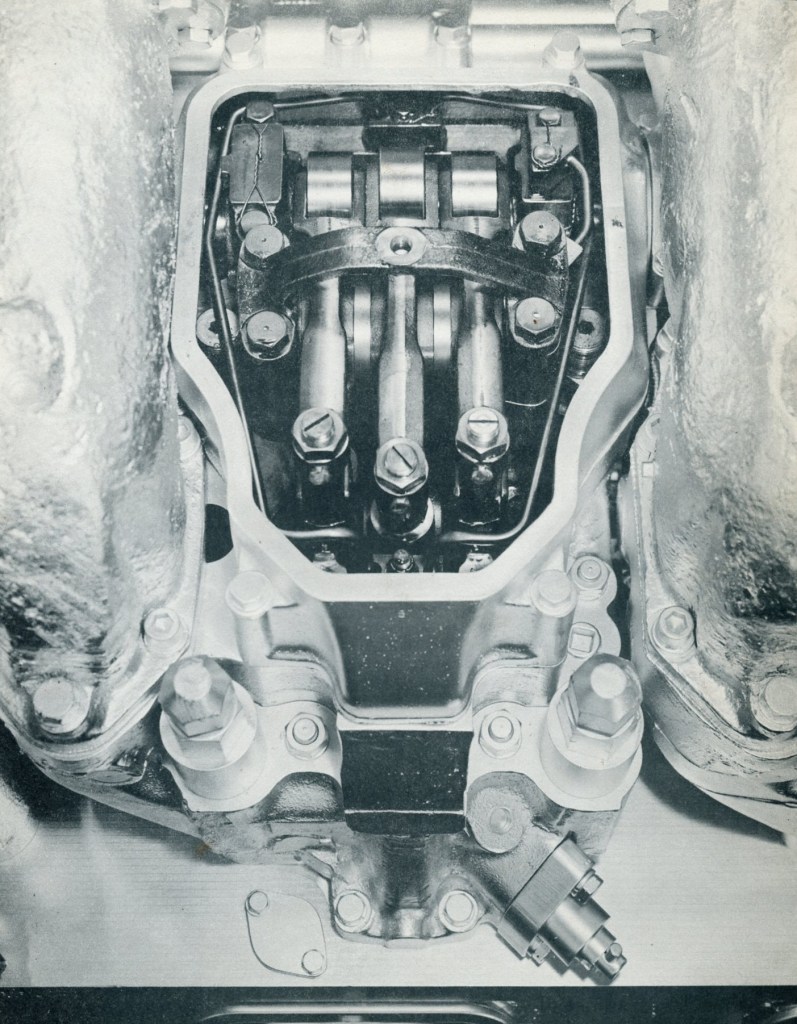
Looking down on the cylinder head, which is a bit more cramped then those on the 278 family. Both fuel lines are now inside the engine, connected to main fuel lines under the exhaust manifold. The 498 used a two piece cover, like the original Winton 248 engine (I wonder if they are the same castings..). The new head design uses a combination safety and test valve, which were separate valves on the 278. EMD did not utilize these valves, which open should any excessive pressure build while the engine is running, preventing a bent connecting rod or worse. Note that the exhaust jumper has some sort of spray on insulation.

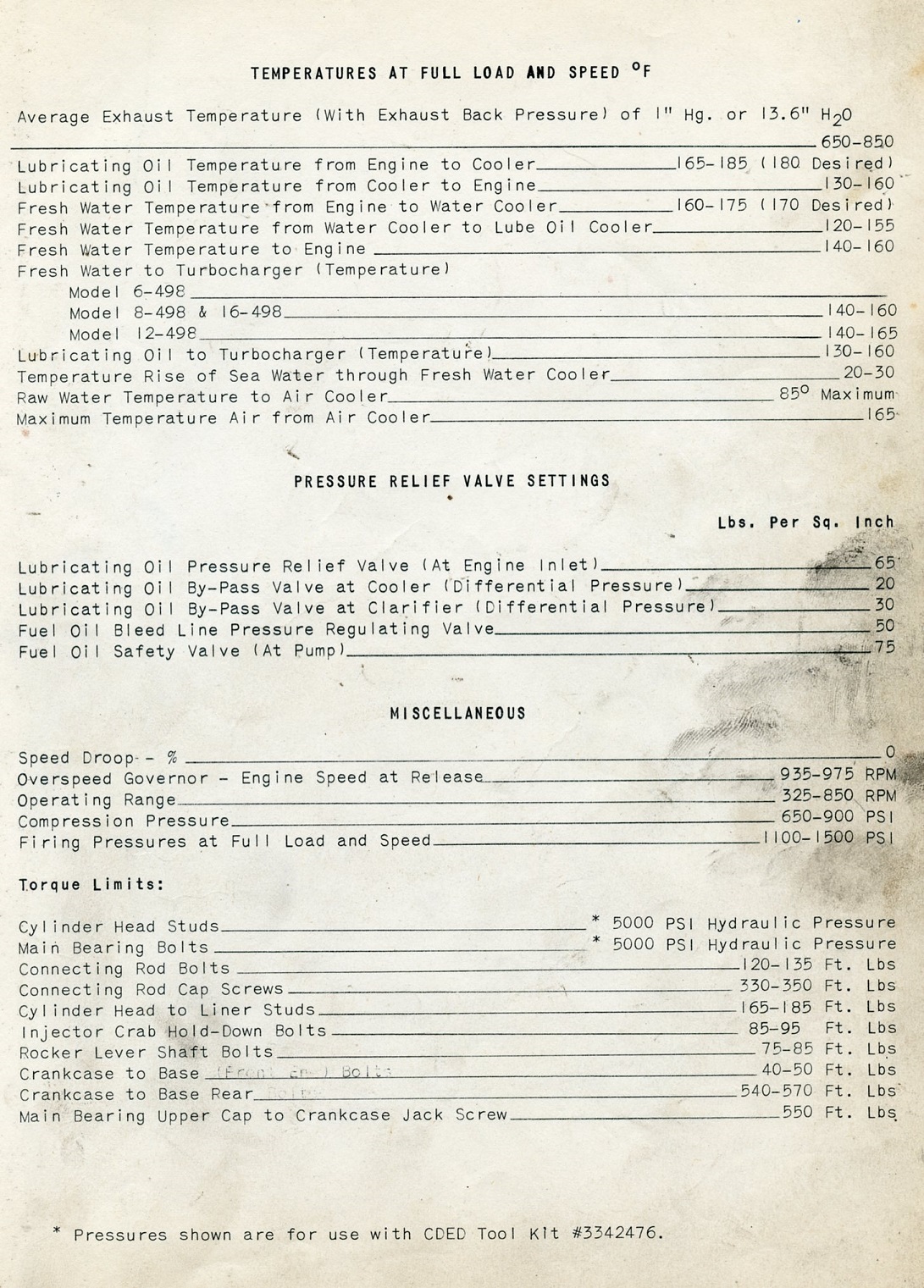
The hydraulic tool for tightening the head bolts was a rather simple process. The tension shaft is threaded onto the top portion of the stud, the tool is slipped over the tension shaft, and a nut on top secures it together. The tool is pumped up to 5,000PSI, and the actual nut holding the head down is tightened with the socket handle inside of the tool. The later 1960 manual indicates that these could also be manually torqued down to 1,030 ft. lbs. Click for larger.

A slight revision on the exhaust jumpers as well was devised.  Previous engines used a completely water- jacketed jumper (the older manual incorrectly stating that the 498 had this as well), however with the 498, it was preferable to keep the exhaust gases as hot as possible entering the turbocharger – thus no water jacketing on the exhaust jumper. A small pipe exits the head and carries water to the main exhaust manifold, which was still water jacketed.   The main exhaust manifold itself used diffuser sections to carry the exhaust gas to the turbocharger. 

Camshaft, Accessory and Governor Drive
Nothing all that special going on here.  The water pumps and blower are driven off the accessory drive on the front of the engine.  The camshafts are driven from the rear end of the engine by the crankshaft through a set of gears.   6- and 8-cylinder engines use one-piece camshafts, with 12- and 16-cylinder engines having two-piece camshafts.  On the forward end of the camshafts, the left side has a vibration damper (not used on the 12-cylinder engine) and counterweight, with the right side having the fuel pump mounted. 

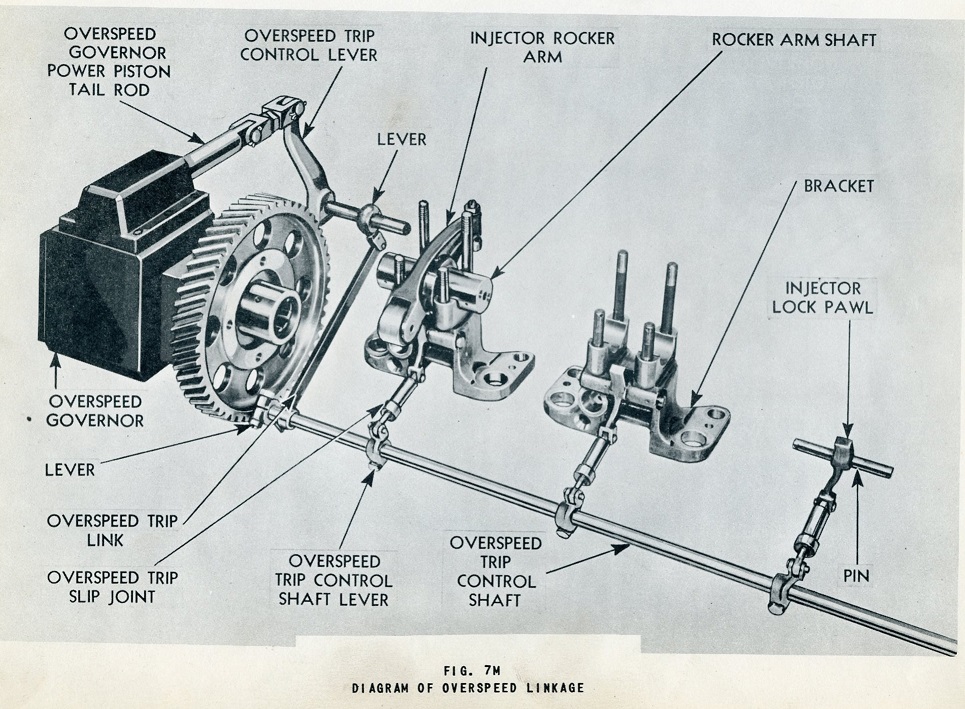
The governor drive is also driven through bevel gears on the camshaft drive.   The engine uses a Marquette hydraulic governor for operation.  Driven from the back of the camshaft, the overspeed governor is a bit of a complex mechanical/hydraulic device devised by Cleveland, rather than using an additional off-the-shelf Marquette governor like the previous models. When the engine overspeeds, a centrifugal flyweight arrangement closes off oil flow to the small oil pump in the governor, forcing it to build pressure which discharges to a small piston on top.  The piston acts against a spring and controls a set of linkage going to each injector rocker arm.  When the overspeed is tripped, these arms engage onto the rockers, and hold the injector down in the no fuel position. 

Addition 9/2021 –
J. Boggess made the note that I did not catch, in that the 498 engine uses the same style of hydraulic overspeed governor that the 268A family of engine used. The 16-278A engine overspeed has a dedicated flyball thingy that when overspeed RPM is hit, it locks out all injectors until you press a reset button on the overspeed governor.  The 498 and 8-268A overspeeds are self-resetting;  Engine overspeeds, the overspeed governor locks out injectors until the speed gets to “normal”, then it releases the injectors, thus going up and down if the cause of the overspeed is not fixed.

Overspeed operation. Click for larger.

Oil & Cooling system
The 498 uses 3 lube oil pumps, a scavenging pump and a two pressure pumps (one for main oiling, one for piston cooling).  Diesel-Electric engines had an additional scavenging pump installed for the support bearings on the generators.  An additional small oil strainer is mounted on the feed line for the turbocharger bearings. 

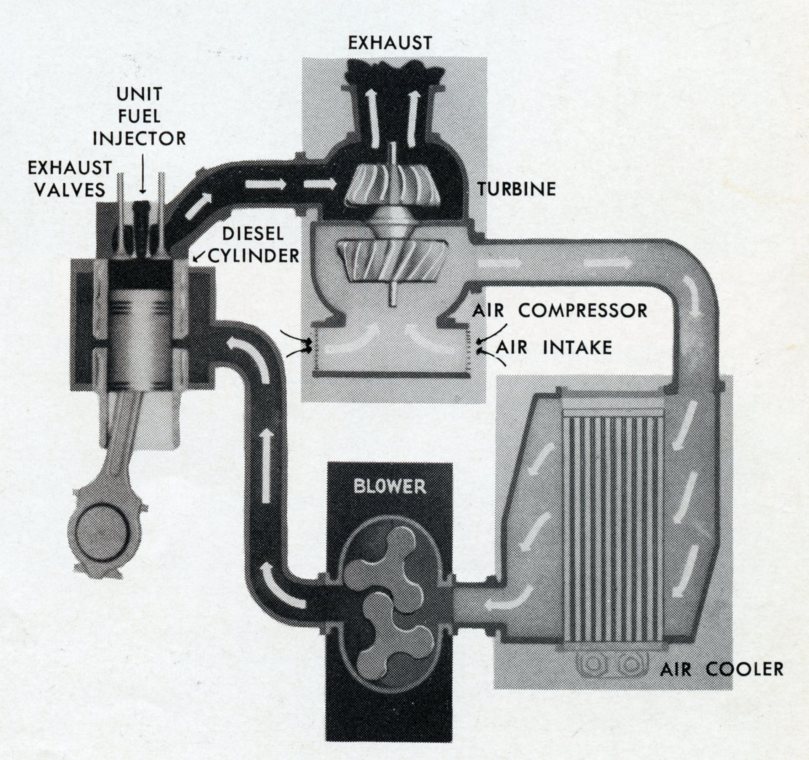
The cooling system for the 498 is virtually unchanged from the 278A except for the lack of water- jacketed exhaust elbows mentioned above.   The 498 uses a raw water-cooled intercooler mounted between the turbocharger and the blower. 

Intake & Exhaust
What sets the 498 apart from her sisters is of course the use of the turbocharger. In addition to the turbocharger, the Roots blower is also used.  See description below.  Since the Roots blower is not doing all of the work providing scavenging air, it was found a much smaller lobe length would be required, although they did spin at a slightly higher RPM then those on the 278A.   

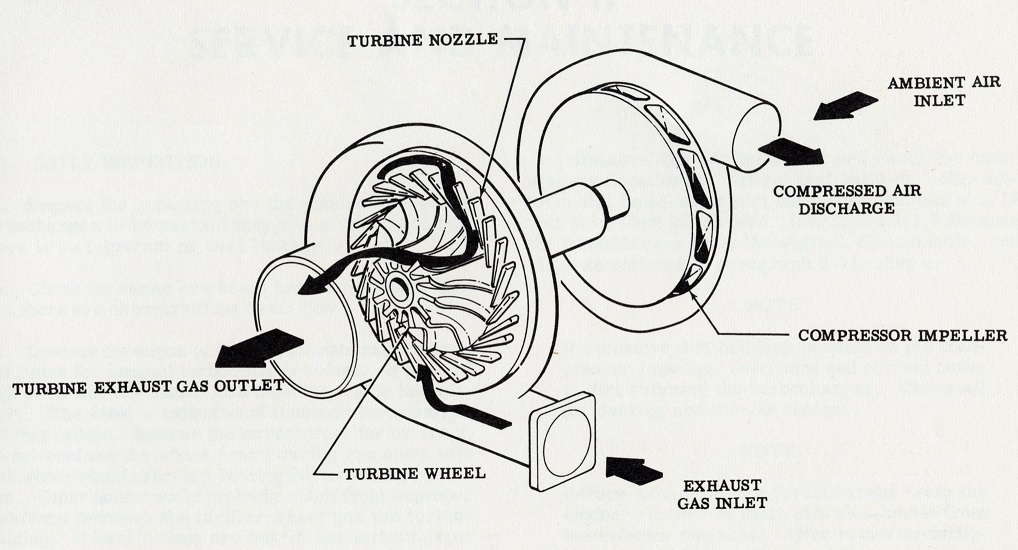
The turbocharger for the 498 was furnished by De Laval Steam Turbine Corp. and was a basic “gas turbine driven compressor”.  The Model A turbocharger was supported in its own service manual supplied by De Laval.  The unit used a “monorotor” construction with both sets of blades mounted on a common central hub.  The housing between the turbine and compressor is water cooled from the engine freshwater cooling system.  The engine also supplies lube oil for the bearings, with an optional self-contained oil pump if so required.

The turbocharger on the 498 was mounted to the front end of the engine, with the air intake sandwiched between the turbocharger housing and the intercooler. A duct ran from the intercooler to the bottom intake side of the Roots blower.

An interesting note on the turbochargers.  On most engines, the turbocharger was mounted vertically, as seen in the photo above.  On the batch of engines sold to Cuba (more on this in Part III), the turbocharger was mounted horizontally.  It is unknown why this was done, be it for clearance issues in the building, or some other unknown reason likely lost to history.

Another interesting note, the tug Robinson Bay (again, more on her in the next part), used an 8-498 engine.  However, it appears this engine did not use a De Laval turbocharger, but it looks to be an Elliot-Bucchi design! More questions we likely will never know the reason why to.

The 16-498 engines built for Cuba used a horizontal De Laval turbocharger. The tug Robinson Bay used what looks to be a much smaller Elliot (or so it appears) style turbocharger, but the engine was still rated at 1400HP. (1959 Diesel Engine Catalog Left, 6/1958 Diesel Times Right, J. Boggess Collection). Click for larger.

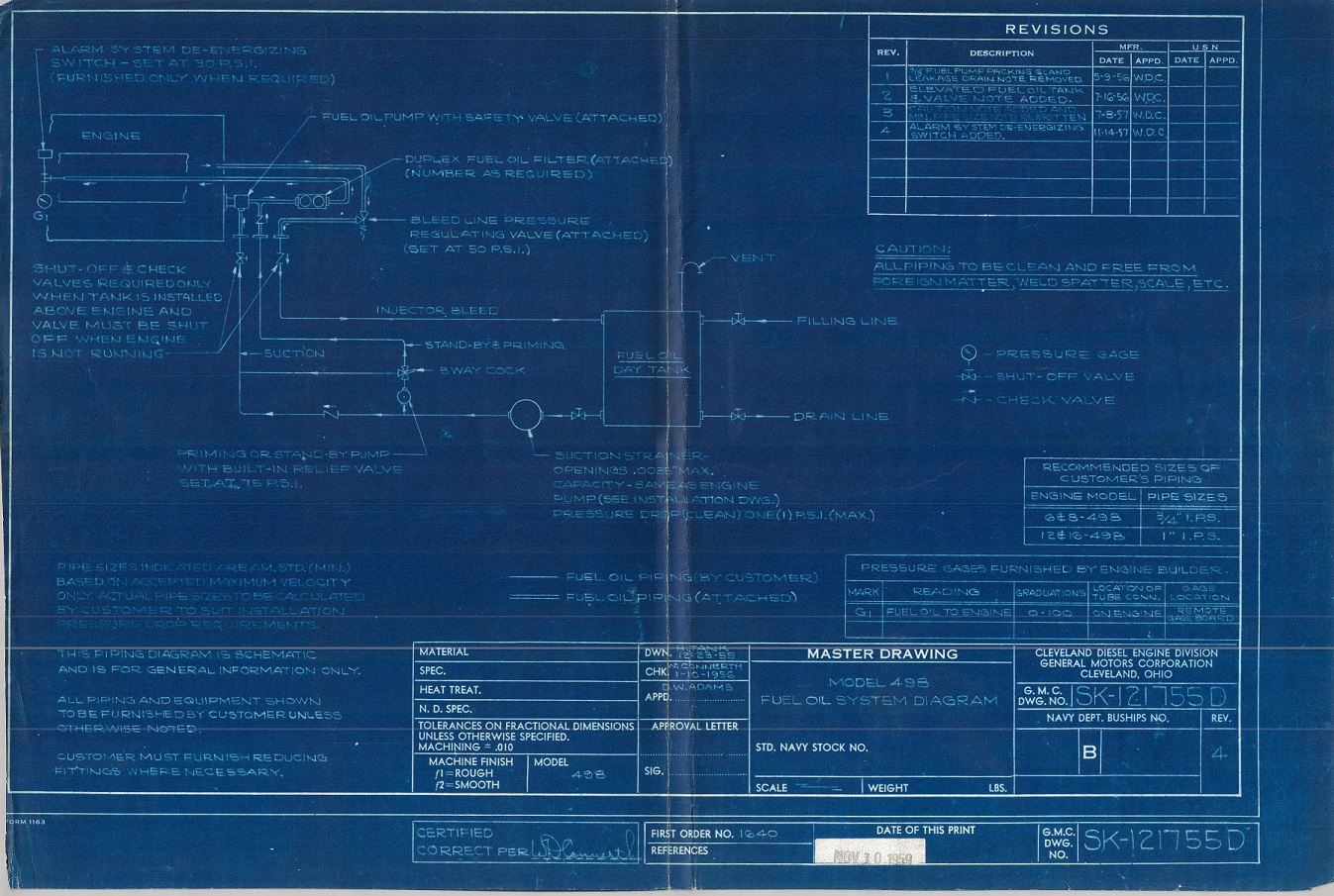
498 engine plumbing for a Diesel-Electric tugboat (click for larger)

In Part III we will go through every 498-engine built (it was only 58!)


Sidebar: My co-conspirator & former EMDer Jay Boggess & I have concluded that we really started this project about 10-15 years too late!  Too many souls have moved to the Great Beyond – souls that could answer the questions our research has uncovered.  We do not have clear reasons why the 498 didn’t make it (more on this in Part III and IV), only guesses and suppositions and the little bit we have been able to gather talking to guys who worked on these engines in the last few years.  But then, 15 years ago, we didn’t have the internet to bring folks from across the country together, sharing common interests and information. And besides, 15 years ago, I was in junior high living 900 miles away!

Special thanks for this part go to Preston Cook, who sent me a Xeroxed scan of a 498 manual several years ago. I have since been able to acquire several versions of the original manual and service newsletters thanks to Great Lakes Towing Co., who was gracious enough to send a few surplus copies to me when we started this research project. I would love to find a service parts book, and an De Laval turbocharger manual (we only have a photo scan of it) for the Cleveland 498, and would happily pay a good price for them! My contact is in the upper Right of this page.

A Turbocharged Failure – The Story of the Cleveland 498, Part I

June is a the two year anniversary of this blog, and with that I am kicking off a series dedicated to the Cleveland 498 engine. The 498 engine has been shrouded in mystery over the years, and was one of the main driving forces of creating this page. I wanted to do a writeup on the engine, but had no place to put it! Just to put this right on top – if anybody has any stories, recollections, information, photos or documentation on these engines, PLEASE send me a message! I am trying to document these engines as best as I possibly can.

In the days after WWII, medium speed, 2-stroke diesel engines essentially hit a horsepower wall, around 1600HP or so.   A common way or obtaining a higher horsepower rating, was simply to add more engines!  Unfortunately, adding more engines, means more space is being taken up.  So, the solution is to try and get more horsepower out of what you already have. 

Enter turbocharging.  

Now, turbocharging was not a new concept by any means. Many diesel engines benefited by use of turbocharging, but these were almost all 4-stroke engines.  Cleveland Diesel had a single turbocharged 4-stroke engine design during WWII, the 258S (originally a Winton engine) which was a 2000HP direct reversing engine built for subchasers.  Even several WWII aircraft, including the B17 Bomber were turbocharged. Turbocharging a 2-stroke engine was an entirely new concept.  As it is, a 2-stroke requires some form of positive displacement blower for scavenging.  The issue with adding a lone exhaust-driven turbocharger, is in periods of startup, lower idle and acceleration, the engine gets starved for air, as it is not providing enough exhaust to spin the compressor.  Kind of a catch 22 situation.  More on this later. 

The basic operation of a turbocharger from a Garrett-AiResearch manual.

Throughout WWII, General Motors Diesel (Cleveland Diesel, Detroit Diesel & Electro-Motive) was the leading Diesel engine supplier to the war effort.  Cleveland Diesel would supply over 13,600 engines (from 7-1939 thru Dec 31, 1945), be sure to read our history about Cleveland Diesel here: Cleveland Diesel Engine Division – GM’s war hero turned ugly stepsister

Cleveland Diesel WWII Production:
16-278A: 1,930
12-278A: 771
8-278A: 243
6-278A: 554
Total 278A Production – 3,498 engines
16-278: 20
12-278: 352
8-278: 55
6-278: 72
Total 278 Production – 499 Engines
268/268A (all models) – 9,136 Engines
248 (all models) – 268 Engines
Miscellaneous – 239 Engines
Total – 13,640 Engines

The Cleveland 16-278A engine was one of the most widely used engines during the war and peaked at about 1800HP, which was about on par with the EMD 16-567C, which was introduced in 1953.  Alco was already there with their 12-251B, also making 1800HP, however this was a 4-stroke, with a turbocharger already.  Fairbanks-Morse cracked the magic 2000HP barrier in a medium speed engine with the 10-cylinder 38D OP engine by 1950, using only a Roots style blower.  

With General Motors (and Cleveland Diesel) still working closely with the Navy, an experimental test was devised by the Navy’s Engineering Experiment Laboratory in Annapolis, Maryland in 1947 to start testing turbochargers.  A proof of concept test was launched, using a Detroit Diesel 1-71 (yes, GM turbocharging has its roots in the diminutive, little 1-71 engine!).   With the proof of concept done, more testing was devised in the early 1950’s at the Engineering Lab using a bone stock 16-278A engine.   A test was devised in which a mock “turbocharger” (another Roots blower) was installed on the test floor, operated by an electric motor, to feed the engine in a simulated and controllable environment.  A goal was set to maintain a cylinder firing pressure in the area of 1300 PSI (compared to the stock 850-1050 PSI) and make 3,000HP. Numerous tests were conducted with various configurations of inner and after coolers, blower sizes, injectors, controlling exhaust timing and use of snorkels for Submarine use. A similar test was conducted using an 8-268A engine as well.   Unfortunately, I have yet to come across any photos of these tests. 

The winner – Using the stock configured 16-278A engine, with turbocharger feeding the Roots blower with an aftercooler made an impressive 2,990HP at its rated 750RPM.  With controlling the exhaust timing, the engine made 3,130HP.  Amazing numbers for a stock engine! Not to mention, a true testament to the engineering of this engine, and its ability to take such punishment.

Performance ratings for the test engine, from Turbo-charged engines for the Navy, by L. Wechsler and T.W. Shipp, Internal Combustion Engines Branch, Bureau of Ships

After the tests, three turbocharger manufacturers would begin working with the Navy to spec out an appropriate design, and how to supply the air to it, be it via individual ducts from each cylinder (common on 4-strokes), divided manifolds or a single manifold using a venturi system.   The results of the testing were concluded in a presentation at the SAE National Diesel Engine Meeting on October 27th, 1954.  The report, High Supercharging, Development of a GM 16-278A 2-Stroke-Cycle Diesel Engine, was presented by Warren G. Payne and Wolfgang S. Lang of the US Naval Engineering Experiment Station. 

Unfortunately, not all the testing was complete at the time of this paper, so it is unknown just how well the testing progressed when the turbochargers were installed on the engine.  What is known, is that testing further proceeded at the Engineering lab on the 16-278A, The Lanova Corporation handled the 6-71 testing in New York, and De Laval Steam Turbine further tested the 8-268A at their own lab. 

The test 8-268A test engine at the De Laval test lab, used a model B-8 turbocharger. From a 1955 De Laval advertisement.

After the presentation, a discussion panel ensued, which is also part of the transcript of the report, in which comments were heard from other engine builders and engineers.  One such stands out:  Rudolph Birman of the De Laval Steam Turbine Co., who essentially picked apart the findings. Mr. Birman states several things, such as:

“Water cooling of the exhaust manifold cannot be tolerated in a turbocharged 2-stroke engine.”

 “All starting, idling and high exhaust back pressure problems are eliminated, however, if the positive displacement blower is retained and the turbocharger arranged to operate in series therewith.”

“There is a similar disagreement between the findings of the authors and those of De Laval with regard to the location of the intercooler in a turbocharger-positive-displacement-blower in series arrangement.”

I do not know if De Laval were working behind the scenes with GM/Cleveland Diesel already (given the time frame, they must have been), however, Mr. Birman’s commentary would essentially be the entire basis for what would become the 498 engines in just a few short years. 

The concept drawing of the Cleveland 498 first appeared in the August 1955 issue of Diesel Times, along with some basic specifications and features.

Another set of comments worth noting, was from A.K. Antonsen and E.L. Dahlund of Fairbanks, Morse & Co. FM was working in-house on their own turbocharger design, starting in 1945 on a basic 10-cylinder 38D 8 1/8th OP engine used in submarines, as well as a smaller 3-cylinder 5¼” OP engine.  Full production of a turbocharged OP engine was not offered commercially until sometime in the late 1950’s (Anybody have a specific year?). The Turbo OP would be a very popular stationary power engine, and would peak at over 4,400HP for the 12-cylinder engine.

FM’s Turbocharged OP engine is still produced today, producing astronomical amounts of horsepower mainly for standby power generation. Note that like the Clevelands, it retains the Roots blower. FM Brochure

As mentioned above, one of the shortcomings of the turbocharger on a 2-stroke is the lack of enough scavenging air.  The issue was addressed by simply retaining the Roots blower, but it was found a smaller one would work (we will get to this more in Part II).   With the testing on the 268A engine, in place of the blower a small hydraulic motor was tested mounted to the turbocharger.  In periods of low RPM, the hydraulic motor would turn the compressor, essentially making artificial air pressure with the turbo.   The pump for the hydraulic motor was driven by the engine.  

An early Detroit Diesel 6-71T engine used for an industrial application.

With Cleveland Diesel now working on a whole new turbocharged engine – GM sister division Electro-Motive was doing the same.  EMD started their own program in January of 1955 to turbocharge their current 567C engine, unlike Cleveland, they did not start by redesigning the entire engine from the ground up. Like the Navy tests, EMD used an electrically-driven Roots blower in a mock test using a 12-567C engine for development purposes, but EMD would design their own turbocharger for the 567C engine.  Instead of using the combination Roots blower and turbo in series, EMD designed their own all new turbocharger, which would be mechanically-driven from the camshaft through a geartrain during starting, low speed, low power and accelerations, providing scavenging air. The turbocharger is connected to the geartrain through an overrunning clutch.  At certain power levels (approximately Throttle Position 6 on a locomotive), there is enough energy in the exhaust so that the turbo runs faster than the geartrain, the overrunning clutch disengages, providing “free” turbo-supercharging.  This would go on to become a very successful design and used throughout the 710 line (with several refinements of course).   EMD’s first production turbocharged locomotive, the 2400HP SD24, was introduced in 1958. We may do an article specific to EMD turbocharger history down the road, but for now we will stick to the CDED 498. 

The prototype turbocharged EMD 16-567C engine from “Performance of a Turbocharged 567C engine” by A.N. Addie/EMD. Production turbochargers would be used only on 16 cylinder engines, and were given the “D” model. Turbochargers would not be used on 12-cylinder engines until the 645 line.

Union Pacific Railroad was doing their own separate development with adding turbochargers to the 567C used in GP9 locomotives starting in 1955.  Working with Garrett-AiResearch – (later makers of the turbocharger used on the 6-71), a manifold was devised, and four small turbochargers were added feeding into the stock Roots blowers through an intercooler.  UP would also test engines with turbochargers made by Elliot, but using only two slightly larger ones then the Garrett installation.  These tests were successful, and several engines were converted.  UP would send GP9’s to EMD in 1959, which were upgraded with new EMD turbochargers for further testing. Ultimately these test engines were converted to EMD turbochargers, or had them removed.  I urge everyone to read Don Strack’s Utah Rails page on the Omaha GP20’s for much further information on this test program. Please be sure to visit the links below.


Omaha GP20’s, Union Pacific’s GP9 turbocharging program
Omaha GP20’s Diesel Era V7 #6, 11/12 1996

The quad Garrett turbochargers installed on the 567C. Note the complex plumbing for the exhaust and charge air going to the blowers. Union Pacific Photo, Don Strack Collection.

The Elliot installation was a little more simplistic, with a single exhaust manifold feeding a pair of slightly larger turbochargers, with each one feeding one of the blowers. Union Pacific Photo, Don Strack Collection.

The Cleveland 498 made its public debut at the General Motors Powerama Festival.  Powerama was held August 31st-September 25th of 1955 in Chicago, Illinois.  The event, “A Worlds Fair of Power”, would be a giant showcase of products from General Motors, including Cleveland Diesel, Electro-Motive, Detroit Diesel, Euclid, Allison, GMC Truck & Coach, Fabricast and Frigidaire.  On display were numerous engines, pieces of heavy equipment, locomotives, and even the Great Lakes Towing tugboat Laurence C. Turner, and the Fleet Submarine Tautug SS-199.

The first Cleveland 498 displayed at Powerama. I have my doubts that this was a full production engine, as it just does not look “right”, especially the exhaust jumpers and manifold. I think this was more of a mock up model for display. Note the differences just in the cutaway model on the left. The first production engine used commercially was still several months out. Unknown photographer, VDD collection.


Stay tuned for Part II, where we will discuss the 498’s design features and specifications.

This will be a four part series, the links of which will appear for each post as they are added.
Part II – Engine design features & specs
Part III – Uses and installations
Part IV – The last one, Tug Idaho

Note: A complete set of bibliography and notes will appear in Part 4