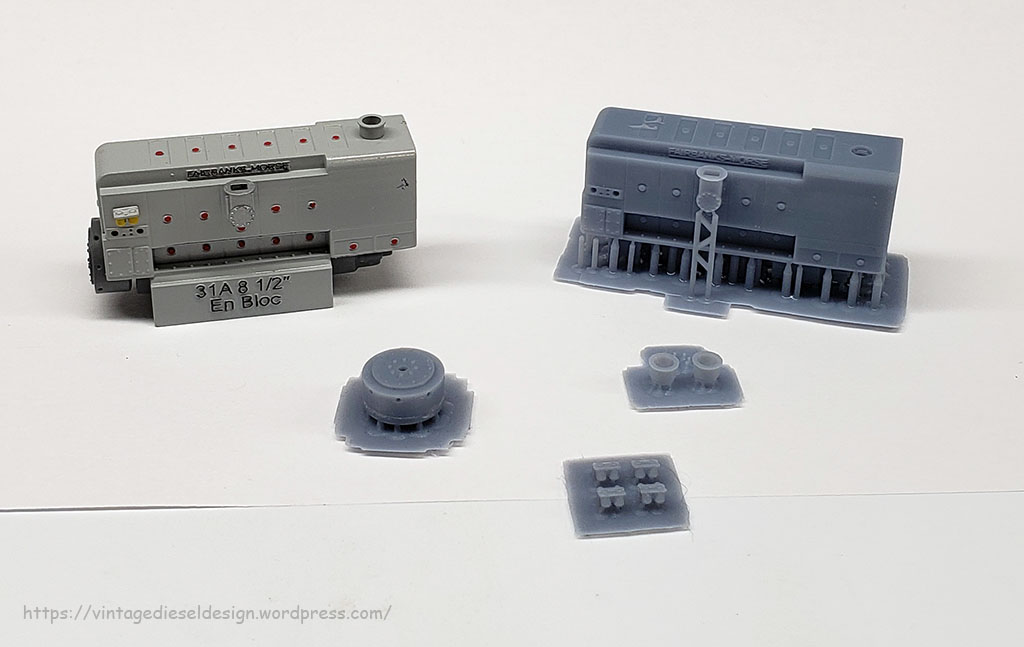
At the end of the last post on the Fairbanks Morse 31A series, I mentioned I was going to draw up the engine in CAD and 3D print it. I am a model builder and a model railroader when I don’t get to play with old engines, boats and locomotives, and even do it as a business now. The model was drawn out and printed in 1/87th scale, better known to model railroaders as HO scale.
I opted to do the 5 cylinder 8 1/2″ version. I am considering making a small diorama depicting the Corpus Christi Pumping station that appears in the post below.
Click for larger
On the left is a finished model, on the right is exactly how it leaves the 3D printer. I decided to make a version of the engine with no base, so that it could be used as a flatcar load.
Click for larger Click for larger
This is just the first of many engines I am going to build models of. I am already well into the CAD for a few more. You will see those here first! If anyone is interested in one for their railroad – I have them forsale over on my actual business page : https://gothamrailmarine.com/3d-printed-parts/
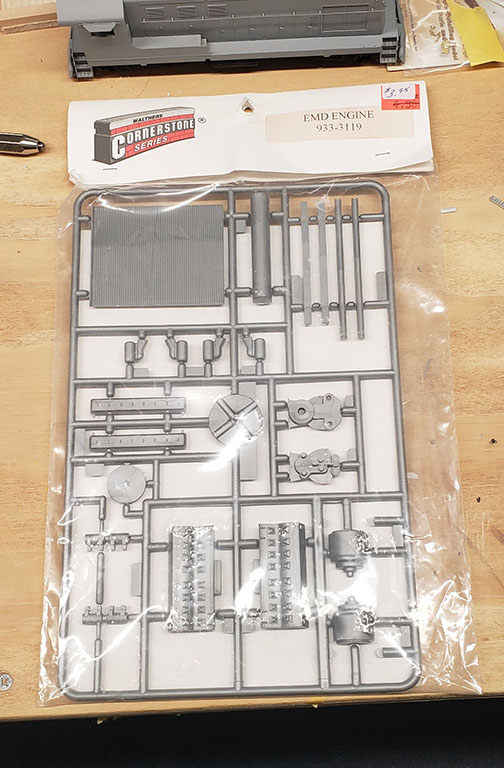
Here is another 1/87th scale engine, an EMD 16-567 offered by Walthers. This kit has been around for 20+ years, and is pretty crude, but not terrible. It is a bit of a mashup between a 567A and a 567B. On my to-do list is a slew of upgrades to make this kit a little more closely resemble something a little nicer. https://www.walthers.com/emd-567-prime-mover-kit
A few years back I cut down one of these kits and made a little 6-567, as if it came out of an SW1 switcher. This sat in the engine facility of my previous layout.
In Part II I will show you some more 3D printed 1/87th engines that are available.
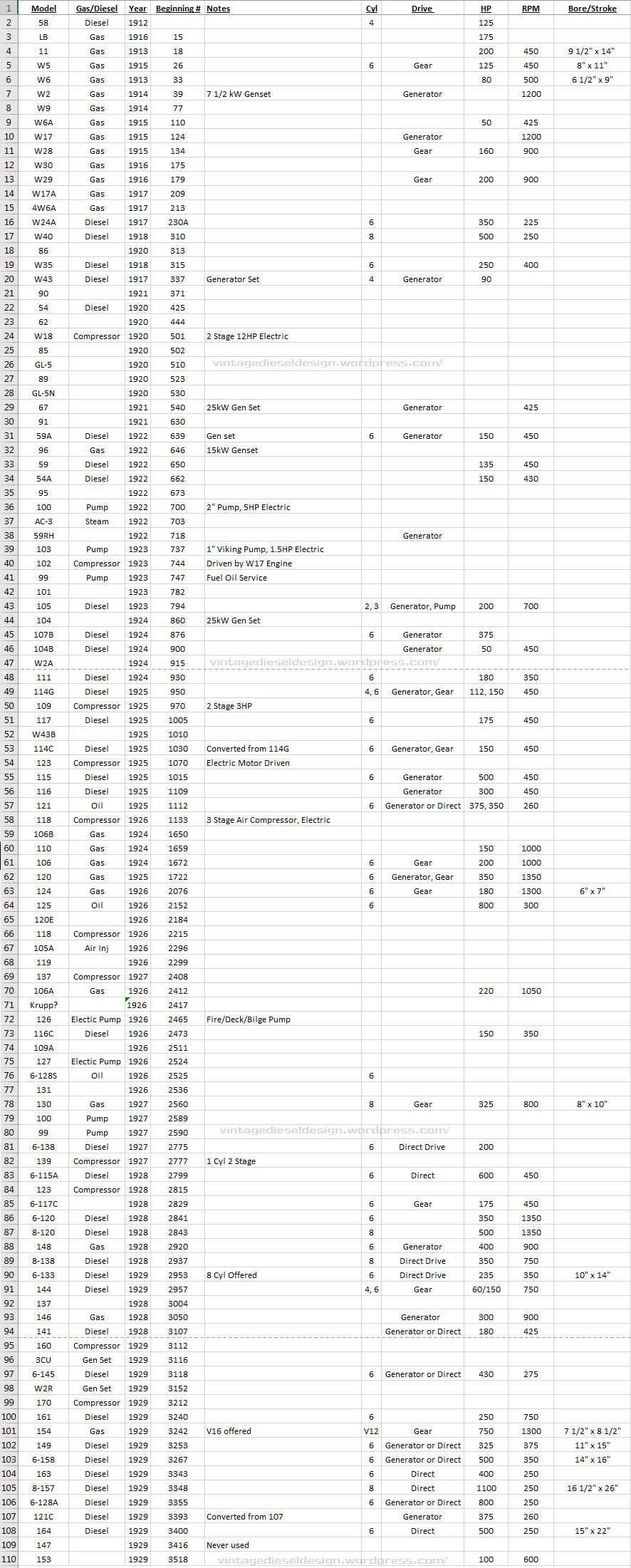
Over the last few months, I have been combing through the records for Winton, and later Cleveland Diesel, and put together the following master list of every engine produced by them. This is the result of several nights of going through 2000+ pages of entries, and then spending the following several months filling in the gaps with specifications using various manuals, brochures, company newsletters and everything else, and even still, there are many, many holes with the early engines.
The records start with engine #15 – thus I can not fill in those very first engines. Note that Winton assigned model numbers to several of their auxiliary units such as compressors and pumps, and are labeled as such below.
3-2023: Since making this post in 2020, I have been able to fill in a huge amount of holes in this, as well as acquiring an official Cleveland listing. This will be posted in the next few weeks.
Click for larger
The last Winton engine before being purchased by GM was engine number #3559 on 6/12/1930, a model 148 engine for Electro-Motive. Winton was purchased by General Motors on 6/20/1930.
Click for larger
On 12/30/1937, Winton Engine Corp., was renamed to the Cleveland Diesel Engine Division of General Motors. The Final Winton Engine was #5359, A 12-201A for Railroad Service. Note 1: 4432/3 are the prototype 201 engines, listed as “used 201” in records.
Click for larger
When it comes to horsepower ratings, especially on the later engines (278A, 268A, 567C), there were simply too many horsepower numbers to list, as it varied by application.
Note that by now – we see engines that are made by sister companies including Detroit and EMC/EMD. Early on, the Detroit Diesel engines sold through CDED (typically part of a “package” for a boat) carried both a Detroit Diesel as well as a Cleveland Diesel builders plate. In the case of the Detroit engines, this was dropped by the 1940’s.
However – with the EMC/EMD 567 line, engines sold though CDED for marine and stationary use carried only a Cleveland builders plate well into the late 1950’s. Only the very last few 567 engines sold through CDED carried both an EMD and a CDED builders plate. More information on this can be found on our post documenting Winton/CDED linked below.
Also to note: This list covers only engines built or sold through Winton and Cleveland Diesel. This does NOT cover any additional engines or developments by Detroit Diesel (such as the 51 or 53 series and later) or EMD (184A, 645 etc.)
Thanks to J. Boggess and P. Cook for helping with this. As always, there are numerous holes in the listing, so please send us a message with any additions or corrections.
Something that I see quite often on various forums and the like, is misidentification of the early EMD 567 series engines. Like all engine manufactures of the day, the EMD 567 line was under constant revision throughout the years. This is not meant to be any sort of history of the engine, just a simple way to differentiate the different types of 567 engines.
The “Straight” 567
One of the first EMC 567’s built in July of 1938 for the “Thomas E. Moran”. While the base engine was built by EMC, it was then sent to Cleveland Diesel to be converted into a marine engine. Note that while the rectangular crankcase and airbox covers are the same, the crankcase ones are horizontal, while the airbox ones are vertical. These engines would be removed and replaced with a single 12-278A in 1944.
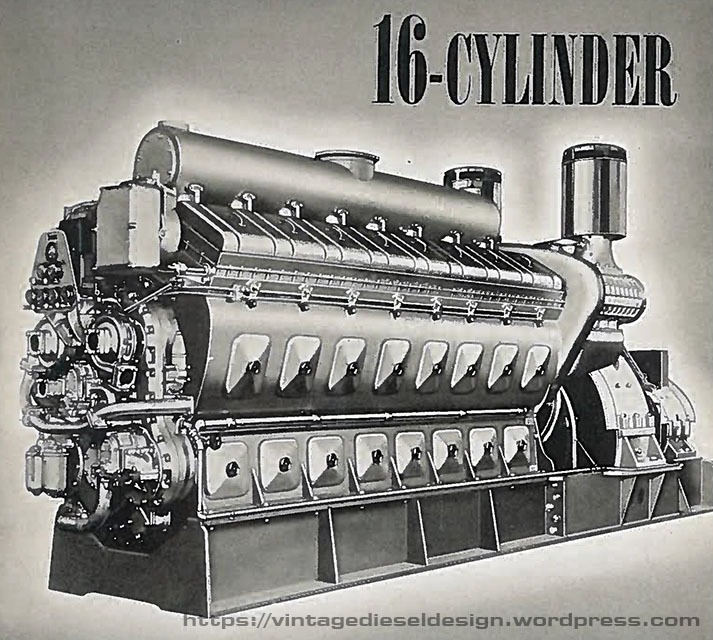
The first production model of the 567 was just that, the 567. Often people dont associate this engine, thinking the 567A was the original, but it was not. The first 567 engines used an interesting top deck design, with extended crab studs to hold down the covers, with a simple rectangular hatch over each injector. The first pair of production 567’s according to the EMD book “Diesel War Power”, were for the Moran Towing “Thomas E. Moran”, built by Defoe Shipbuilding in 1938. Ironically, an engine designed specifically for locomotives, would be first installed in a tug. The engines (one pictured above) were V8, 660HP/750 RPM engines that drove a 400kW generator, with a 24kW belt drive exciter above.
A spare 12-567 on a flat car at the Illinois Railway Museum
The first Railroad use of the 567 would follow in October of 1938, with a set of E4 Streamliners for the Seaboard Air Line railroad. Each E4 used a pair of 1000HP 12-567’s. The first and most obvious way to spot the straight 567, is the very wide housing for the blower drive gears, making the rear end of the engine rather wide. EMC/Cleveland would supply special versions of this engine to the USCG for use in a fleet of Icebreaking Tugs, with a narrowed version of this case, however all of the standard production engines used this wide case. By now, the engine also featured matching doors on both the crankcase and airbox, as well as a larger, removable cover that spanned the entire top deck.
Click for a larger version
Note the upper deck of the engine in the “U” (cast) or “V” (fabricated) upper portion where the exhaust coming out of the heads would mate up with the upper manifolds. The original EMC 567 design is well outlined in Eugene Kettering’s paper on the History and Development of the 567, which will be linked to at the end of this article.
The production EMC 567 would be offered in 6, 8, 12 and 16 cylinder models
567A
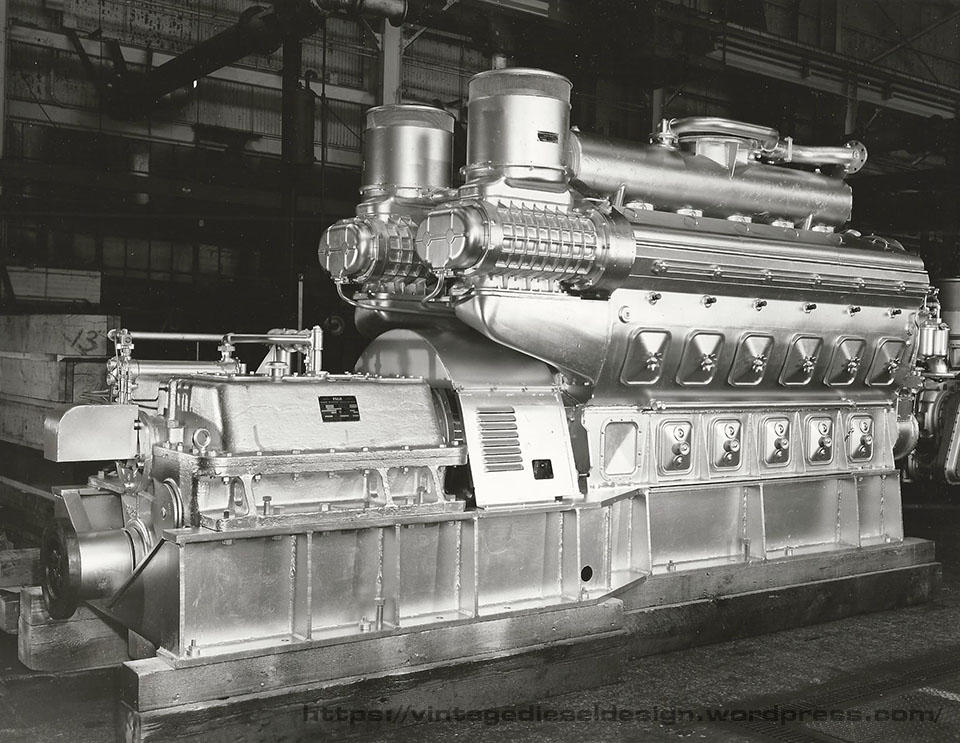
With the onset of WWII, the 567 by now was being refined into the 567A starting around 1942. What would put the 567 line on the map, would be the advent of the Navy LST program. The majority of the LST program would in turn use a pair of 12-567A engines (dubbed ATLP/ATLS for Aux. Tank Landing Port or Starboard), driving a 2.48:1 reduction gear through an air clutch. On land the 567A was being used in all of EMD’s line of locomotives from switchers to road power.
Click for a larger version
The 567A would take the idea of the narrowed blower drive on the USCG 8-567’s, and make it even narrower, thus saving crucial space in the engine room. Midway through the LST program in 1943, the two piece floating piston and carrier design was adopted. Also to note, is the entire upper deck was modified, and now the exhaust from the heads ran inside of a water deck. Note the smooth cast ducts for the scavenging air from the blowers into the airbox.
An early Cleveland 12-567A with a Falk clutch/gear drive. J. Boggess Collection.
The 567A package used in the LST would go on to be one of the most common repower package for tugboats in the 1950’s and 60’s, something we will get into more in the future.
567B
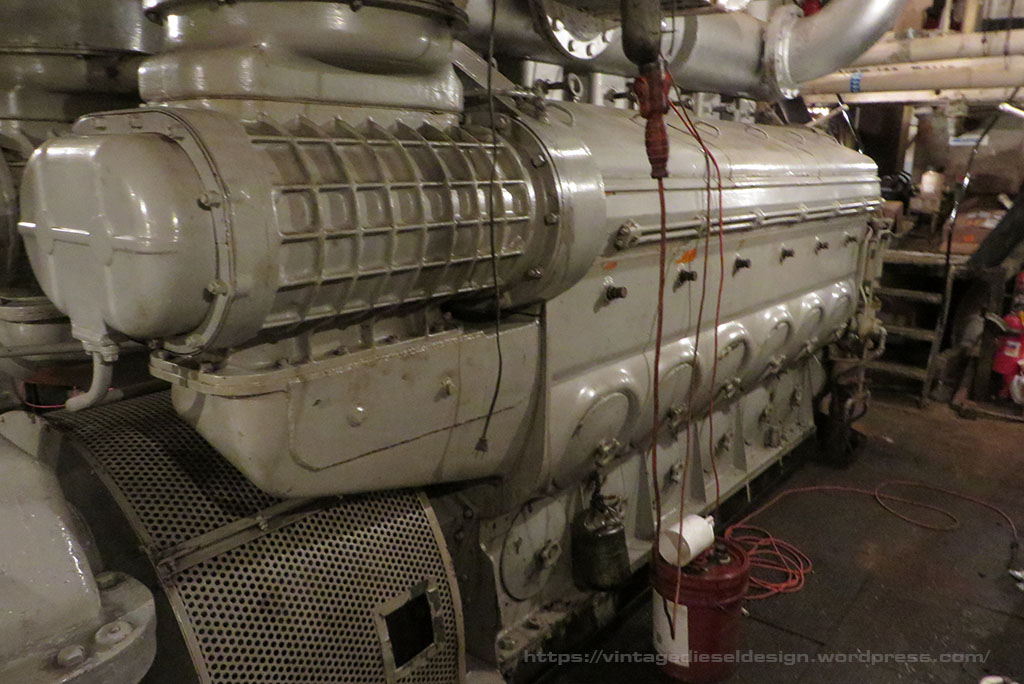
The 567B was introduced after the end of WWII. The 567B was very similar to the 567A, with one main spotting difference on the outside. The 567B now used a ribbed air duct casting from the blowers into the airbox.
Mechanically the 567B was essentially the same as the 567A, with the difference being the attached oil strainer housing on the front end of the engine.
567C
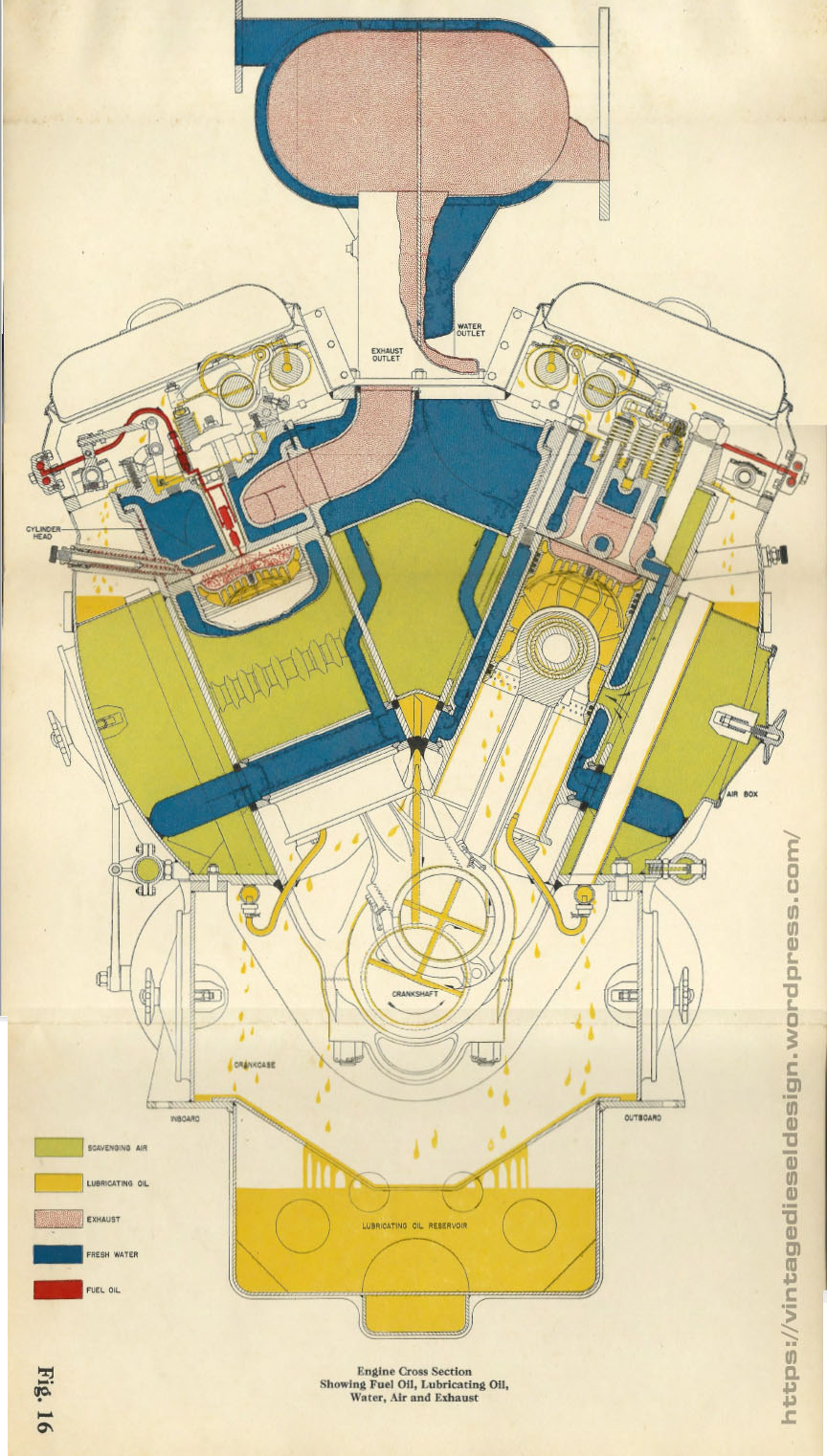
In 1953, EMD introduced the 567C. The C block engine was essentially an all new engine. The C blocks major change involved the elimination of the water deck liners, and the use of O rings to seal them. These O rings were prone to fail, and would thus cause water contamination of the lube oil system. The C liners used a bolted on water inlet type, completely eliminating the water deck.
A Cleveland 16-567C with a Falk 16MB reverse reduction gear. This was one of the more popular marine uses of the engine through the 1960’s. J. Boggess Collection.
The easiest way to spot a 567C – is that the block introduced a few new changes. First is the round inspection covers on both the airbox and crankcase. The fuel rails were moved to the inside of the upper deck, as well as an all new style of hinged upper deck cover, with snap latches. The thing about the 567C is that it is also identical to its replacement, the 645 series.
Click for a larger version
567CR
A short one here – the 567CR was only an 8 cylinder engine, that used a revised firing order, hence the “R”, to help with vibration issues. Externally it is exactly the same.
567D
The final installment in the 567 lifespan development is the 567D of 1959. The D line of engines introduced the turbocharger. EMD, unlike Detroit and Cleveland would develop their own turbo, that was driven off of the gear train through a clutch at low speeds, and would freewheel when the exhaust pressure built up. The 567D was only offered as a 16 cylinder engine, and topped out at 2500HP. Later on they would take the turbo off for a few select applications, and squeezed 1800HP out of it. The 567D2 (used in the GP20 locomotive) utilized a slightly different turbo design, with straighter appearing ducts into the airbox.
The turbo versions of the 567D while overall successful engines and were a major stepping stone to the 645 development, however were plagued with turbo issues early on. Several railroads choose to pull the turbos off and replace them with the traditional roots blowers.
567AC and 567BC
The AC and BC engines, from the outside are identical to their original counterpart. Internally, the engines were upgraded to use “C” block liners (but kept the A/B heads). The only way to spot one of these, would be to remove an airbox cover and see if the water manifold is present.
567CA
Not to be confused with the above conversions, the 567CA engine is its own beast. While it was not any sort of a new development, the CA engine was an EMD designed direct replacement for the 567ATL LST engines that by now were in hundreds of commercial boats.
12-567CA in the tugboat “Jupiter”
The CA engine used a new crankcase with “C” specs (including liners as well as cylinder heads), however there were several recycled parts off of the original ATL engines. The smooth blower ducts, as well as the entire top deck assembly, complete with the external fuel lines and removable covers were recycled off the original engines.
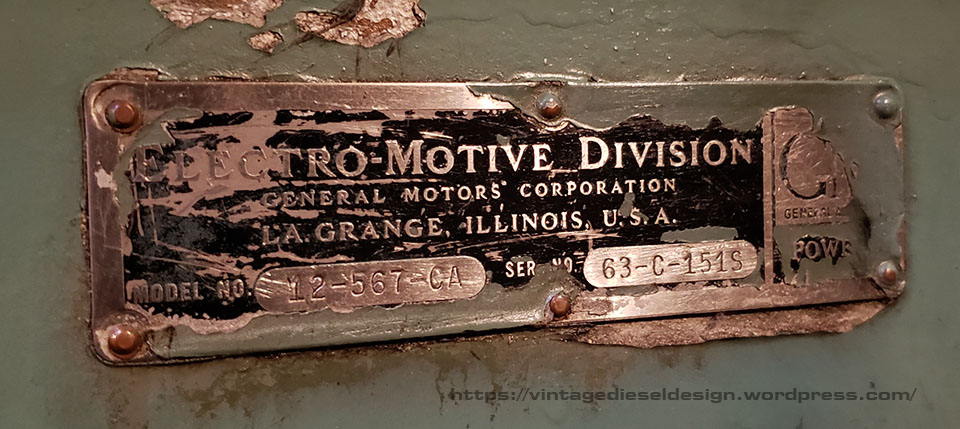
The 12-567CA engines were developed in the early 1960’s as drop in replacements.
645C
Yes – the 645C is actually a 567. The 645C is a 567C that uses 645 power assembly’s. Again, like the AC and BC conversions, the 645C is not distinguishable from the outside. These are sometimes known as a 567E.
Wrap up…
Please note, I wrote this simple as a way to try and help to visually distinguish each model of 567. One thing to keep in mind, is the 567 was a very modular engine at the end of the day, and quite a few components are interchangeable throughout the entire production line, some easier then others.
As mentioned previously, the 567 was an EMC/EMD design, and was built in the LaGrange shop. Between 1938 and 1961, both marine and stationary versions of of the 567’s were marketed and sold under the Cleveland Diesel banner, having been converted for such uses in their Cleveland shops. These engines carry Cleveland Diesel builders plates, and numbers.
Preston Cook, one of the leading authority on EMD, has a fantastic write up at the following link which gets a bit more into the technical sides of the model development over the production spans.








 Vintage Diesel Design