Several years ago, we were doing a gasket kit on a power pack on the Cornell. We had it torn almost all the way apart and I had a “brilliant” idea… Lets see whats in the exhaust.
So… I reach in….expecting some carbon chunks..
Huh..there’s a pile of something… I don’t think its carbon.. Its just this one pile..
There’s a lot. Huh. Lets see if I can get it out.
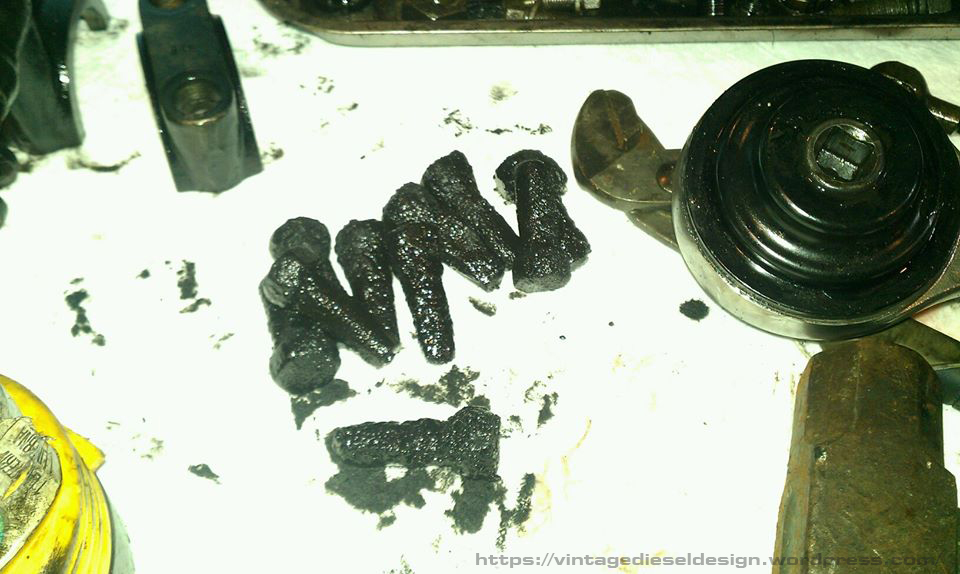
What the hell!
Click for larger.
Sure as shit, it was a pile of bolts. They were totally caked into the oil and carbon in the bottom of the manifold. Turns out – Once upon a time, somebody doing the same thing many years ago, must have pulled the exhaust jumper off, and stuck the bolts in the manifold so they don’t get lost. Because that seems like a great idea..
The exhaust jumper is held on with 12 bolts, 6 on top and 6 on the bottom. The kicker is the top ones are fine thread, but the bottom is coarse thread, so you cant mix them. In-between is a set of asbestos-copper gaskets between the elbow and the head/manifold.
We did not feel the need to put them back in.
A look into the manifold. Not bad considering the engine does not get worked hard at all. Click for larger.
Its been a busy holiday season. Hopefully I can get back on track soon with a weekly advertisement as well as getting some more in depth write ups done.
Seeking out leaking liner O rings. The Cleveland 278A uses a water deck style liner, somewhat like the early EMD’s. Yes, that is a piston by the stairs. Makes a great step stool. Click for larger.
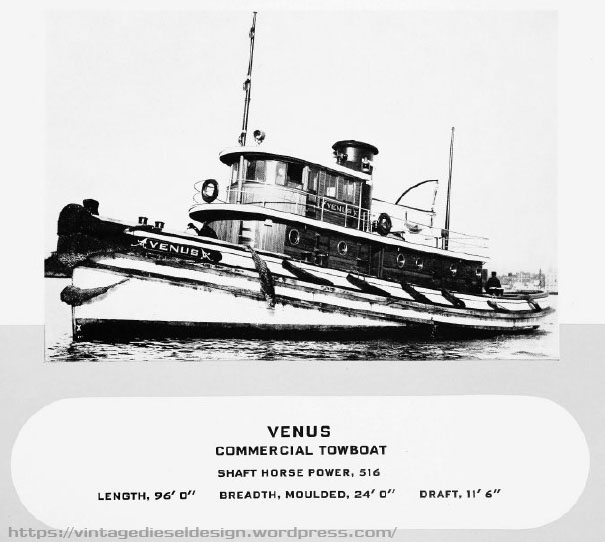
In early 1930, the Mystic Steamship Company sat down and had the firm of John C. Alden Naval Architects of Boston design them a pair of tugboats for their Boston Tow Boat operation. Built by M.M Davis & Sons Shipbuilding of Solomons, Maryland, they would be powered by the then growing in popularity – Diesel Electric Drive. While steel shipbuilding was gaining traction, the twins were both built out of wood.
Click for larger. From “Floating Power Plants”, June 1935 Diesel Progress.Click for larger. From “Diesel Electric Vessels powered by Cleveland Diesel” Click for larger. From “Diesel Electric Vessels powered by Cleveland Diesel”
The duo would go on to become flagship tugs for the company, and were used in a number of advertising for Winton, Cleveland Diesel and General Electric. By the late 1930’s, Boston Tow Boat would be reorganized as the Boston Towboat Co., now under parent company Eastern Gas & Fuel Associates, and ultimately falling under the Midland Enterprises banner, parent company to numerous inland tug and barge companies.
Luna and Venus team up to help dock an Amoco ship in Boston. Unknown photographer/collection of VDD. Click for larger.
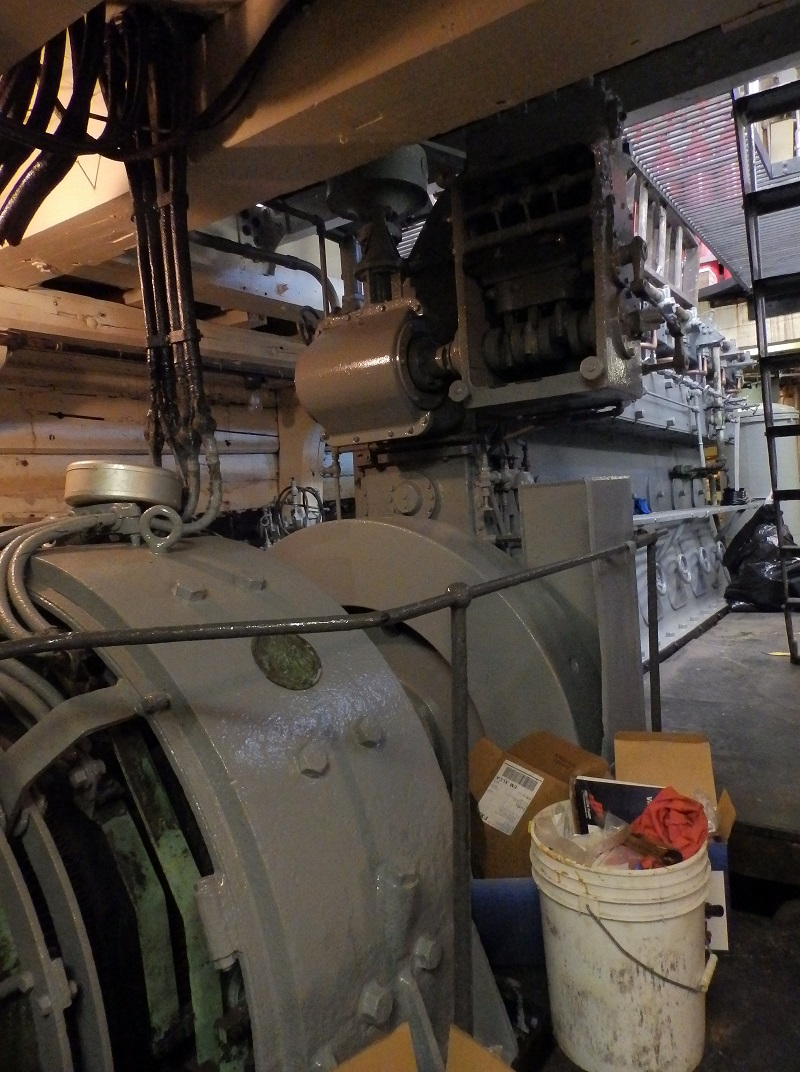
Luna and Venus are each powered by a pair of Winton 6 cylinder, 335HP/300RPM model 129 engines. Each engine drives a General Electric 213kW, 250V DC generator, with a 25kW exciter/generator mounted behind them on the same shaft. A single GE 516HP, 500V double armature (think of it as two 258HP motors together on a common shaft) electric propulsion motor would spin the prop at up to 125RPM. A battery bank was provided in the fidley to power the compressors and other auxiliary as needed. A major change bought on with Diesel Electric drive, now the Captain had full control of the propulsion right in the wheelhouse, and he did not have to rely on the engineer downstairs through a system of bells to control the engine. The Luna is often credited with being the first Diesel-Electric tug, however this is not true. That honor goes to the Pennsylvania Railroad #16, built in 1924. Luna may have been the first Diesel Electric tug in Boston, or even the first Diesel-Electric Ship Docking specific tug, but she was not the first overall.
Engine shipping dates for Luna and Venus. Click for larger.
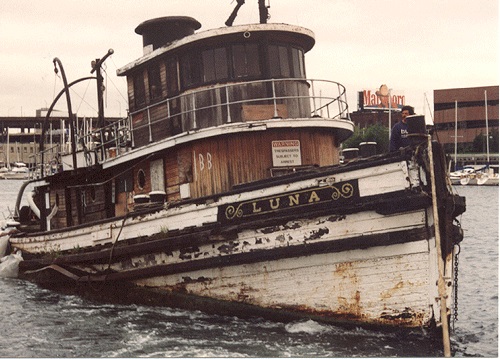
The Luna and Venus, now painted in Boston Towboats deep red, with a silver stack band (its no varnished wood, but it was one of the authors favorite color schemes for a tug company) were working alongside the rest of the Boston Towboat fleet providing mainly ship docking work in the Boston area. Unfortunately, tugs grew quickly, so even by the 1950’s they were rather outdated and very under-powered. Luna and Venus were both retired in 1971 and languished around Boston for several years. Venus was owned by Bay State Cruise Co., and used as an office at Long Wharf. Luna was planned to become a reef. Boston Towboat itself would not be around much longer either, they would become part of Boston Fuel Transport in 1985.
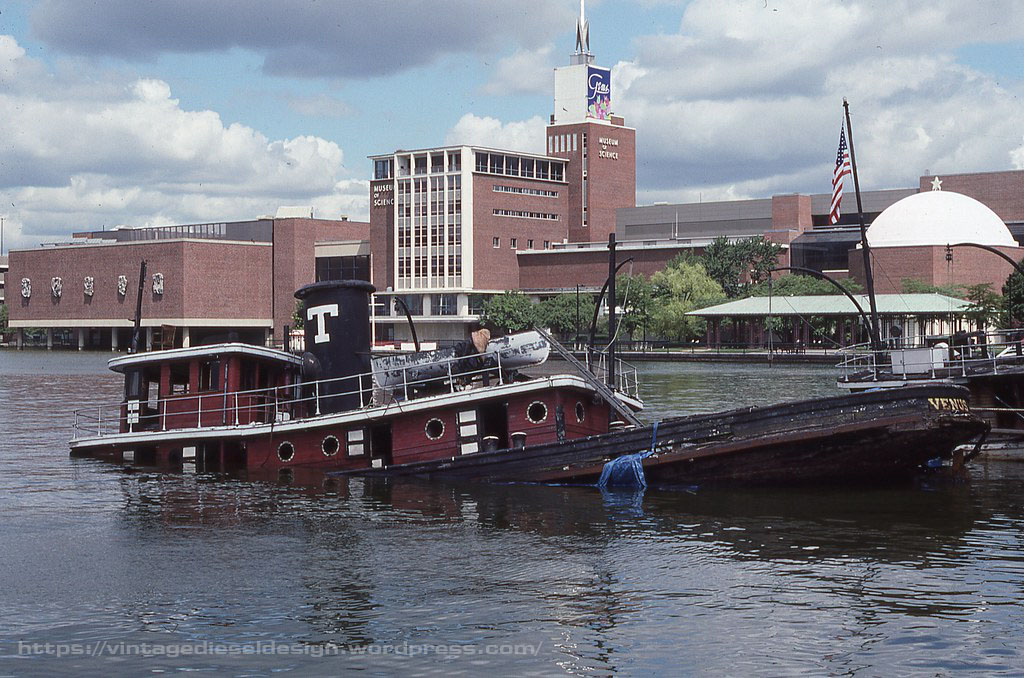
Venus in 1992. Unknown photographer/collection of VDD. Click for larger.
By the early 1980’s, plans were in place to save the Luna. She was listed on the National Register of Historic Places in 1983. She and sister Venus were back together in the Charles River Basin, and Luna was being used as an office for the Terra/Marre Research & Education Society, her then owners. The Luna was under restoration and open for tours, and was still operational with one engine running, although she still sat unused. By the late 1980’s, the tug was now owned by/under control of the Metropolitan District Commission.
The inevitable finally caught up with the 60 year old tugs. Luna was beached and awash, with sister Venus next to her sunk by the bow. A plan was finally in place by the MDC, and Luna was raised in the summer of 1992 and towed to Jay Cashmans yard. Luna was being kept afloat with a 6″ pump running around the clock, and one night the pump ran out of fuel, and down she went at the dock.
Towing the Luna out of the Charles River. Pat Folan Photo. Luna sunk at Cashmans pier. Click for larger. Pat Folan photo.
Luna was finally raised, again and towed into the drydock at the former Bethlehem Shipyard in East Boston in December 1993. Fate would not be as kind to Venus, and she was broken up. Luna languished in the drydock until mid 1994 when the Luna Preservation Society was formed. The new group took over the project from the MDC, and was able to get the Luna stabilized by wrapping the hull in PVC roofing material, which kept her floating for the next 5 years. In 2000 the Luna was towed to Sample Shipyard in Maine, and underwent a 2 year long hull restoration.
Luna today in Boston. Click for larger. Will Van Dorp Photo
Volunteers have since done an amazing job returning the Luna to her 1930’s appearance. The current plan is for her to become a new centerpiece at Pier 3, in the Boston Navy Yard. Unfortunately, having been submerged for so long, Luna will likely never run again. There were some plans to possibly install a small diesel engine in the back of the engine room so she could do some light cruising in the Harbor – Boy how I hope this does not happen. She serves her purpose well as a stationary vessel, a testament of 1930’s tugboat technology.
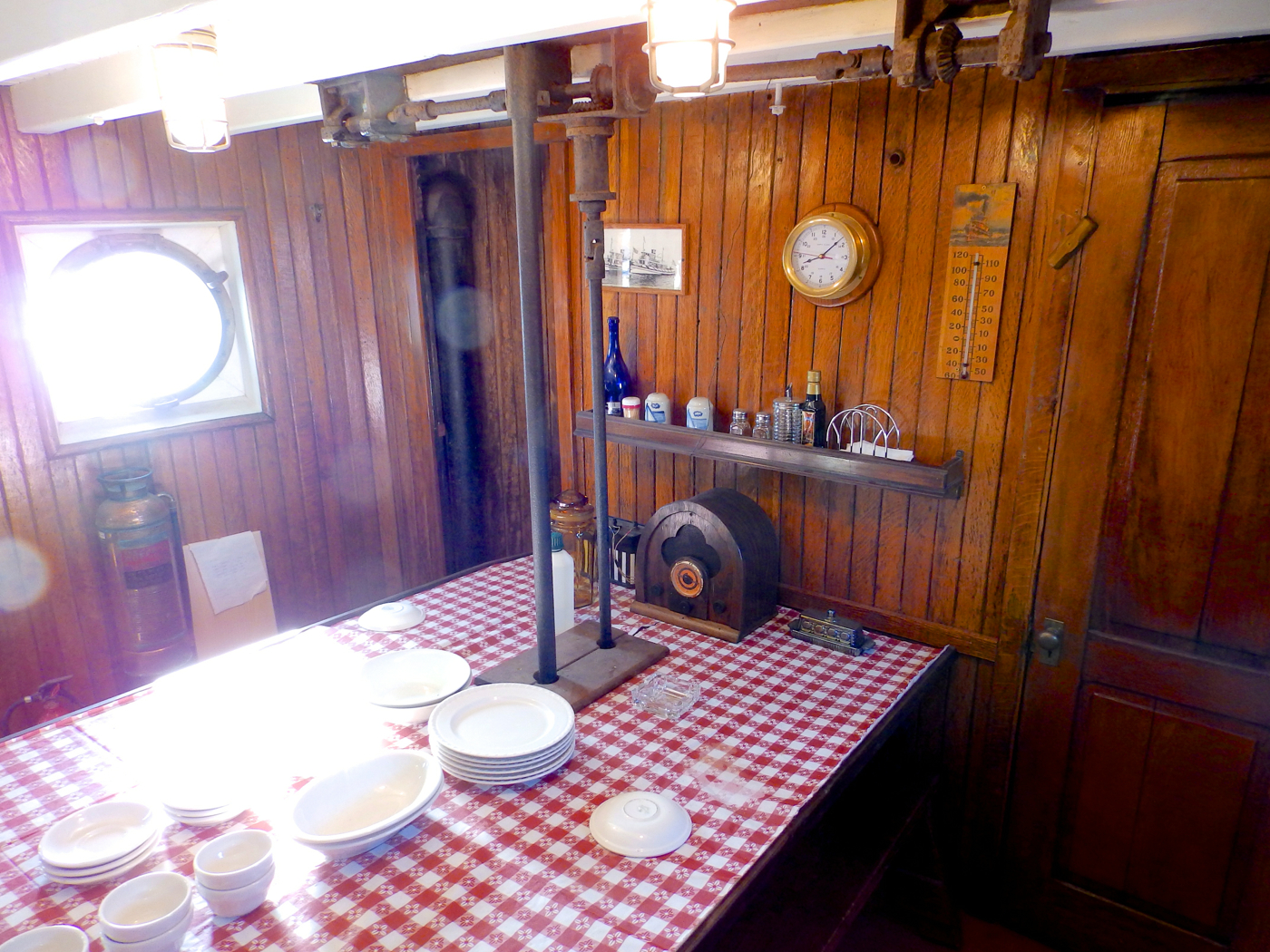
Looking aft at the Starboard Winton 129 engine. Click for larger. Will Van Dorp photo. Outboard side of the engine. Click for larger. Will Van Dorp photo. Looking forward at the Port Winton 129. Note the large flywheel, and the GE 213kW generator. Click for larger. Will Van Dorp photo. What is interesting is that the propulsion motor in Luna is mounted on the very forward end of the engine room, between the forward two fuel tanks. A long shaft spans the entire length of the engine room. Click for larger. Will Van Dorp photo. Looking down at the rockers on the top of the engine. Click for larger. Will Van Dorp Photo. The galley of the Luna, with some gorgeous wood paneled walls, not something you see on tugs today! Note that the shaft for the steering, as well as the duplex propulsion controls (linked together) run right through the galley table! Unfortunately Will was not able to get a photo inside the wheelhouse on his visit. Click for larger. Will Van Dorp photo.
Here is hoping for a bright future for the Luna in her new home at the Navy Yard. Unfortunately the Luna Preservation Society’s website has not been updated in 17 years. http://www.tugboatluna.org/
Many thanks to Pat Folan and Will Van Dorp for use of their photos, and of course J. Boggess for scanning the Winton records and Cleveland booklets. Thanks to several of my Boston area tug friends for help with clearing up some details.
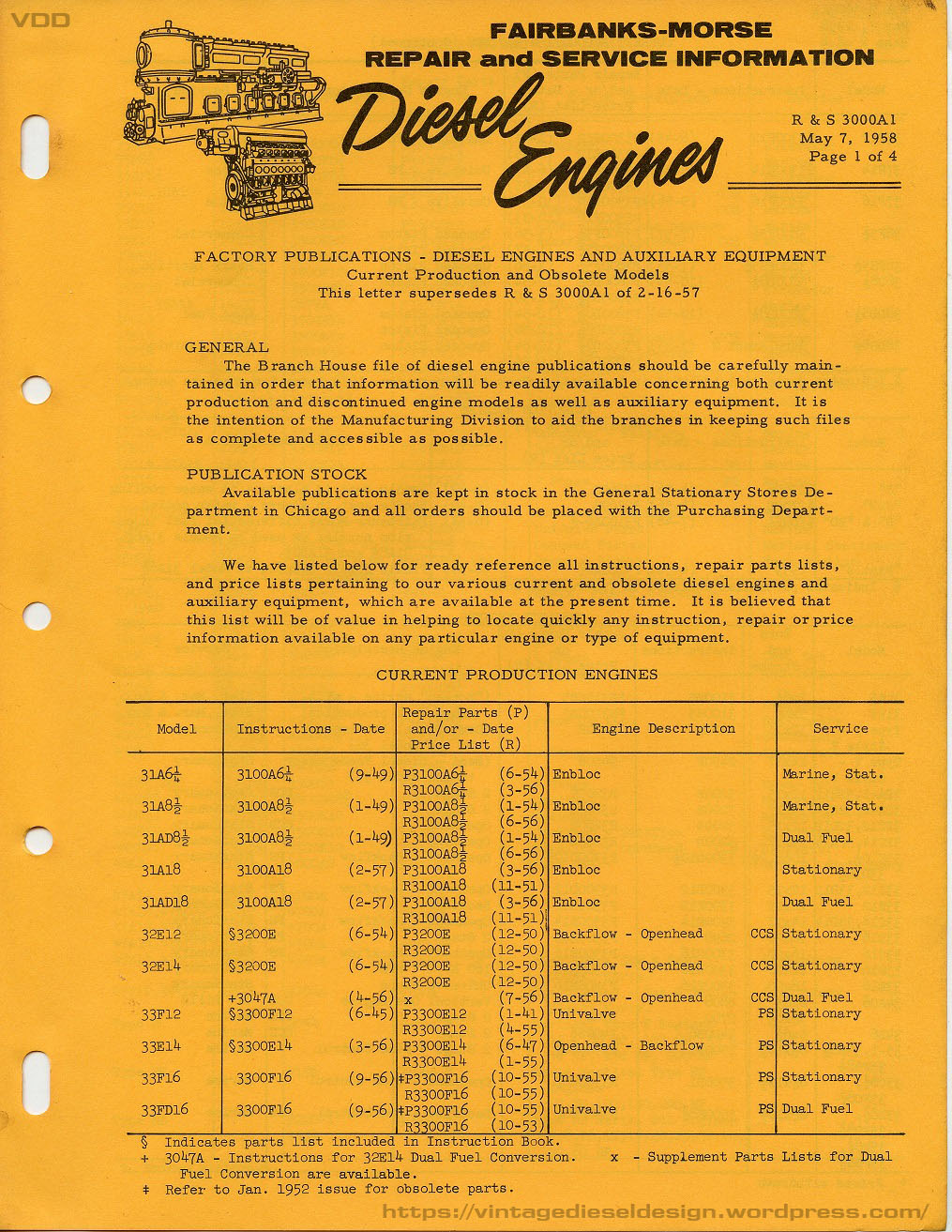
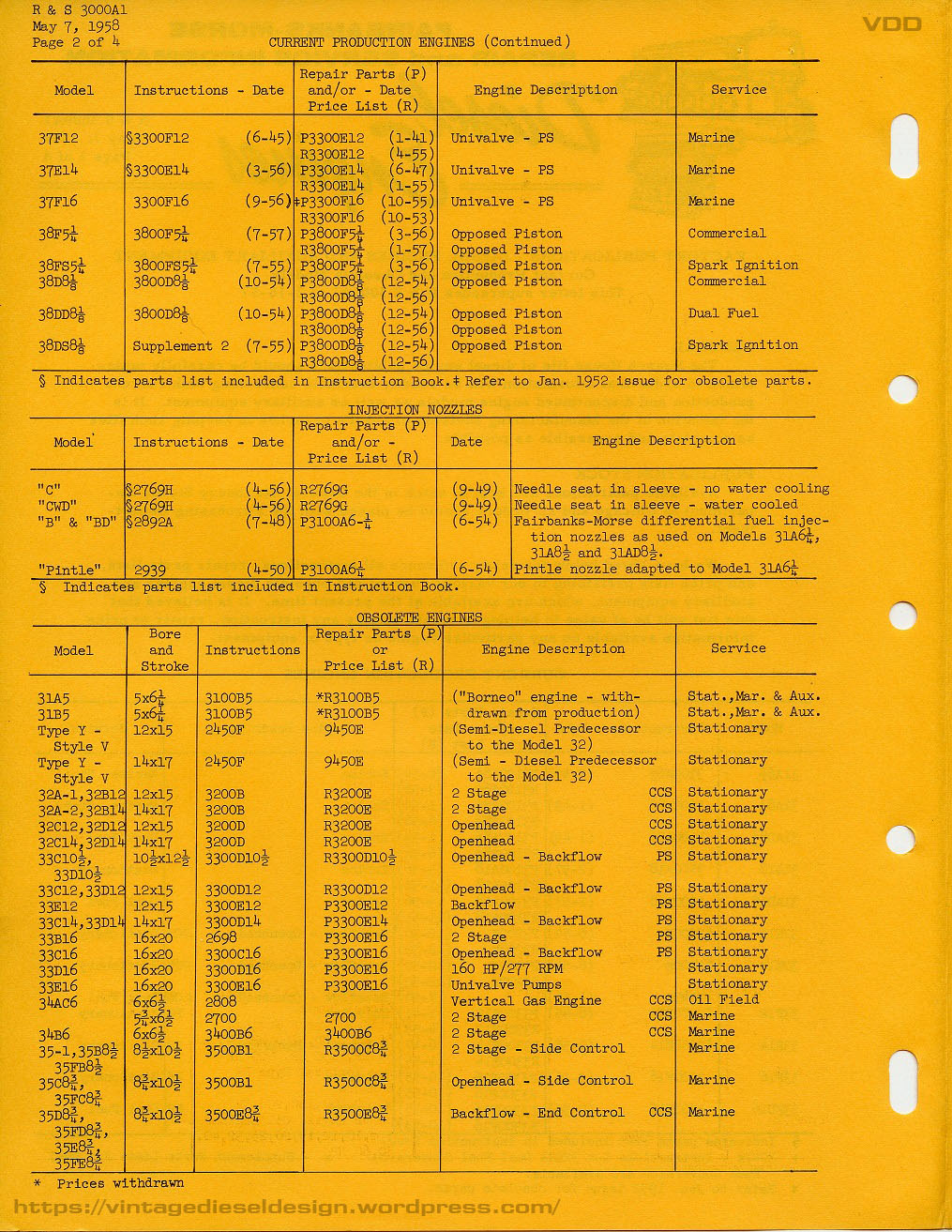
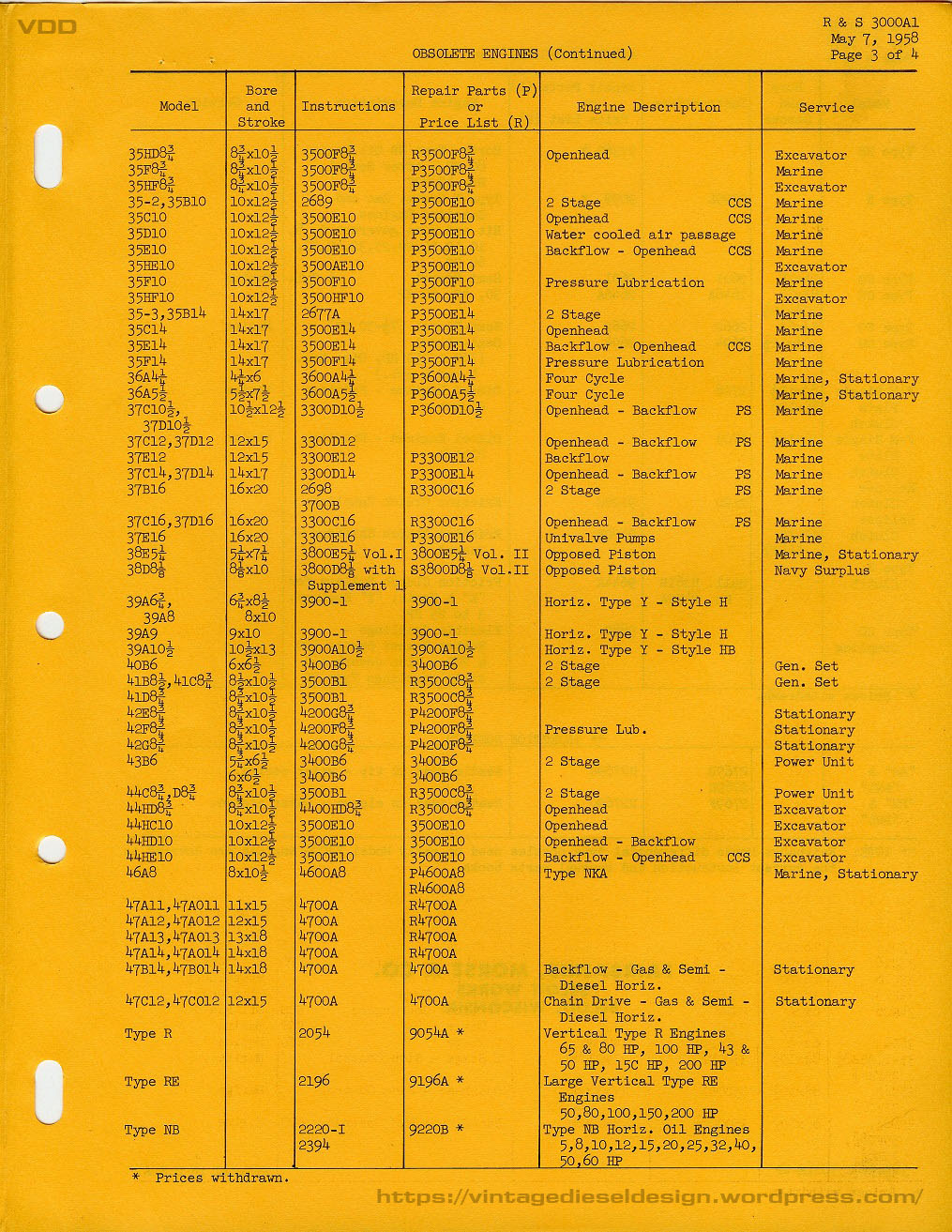
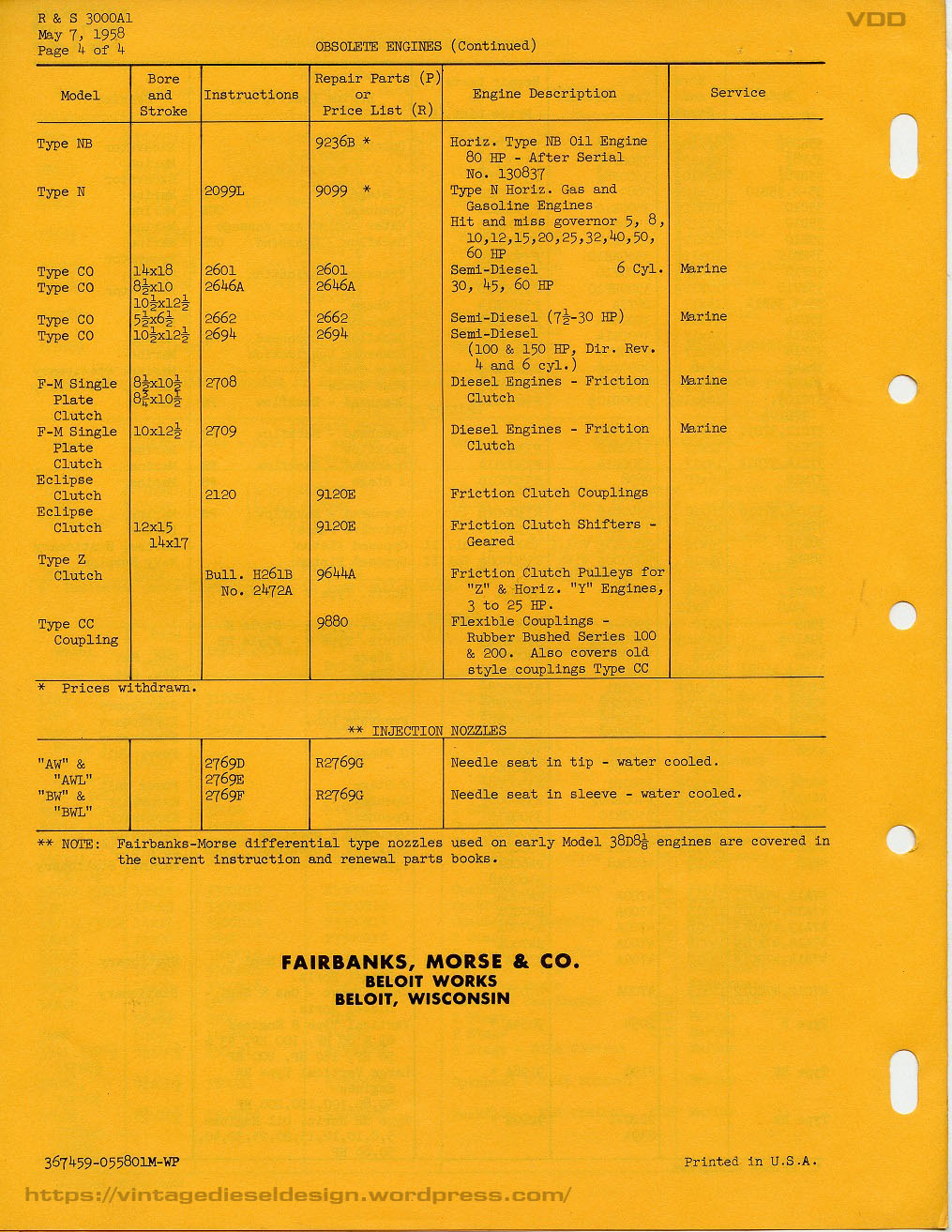
Unfortunately due to travel, I have not had nearly the time I would like lately to sit down and type up another article. This week however, I will provide some interesting reading. This is a Fairbanks Morse bulletin from 1958, that details every diesel engine model they ever produced. The one downside, is that it only covers the model, and not the cylinder arrangements offered for each one.
F-M was another one of those companies that seemed to have a new “model of the week” engine. Its impressive that quite a number of these engines survived, both as museum pieces, as well as a fair bit still in service today, unlike Winton and many other early diesels.
Keep in mind, this is a 1958 list, and does not cover the later engines that popped up when Colt took over, such as the 38A20, or any of the Pielstick engines.








 Vintage Diesel Design